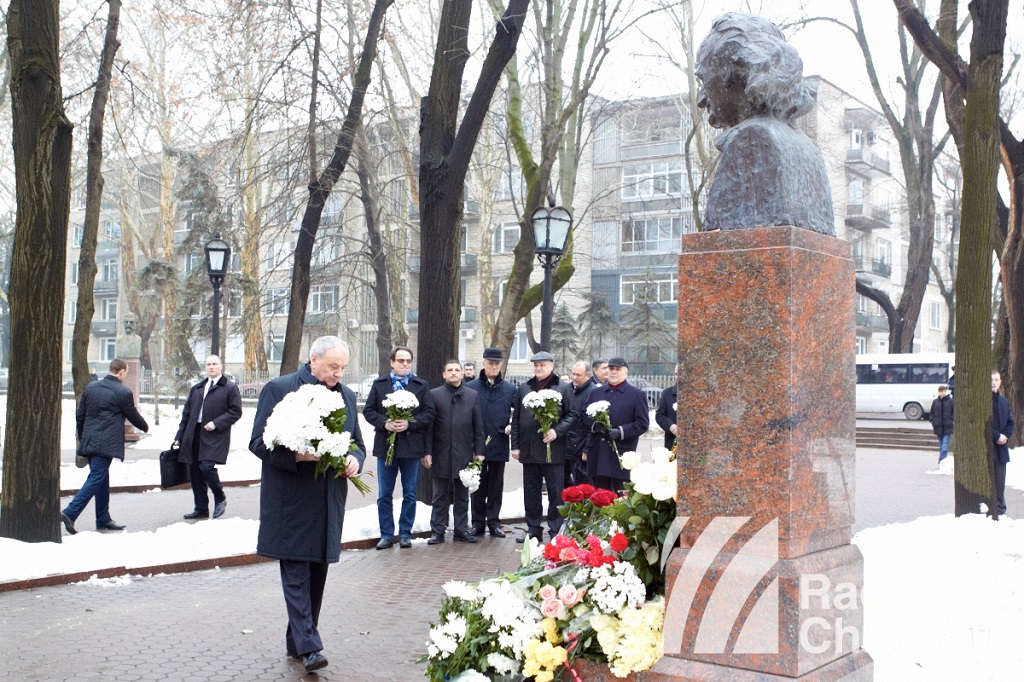
G. T. Kirileanu Library Piatra Neamț – “Maluri de Prut – Basarabia Necunoscută” (VI)
A new edition of “Maluri de Prut – Basarabia necunoscută”, with State Secretary Veaceslav Șaramet in attendance at the County Library
* The debate “National Liberation Movement in Bessarabia – the turbulent history of the return to ancestral values on the left bank of the Prut” will be centred on evoking the personality of Grigore Vieru
* The State Secretary of the Ministry for Romanians Everywhere, Veaceslav Șaramet, will hold a workshop entitled “Funding Opportunities through the Ministry for Romanians Everywhere”
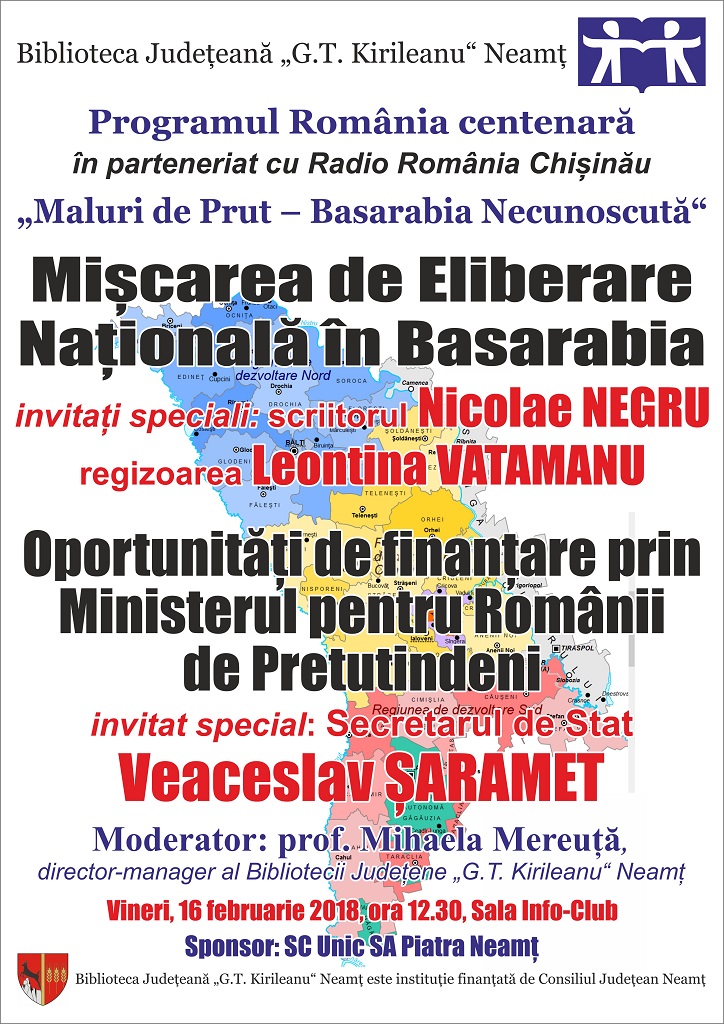
The “G.T. Kirileanu” Neamț County Library, in partnership with Radio România Chișinău through journalist Ina Guțu, is organising a new debate as part of the Romania Centenary programme and the cultural project “Maluri de Prut – Basarabia necunoscută”, under the heading “The national liberation movement in Bessarabia – the tumultuous history of the return to ancestral values on the left bank of the Prut”, on Friday, 16 February 2018, at 12:30, in the Info-Club Hall.
The special guests are Nicolae Negru – writer and political analyst, member of the Union of Journalists of the Republic of Moldova, the Union of Writers of Moldova and the Union of Writers of Romania, participant in the National Liberation Movement of Bessarabia – and director Leontina Vatamanu.
The Romania Centennial Programme and the cultural project “Maluri de Prut – Basarabia Necunoscută” are enriched in this edition by the presence of Veaceslav Șaramet, State Secretary at the Ministry for Romanians Everywhere, who will hold a workshop titled “Funding opportunities through the Ministry for Romanians Everywhere”. The visit of State Secretary Veaceslav Șaramet to Piatra Neamț takes place through a partnership between the G.T. Kirileanu County Library and the Christiana Cultural, Social and Economic Association.
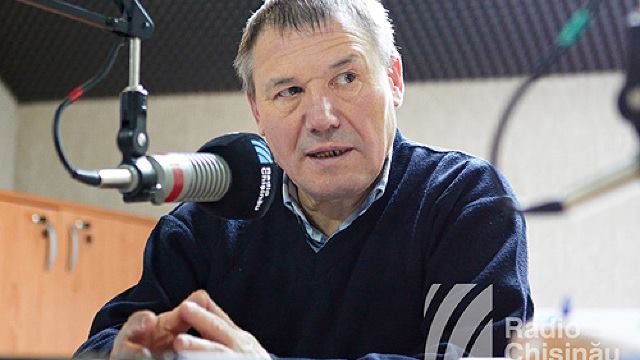
Nicolae Negru
“The flame of Romanian identity never died out in Basarabia; it smouldered among intellectuals and flared up at the first opportunity, during the Khrushchev 'thaw', then again after 1985, during the period known as perestroika, when Gorbaciov loosened the grip of the communist dictatorship a little. Writers were the first to join the struggle for the Romanian language and the Latin alphabet, lighting the torch of awakening. Their courageous actions soon gave rise to a broad movement for national revival and liberation, surprising and frightening the occupying regime, which had until then believed that Romanian identity had died in the Moldavian Soviet Socialist Republic. Once they had regained their composure, the communist authorities resorted to diversionary tactics, attempting, with some success, to steer the movement down the false path of Moldovanism,” Nicolae Negru, a publicist, told Radio Chișinău.
Nicolae Negru was born on 14 October 1948 in the locality of Ciutulești, Florești. In 1951, at a young age, he was deported together with his family – mother Domnica, father Mihail and two brothers – to Siberia. The fourth brother, the historian Gheorghe Negru, was born in the Tomsk region.
He is a member of the Union of Journalists of the Republic of Moldova, of the Writers' Union of Moldova and of the Writers' Union of Romania. He worked at the Centre for Independent Journalism (CJI) as editor-in-chief of the analytical bulletin “Mass-media în Republica Moldova”. He was a member of the Executive Committee of the Popular Front, the political movement in the Moldavian Soviet Socialist Republic and subsequently in the newly created Republic of Moldova, which prepared the National Liberation Movement at the end of the 1980s.
The national liberation movement on the left bank of the Prut in the mid-1980s was a drive for emancipation and a break with the Soviet past of the Bessarabian Romanians between the Prut and the Dniester. It was led by the Bessarabian cultural elite, among the movement’s leaders being the writers Grigore Vieru, Leonida Lari, Ion Vatamanu and Dumitru Matcovschi.
Grigore Vieru, the 83rd anniversary of whose birth falls on 14 February 2018, was also among the founders of the Popular Front of Moldova, the organisation that prepared the movement. He actively participated in the debates of the thirteenth session of the Supreme Soviet of the MSSR, during which Romanian was adopted as the official language and the switch to the Latin script was decided.
Leontina Vatamanu
“I remember with nostalgia and emotion the period 1989-1993, during which the most significant events bringing Bessarabians together around national ideals took place, events I witnessed and participated in. For me, it was the most intense, fruitful and concentrated period of our recent history, when we demonstrated dignity and character. I was a teenager being shaped by this wave of historic transformations, experiencing all the enthusiasm, pressure, courage, revolt and sacrifice with the utmost intensity. This was because my father, the poet Ion Vatamanu, was – together with Leonida Lari, Grigore Vieru, Doina and Ion Aldea Teodorovici, Ion Ungureanu, Lidia Istrati, Nicolae Costin and others – on the front line in the struggle for these ideals. Consequently, what was happening on the streets, at rallies, in parliament and in society was also discussed at home, and I absorbed and internalised all this information, all my father’s effort and sacrifice, all the fluctuations of his emotions – from agony to ecstasy and back. Perhaps even today, the artist in me returns to those days, and it is no coincidence that many say my films are strongly rooted in patriotic themes. And they are probably right. In my view, love of country is a natural feeling, just like love for one’s mother or children,” says director Leontina Vatamanu.
Leontina Vatamanu is the youngest daughter of the late poet, scholar and politician Ion Vatamanu. Her mother, Elena Vatamanu, a well-known translator, is the daughter of the Bessarabian writer Mihail Curecheru, who was deported to Siberia and died in 1943 in a camp at Taișet. Leontina graduated from the Faculty of Screenwriting and Film Criticism at the Academy of Theatre and Film in Bucharest in 1995. She and her husband, producer Virgiliu Mărgineanu, founded the International Documentary Film Festival “Cronograf”, now in its 14th edition and the only international documentary festival in the Republic of Moldova.
Leontina Vatamanu has made more than 15 documentary films with patriotic themes, including “Te iubesc Ion și Doina”, “Dor de Ion Vatamanu”, “Satul din oglindă”, “SĂRMAna de pe Prut”. She has won awards at several international documentary film festivals.
“Maluri de Prut – Basarabia Necunoscută”
“Maluri de Prut – Basarabia Necunoscută” is a cultural project carried out by the G.T. Kirileanu Neamț County Library and Radio România Chișinău. It involves organising cultural and educational activities, research and information activities, and debates with special guests from the left bank of the Prut on topics such as Romanian-language education in Transnistria, famine and deportations in Bessarabia, the press and freedom of expression in the Republic of Moldova, Bessarabian literature during the Soviet period, and the economic, social and cultural relations between the two banks of the Prut. The project’s supporter is businessman Vasile Ouatu from Neamț County, an honorary citizen of the municipality of Orhei, known as a defender of the Bessarabian cause and of closer ties between the two banks of the Prut.
Photo gallery:
Director-manager,
Mihaela Mereuță
More on the same topic
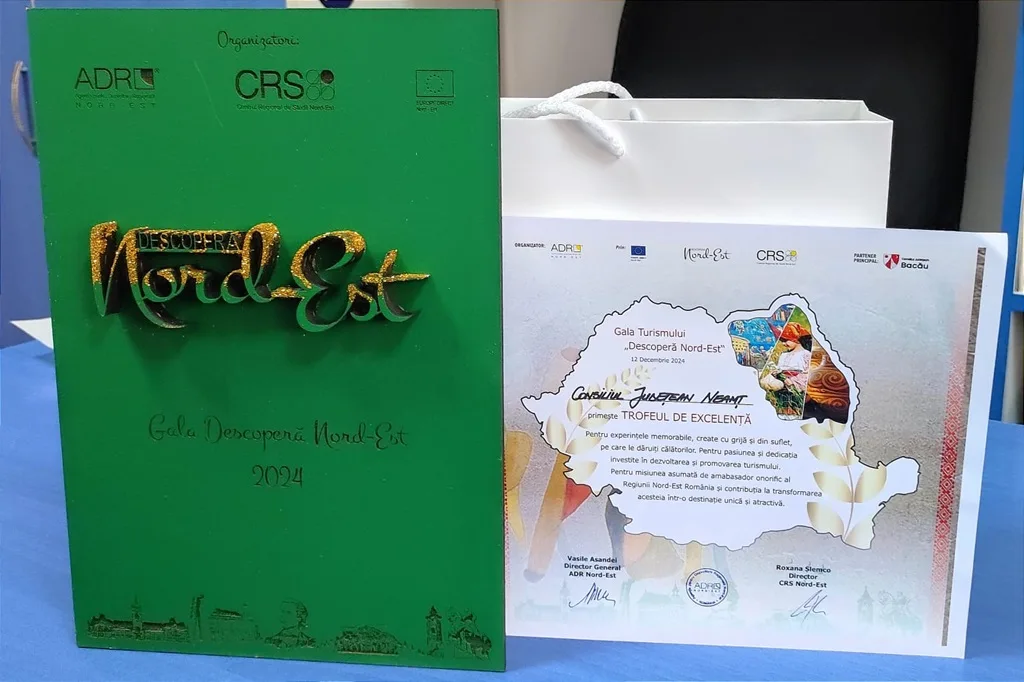
Neamț Awards at the Discover North-East Tourism Gala, 2024
The awards were presented at the 9th edition of the Discover North-East Tourism Gala on December 12, 2024: Newcomer – Award for new locations/attractions/tourist products or emerging tourist destinations: Zenzia Glamping Piatra-Neamț. Poem Rural Piatra-Neamț.
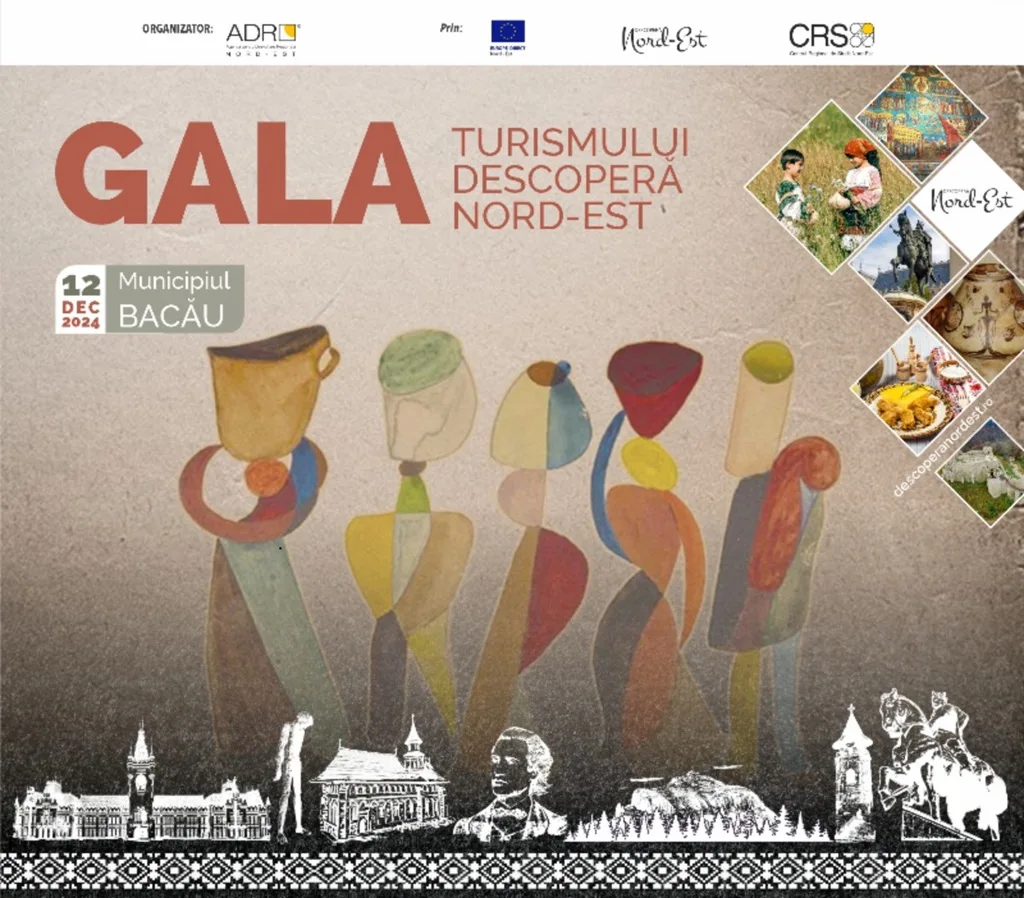
Excellence in Developing Tourism in Neamț at the 9th Edition
On December 12, 2024, we celebrate the tourism initiatives of Neamț County, alongside those from the North-East Region of Romania—a uniquely beautiful and rich area that deserves to be discovered by tourists.
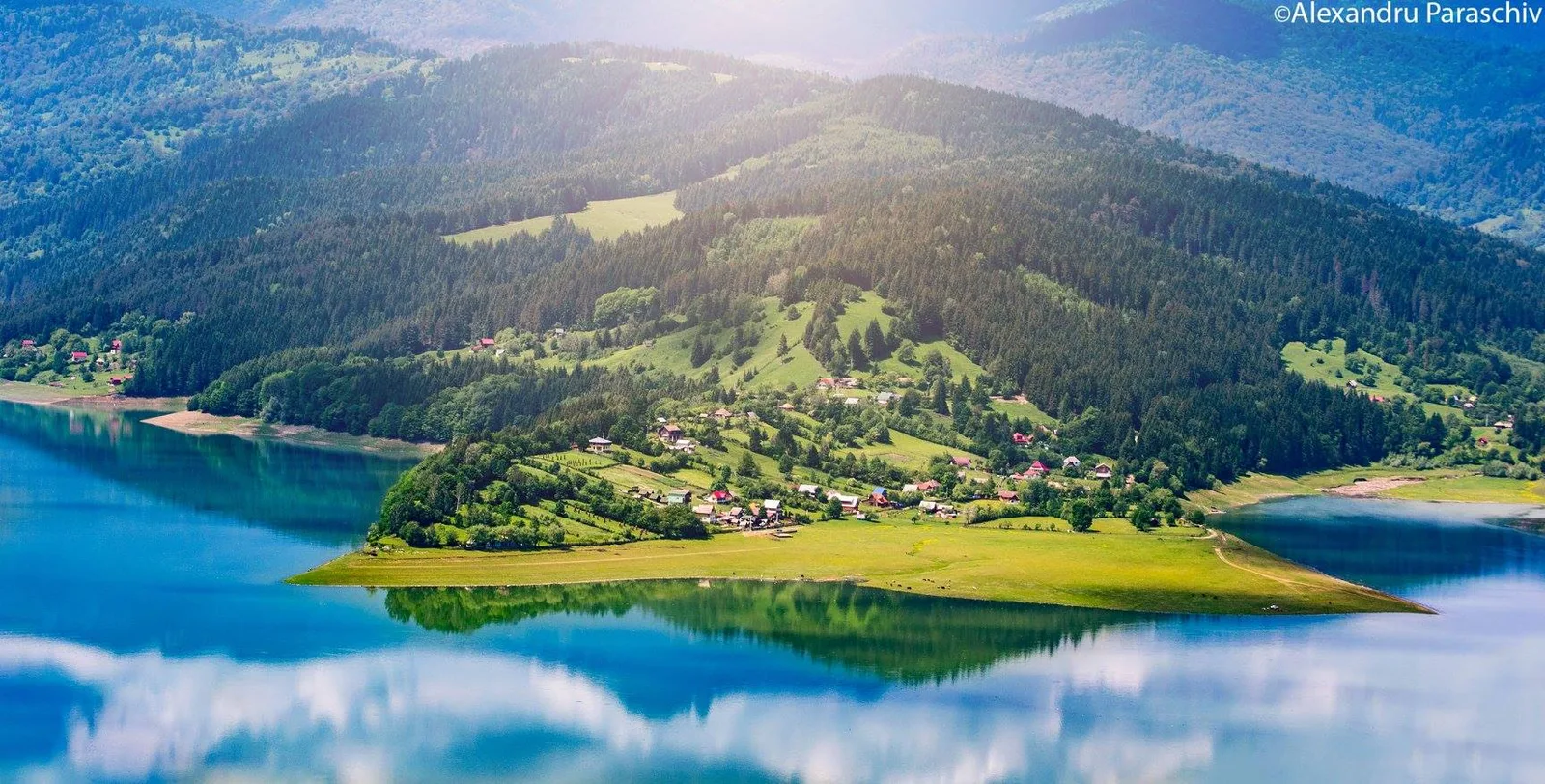
Nominations for Destination of the Year 2025
In the category Enchanted Realms – Geographical areas or localities with a rich treasure of nature, history and tradition our proposal is: The city of Bicaz and its surroundings.