Dormition of the Mother of God Church at Agapia Monastery
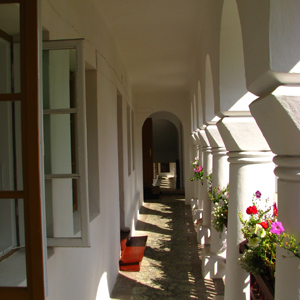
The Dormition of the Mother of God Church at Agapia Monastery is the monastery’s second church, where religious services are held daily. Set in the valley, amid monastic houses arranged in a square around it, the church is surrounded by thousands of flowers in the courtyards of the monastic cells.
The beautifully designed church was built of wood, roofed with sheet metal and wooden shingles, and given three octagonal, onion-shaped towers. With no clear inscription establishing the year of its construction, it is thought to date from the 18th century, when monks lived at the monastery, or at the latest from the 19th century, when nuns from other monasteries were transferred to Agapia.
The Dormition of the Mother of God Church was built to meet the needs of worship, as the main church at Agapia Monastery had become too small. The church has undergone several periods of restoration, including extensive repairs in 1885, when its age had left it almost in ruins.
The church’s interior was painted in oils in 1946 by the painter Constantin Negrescu from Roman, at the expense of Metropolitan Irineu Mihalcescu. Further repairs took place in 1981, when the roof was rebuilt and parquet flooring laid. At that time, smoke deposits were also cleaned from the church’s paintings, and the sanctuary was repainted in fresco by the hierodeacon Vartolomeu Florea from Sihăstria Monastery.
Today, the Dormition of the Mother of God Church at Agapia Monastery is a jewel among the nuns’ flower-filled houses, welcoming the faithful to visit and pray here.
More on the same topic

Ethnographic museums, treasures of local history and traditions
Ethnographic museums are true treasures and expressions of love for traditions, folklore, and spirituality of the places, and so is the Ethnographic Museum Casa Bunicilor in the village of Mitocul Bălan, Crăcăoani commune.

Neamț receives five nominations across four categories in Destinația Anului
We have good news for everyone who loves Neamț County and all its beauty: it is among the finalists in the Destinația Anului 2024 competition, with five nominations across four categories: Piatra Neamț in the Inspiring Cities category.

The Story of the Seven Miraculous Icons of the Holy Virgin and Saint Anne from Neamț Land
Renowned not only for its beauty and historical significance but also called the “Jerusalem of Romanian Orthodoxy,” Neamț Monastery houses the miraculous icon of Virgin Mary with three hands…