Old churches in Roman
“Sfânta Parascheva” Episcopal Cathedral in Roman
“Sfânta Parascheva” Episcopal Cathedral in Roman, for centuries the seat of the Diocese of Roman, which was elevated in 2009 to the Archdiocese of Roman and Bacău, was built in the mid-16th century by Petru Rareș, modelled on Putna and Neamț.
The prince built it on the site of a church dedicated to the same patron saint, erected by Alexandru cel Bun around 1406 to house the remains of one of the voivode’s wives. This is why it became an episcopal seat at that time. During Rareș’s reign, the bishop was Macarie, the renowned chronicler. The great scholar Dosoftei, who became Metropolitan of Moldavia and wrote “Psaltirii în versuri”, printed in 1673, preached in this cathedral for 11 years. The bell tower, built between the 18th and 19th centuries, dominates the complex. At the entrance to the church, visitors are greeted by the image of Sfânta Parascheva, patron saint of the cathedral and all of Moldavia. The original 16th-century paintings in the narthex and porch have survived relatively well. The episcopal cathedral in Roman is part of both national and world heritage, a work of inestimable value created by Romanian artistic genius.
Armenian Church
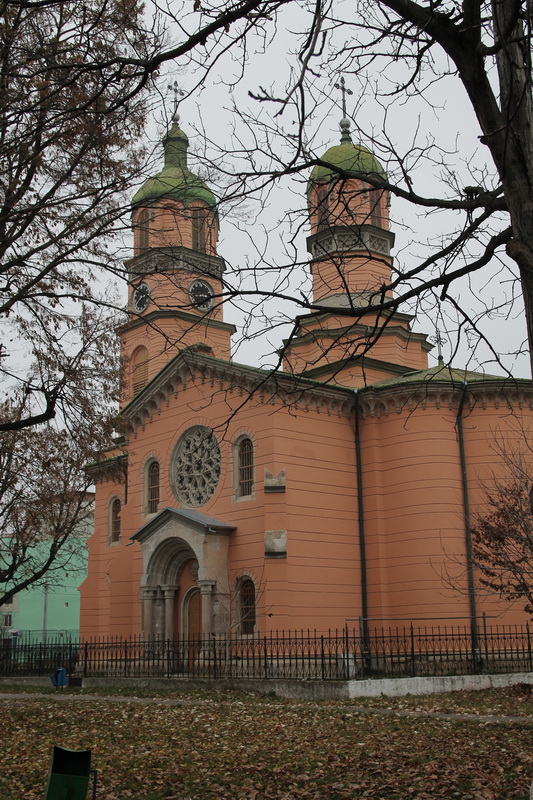
In Roman, as in almost all the market towns of Moldavia, there was a thriving community of Armenian merchants and craftsmen in the 14th century, welcomed and encouraged by the princes Alexandru cel Bun and Ștefan cel Mare. The Armenians of Roman are said to have bought a wooden church from the local Saxons as early as 1355. The Armenian Church in the city of Roman was built between 1588 and 1609 by an Armenian nobleman named Agopsa. At that time, more than 500 Armenian families lived in Roman. It was only around 1709 that the imposing church we see today was built.
The Armenian Church in Roman, at 13 Veronica Micle Street, was restored and enlarged between 1863 and 1868 in the Armenian neoclassical style, when the bell tower was also built. The exceptional paintings of the iconostasis, nave and narthex also date from this period. As the Armenian community had dwindled over time and the church had fallen into disrepair, extensive restoration, structural reinforcement and refurbishment work was carried out in 1981. Following its consecration on 15 August 1991, the Armenian Church was placed at the disposal of the Orthodox Diocese of Roman, and became home to the “Pogorarea Sfantului Duh” parish.
The Armenian Church is part of the national heritage and is a major attraction for tourists visiting the town of Roman.
More on the same topic

Ethnographic museums, treasures of local history and traditions
Ethnographic museums are true treasures and expressions of love for traditions, folklore, and spirituality of the places, and so is the Ethnographic Museum Casa Bunicilor in the village of Mitocul Bălan, Crăcăoani commune.

Neamț receives five nominations across four categories in Destinația Anului
We have good news for everyone who loves Neamț County and all its beauty: it is among the finalists in the Destinația Anului 2024 competition, with five nominations across four categories: Piatra Neamț in the Inspiring Cities category.

The Story of the Seven Miraculous Icons of the Holy Virgin and Saint Anne from Neamț Land
Renowned not only for its beauty and historical significance but also called the “Jerusalem of Romanian Orthodoxy,” Neamț Monastery houses the miraculous icon of Virgin Mary with three hands…