The Historic Ecclesiastical Art Collection at Văratec Monastery
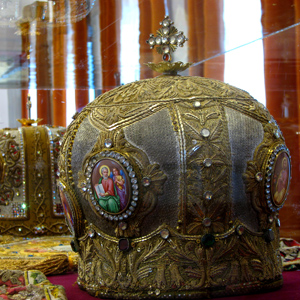
In 1960, a collection of historic ecclesiastical art was established at Văratec Monastery, in the buildings on the left-hand side. What distinguishes this museum from those at Agapia Monastery and Neamț Monastery is that the objects on display belong not only to Văratec Monastery but also to other monasteries in Moldavia and across the country: works of art ranging from paintings and sculptures to embroidery and decorative metalwork, textiles and antique pieces, icons and vestments, crosses and decorative objects. All these exhibits bear living witness to an ancient culture, a people's piety and their creative abilities.
Items in the Văratec Monastery Museum
The historic ecclesiastical art collection at Văratec Monastery includes the oldest icons painted in tempera on wood, dating from the 15th century and depicting Saint Nicolae or the Archangels Mihail and Gavril, brought from Rasca Monastery – Falticeni. A pair of principal iconostasis icons from Valeni – Neamț, one depicting the Saviour Isus Hristos and the other the Mother of God with the Child, and the icon “Schimbarea la Fata” date from the 16th century; painted in tempera on wood, they display classic Byzantine stylisation. A series of small icons, also from Valeni, date from the 17th century, as does the icon “Maica Domnului Dolorosa”, painted in tempera by the icon painter Eftimie. The icons of the Saviour and the Mother of God from Topolita Hermitage were painted by the hieromonk Tiufan in 1697.
The other icons of the Mother of God displayed here are also impressive: one from the 16th century depicts the Virgin with the Child on her right; another from the 17th century, also with the Child on her right, was donated in 1661; these are followed by an icon of the Mother of God nursing the Child on her right, an icon dating from 1779 from Razboieni, and an icon depicting the Mother of God with the Child among angels, painted by Nicolae Grigorescu in 1859.
The Văratec Monastery Museum also impresses with its wealth of liturgical objects: carved or painted wooden crosses, chalices, patens, vessels for the bread offered in honour of the Mother of God, and candlesticks.
Displayed alongside them are silver-gilt objects decorated with enamel medallions, the Gospel printed in 1821 by Veniamin Costache at Neamț Monastery, and the Greek Gospel Book, printed in Venice in 1811.
The collection at Văratec Monastery also includes priestly vestments, liturgical tunics, priestly stoles, chasubles, cuffs and ceremonial thigh cloths, considered true masterpieces of artistic embroidery. Displayed alongside them are carpets made by the nuns, demonstrating the exceptional development of weaving at Văratec Monastery. The museum also has a room housing a special library of the monastery's manuscripts and old books, liturgical books, religious literature, and works on preaching, saints' lives and Byzantine chant.
A visit to this museum offers an opportunity to discover the history and spiritual wealth of Văratec Monastery.
More on the same topic

Ethnographic museums, treasures of local history and traditions
Ethnographic museums are true treasures and expressions of love for traditions, folklore, and spirituality of the places, and so is the Ethnographic Museum Casa Bunicilor in the village of Mitocul Bălan, Crăcăoani commune.

Neamț receives five nominations across four categories in Destinația Anului
We have good news for everyone who loves Neamț County and all its beauty: it is among the finalists in the Destinația Anului 2024 competition, with five nominations across four categories: Piatra Neamț in the Inspiring Cities category.

The Story of the Seven Miraculous Icons of the Holy Virgin and Saint Anne from Neamț Land
Renowned not only for its beauty and historical significance but also called the “Jerusalem of Romanian Orthodoxy,” Neamț Monastery houses the miraculous icon of Virgin Mary with three hands…