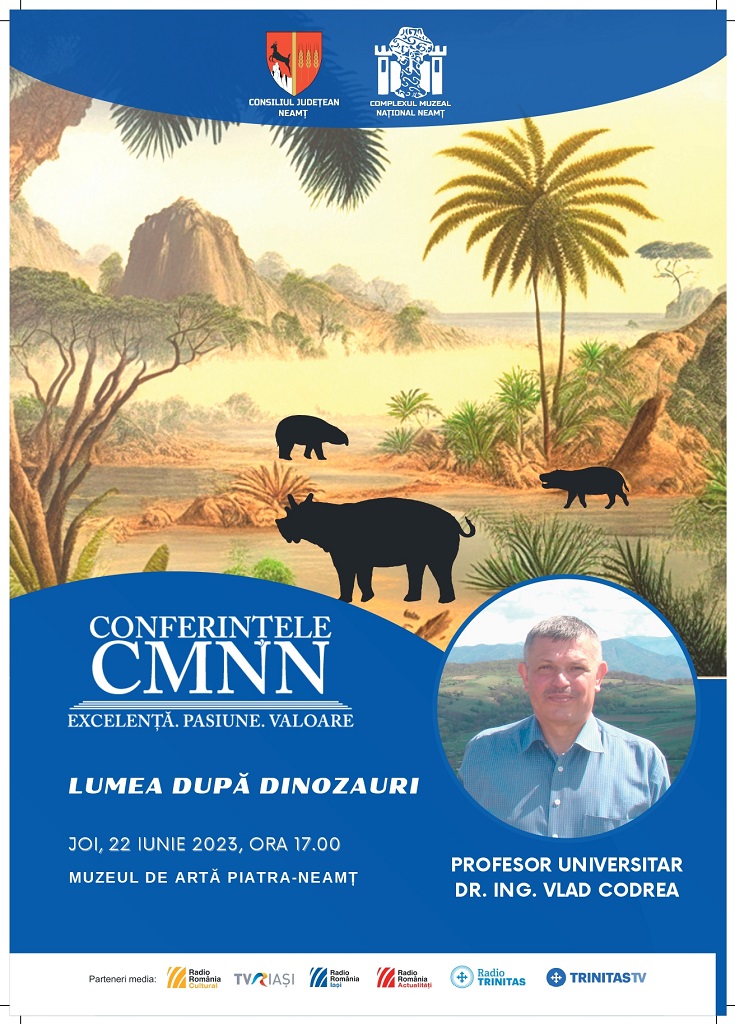
CMNN Lectures: “Lumea după dinozauri”
Neamț National Museum Complex invites you to the fourth conference within the cultural-scientific project “Conferințele CMNN”, which aims to bring excellence, passion and value to the public of Neamț through distinguished figures from various fields of culture and science.
The Lumea după dinozauri conference gives us the opportunity to explore palaeontology, with Prof. Dr-Ing. Vlad CODREA as guest – a distinguished professor, consummate researcher and a leading representative of Romanian geology. Specialising in vertebrate palaeontology, his work includes valuable contributions on dinosaurs and fossil mammals from Romania and beyond. Among the books that have established his reputation are Geologia Cuaternarului – Noțiuni de bază, Babes-Bolyai University, Cluj-Napoca, 1998 and Rinoceri si tapiri terțiari din România, Presa Universitară Clujeană, Cluj-Napoca, 2000.
Currently, his activity in the field of palaeontology includes more than 350 scientific articles, participation in over 480 national and international symposia, the establishment of the Laboratory of Paleotheriology and Quaternary Geology within the Faculty of Biology and Geology, Babeș-Bolyai University, Cluj-Napoca (2002), coordination of two international research projects funded by the National Geographic Society (USA) and seven national projects, participation as a team member in 47 grants, membership in the “Society of Vertebrate Paleontology (Illinois, USA)”, membership in the “Divizia de Istorie a Științelor” of the Romanian Academy, and membership on the jury for the “Youth Innovation Competition on Global Governance (2019)”, Jakarta, Indonesia.
His teaching activity involved delivering courses in Palaeontology-Stratigraphy, Geology of Romania, Marine Geology and Quaternary Geology at the Faculty of Biology and Geology, Babeș-Bolyai University, Cluj-Napoca; he is also a consulting professor at universities in Paris, Brussels, Belgrade, Budapest and Chișinău.
Prize of the Romanian Academy (2002), the “Ion Simionescu” Prize of the Society of Paleontologists of Romania (2007), the Babeș-Bolyai University Prize for scientific research (2011, 2014, 2015, 2019) and the Gold Medal at Euro Invent Iasi, European Exhibition of Creativity and Innovation (2019).
University Professor Dr Eng. Vlad CODREA graduated in 1981 and earned his doctorate in 1994 at the Faculty of Biology and Geology, Babeș-Bolyai University, Cluj-Napoca.
He worked as a geological engineer and chief geologist at IFLGS Bucharest, in the Arad and Timiș divisions (1981-1986), a researcher at the Geological Studies Group, Faculty of Biology, Geography and Geology, “Babes-Bolyai” University Cluj-Napoca (1986-1990), a university assistant (1990-1992), lecturer (1992-1998), associate professor (1998-2002), and professor (2002-2022) in the Paleontology-Stratigraphy Section (Department of Geology). He was head of the Paleontology-Stratigraphy Section (2000-2004) at “Babeș-Bolyai” University Cluj-Napoca, a member of the Commission for Awarding University Titles (2010-2012), president of the Earth Sciences Committee within the Ministry of Education (2014-2016), and a member of the National Council for the Attestation of University Titles, Diplomas and Certificates (2016-present). He is currently a research professor and research director for a grant at the STAR Institute (Institute of Advanced Studies in Science and Technology), “Babes-Bolyai” University, Cluj-Napoca.
Conference theme focuses on geological events that occurred after the catastrophic extinction of the dinosaurs, during the era in which we live: the Cenozoic. While the Mesozoic era was a relatively stable climatic period, the following tens of millions of years saw the opposite, with the planet and life undergoing radical transformations. The main turning points in the evolution of life will be reviewed in terms of their causes and effects, also highlighting representative organisms.
The presentation focuses on events that occurred 66 million years ago (the Cretaceous/Paleogene boundary), 55.5 million years ago (the end of the Paleocene), 33.9–33.4 million years ago (the Eocene/Oligocene boundary), 14 million years ago (the Middle Miocene) and subsequently, up to the drastic cooling of the Quaternary. Climatic events are illustrated by changes in the composition of animal and plant life. Towards the end of the Cenozoic era, their effects also include the process of human evolution, which has led to modern humans and the civilisations they have developed and lived through in recent, Holocene history.
Dinosaurs and their worlds are well known to the general public, captivating especially young people, children and teenagers. Modern, Cenozoic life, however, is no less important in terms of the evolution of the living world, with equally spectacular participants such as giant rhinoceroses, giant warthogs, sabre-toothed tigers, the great marine mammals and many other examples. Fossil humans remain a priority research subject, as reconstructing their history helps us chart our own development. All these transformations have been governed by various factors, among which climate is an essential controlling element that must be taken into account in such an approach.
Climate changes have occurred since millions of years ago, and they should be studied and understood. The notion of “climate change” has become a topical issue, but also a source of fear if such changes are caused by humans. Yet, as the author of *The Jungle Book*, Rudyard Kipling, wrote, this is another story…
More on the same topic
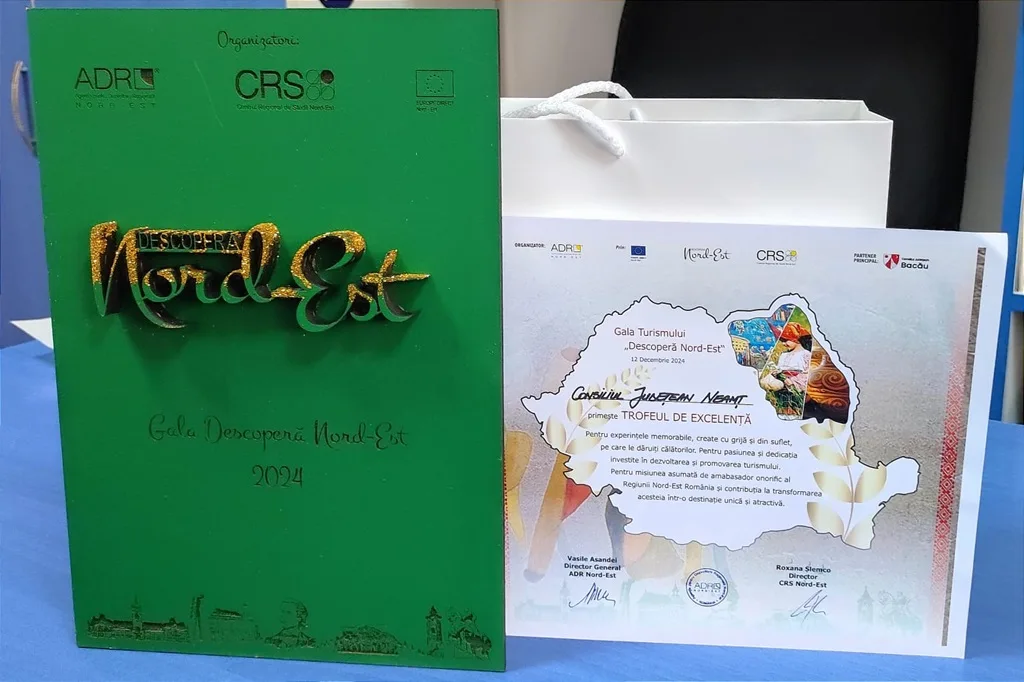
Neamț Awards at the Discover North-East Tourism Gala, 2024
The awards were presented at the 9th edition of the Discover North-East Tourism Gala on December 12, 2024: Newcomer – Award for new locations/attractions/tourist products or emerging tourist destinations: Zenzia Glamping Piatra-Neamț. Poem Rural Piatra-Neamț.
Excellence in Developing Tourism in Neamț at the 9th Edition
On December 12, 2024, we celebrate the tourism initiatives of Neamț County, alongside those from the North-East Region of Romania—a uniquely beautiful and rich area that deserves to be discovered by tourists.
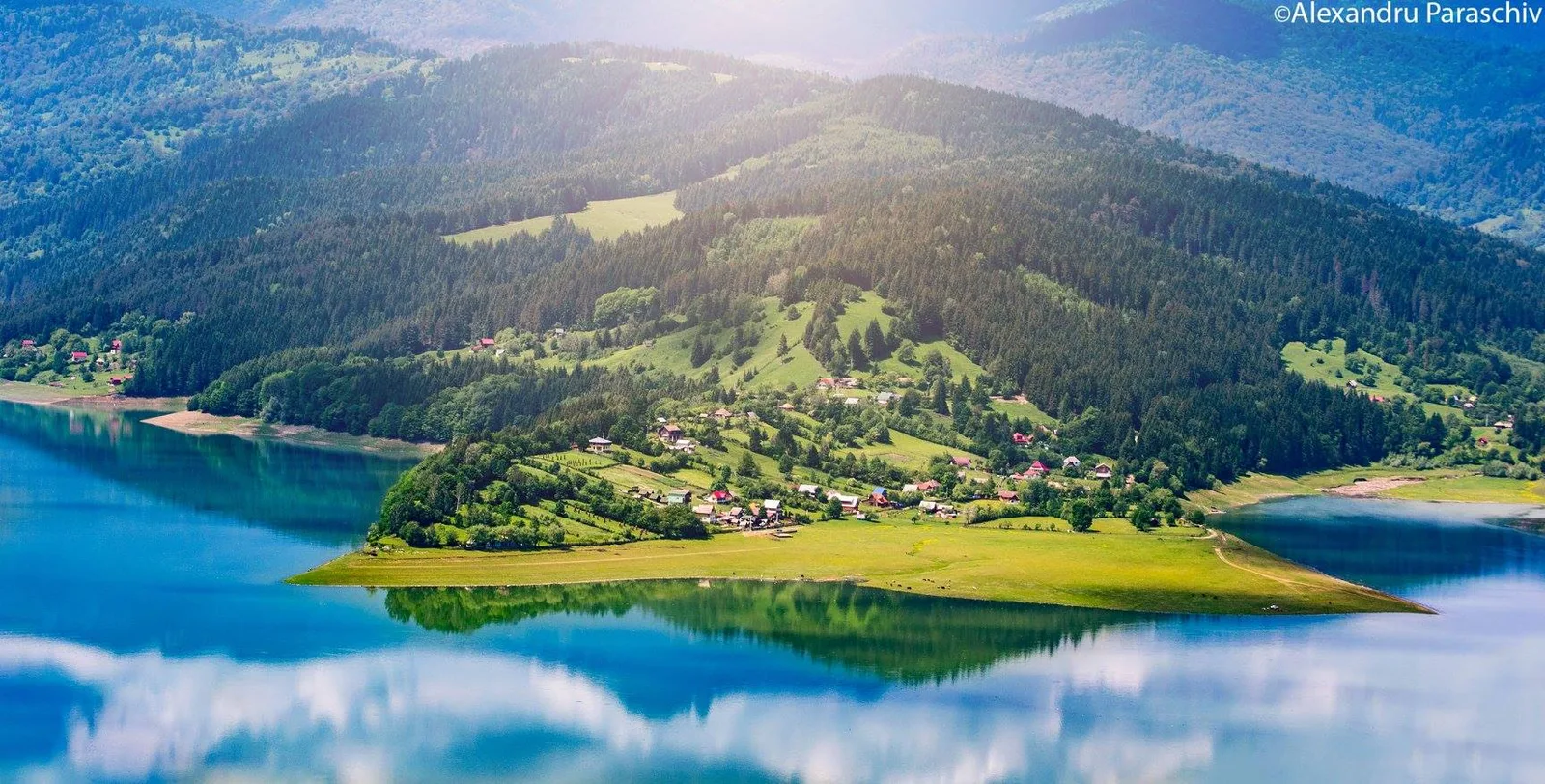
Nominations for Destination of the Year 2025
In the category Enchanted Realms – Geographical areas or localities with a rich treasure of nature, history and tradition our proposal is: The city of Bicaz and its surroundings.