Dormition of the Mother of God Chapel at Secu Monastery
The Secu monastic complex comprises several buildings of great historical and religious value, true monuments to this people’s past. Built like a fortress with thick walls, the complex has 2 chapels in two of its wings, both open to visitors.
Situated in the south-eastern part of the complex, in the right-hand wing, the “Dormition of the Mother of God” Chapel at Secu was built in 1640 by the hieromonk Ghedeon. Over time, the chapel underwent several alterations to meet the needs of each period.
Although there is a foundation inscription in Slavonic on the outside of the enclosing wall, it does not belong to the chapel at Secu Monastery, but to “Saint Nicolae” Church in Neamț Citadel; it was brought here in 1718 along with other religious objects.
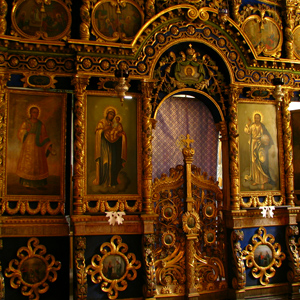
In 1853, the monk Iulian made the iconostasis inside the chapel and also painted the iconostasis of “Saint Nicolae” Chapel, situated in the north-eastern corner of the complex, in the left-hand wing. The icons on the iconostasis are particularly fine, painted in the Renaissance style. The carvings on the iconostasis were also gilded and executed in a mixed Baroque style.
In 1958, Protosyncellus Ghervasie Hulubaru painted the door of the Secu Monastery chapel in the Neo-Byzantine style. This distinctive painting depicts the “Dormition of the Mother of God”. The interior of the chapel has never been painted, which is unusual for a place of worship of this kind.
The “Dormition of the Mother of God” Chapel at Secu Monastery also houses the remains of two renowned spiritual fathers, Hieroschemamonk Vichentie Malau and Hieroschemamonk Antim Gaina, in two beautifully carved reliquaries. These two monks, whose lives shone like two bright stars in the Neamț Mountains, are known for their deeds, having guided many spiritual children, both monks and laypeople, throughout their lives.
More on the same topic

Ethnographic museums, treasures of local history and traditions
Ethnographic museums are true treasures and expressions of love for traditions, folklore, and spirituality of the places, and so is the Ethnographic Museum Casa Bunicilor in the village of Mitocul Bălan, Crăcăoani commune.

Neamț receives five nominations across four categories in Destinația Anului
We have good news for everyone who loves Neamț County and all its beauty: it is among the finalists in the Destinația Anului 2024 competition, with five nominations across four categories: Piatra Neamț in the Inspiring Cities category.

The Story of the Seven Miraculous Icons of the Holy Virgin and Saint Anne from Neamț Land
Renowned not only for its beauty and historical significance but also called the “Jerusalem of Romanian Orthodoxy,” Neamț Monastery houses the miraculous icon of Virgin Mary with three hands…