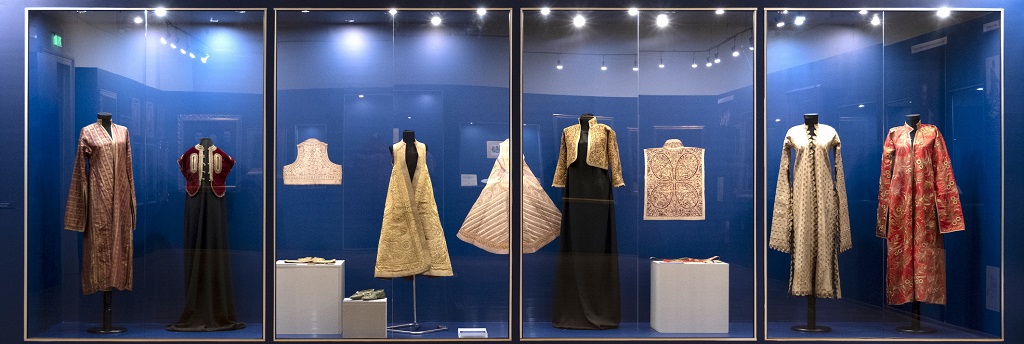
Stories from the Exhibition: From East to West. “The Change of Dress” in the Romanian Principalities
“The prelude to the modern history of the Romanian lands is necessarily the change in dress; today’s civilisation is the logical consequence of abandoning old clothes; the new idea swept into the country along with trousers and, more formidable than the Tatar invasions, burned through baggy trousers, tall hats, soft leather shoes, long outer coats and the entire ancestral wardrobe in a flash.”
Starting from the reflections of Alecu Russo in *Studie Moldovană* (1851), over the next three episodes of *Poveștile expoziției* we will highlight several aspects concerning the evolution of costume history in the Romanian Principalities from the late 18th century and the first half of the 19th century, through cultural artefacts preserved in the collections of partner museum institutions.
In Tudor Vladimirescu’s time, a noblewoman’s attire in the Romanian Principalities invariably consisted of the following. “(…) Over their linen or silk shirts, noblewomen and ladies generally wore a waistcoat. They wore baggy trousers on their legs. Over these came a taffeta or velvet dress, followed by a long, sleeved robe fastened at the front with hooks and eyes (…)”. Over the robe they wore a short jacket reaching to the waist or a jacket with sleeves slit along the inside up to the armpit. In summer they also wore a cloak or a loose outer robe, and in winter a heavy coat. The young noblewomen’s “slippers” were made from “kid skins” or other small animal skins. Men’s clothing differed very little from women’s: “The great boyars wore red trousers, soft leather shoes, slippers or yellow sheepskin boots with pointed, upturned toes and no heels; their robes were made of silk satin, printed cotton, striped silk, patterned silk or silk brocade; they tied an Indian shawl around their waist: in summer, a short jacket (…); over it, a broadcloth coat or, on feast days, a loose outer robe (…)”. The description is by Ion Ghica and was reproduced by Al. Alexianu in his work, Mode și veșminte din trecut. Cinci secole de istorie costumară românească, vol II.
In the following paragraphs, we present two garments from the prized costume collection of the Bucharest Municipal Museum, displayed in the exhibition hosted by the Piatra-Neamț Art Museum. These cultural objects are classified in the Treasure category of Romania’s national movable cultural heritage and are featured in researcher Dr Maria-Camelia Ene’s valuable volume Moda în Țara Românească. Secolul al XVIII-lea și prima jumătate a secolului al XIX-lea. Veșminte și accesorii de epocă din patrimoniul Muzeului Municipiului București, with a foreword by art historian Adrian-Silvan Ionescu.
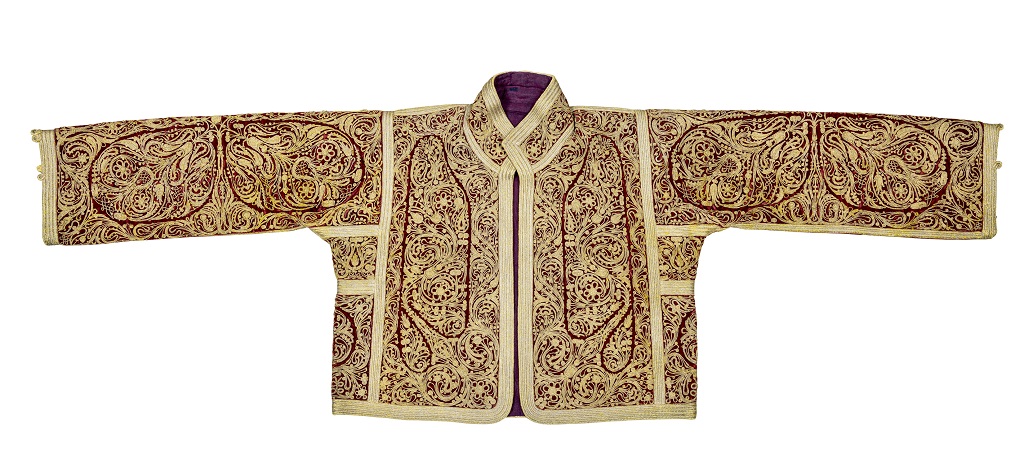
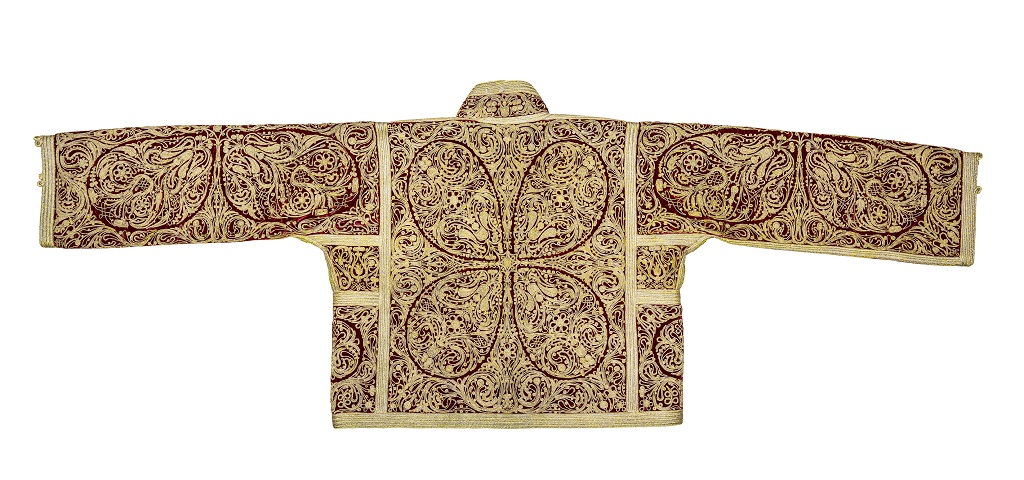
The short jacket, also dated to the 18th century, is handmade from silk with gold metallic-thread embroidery.
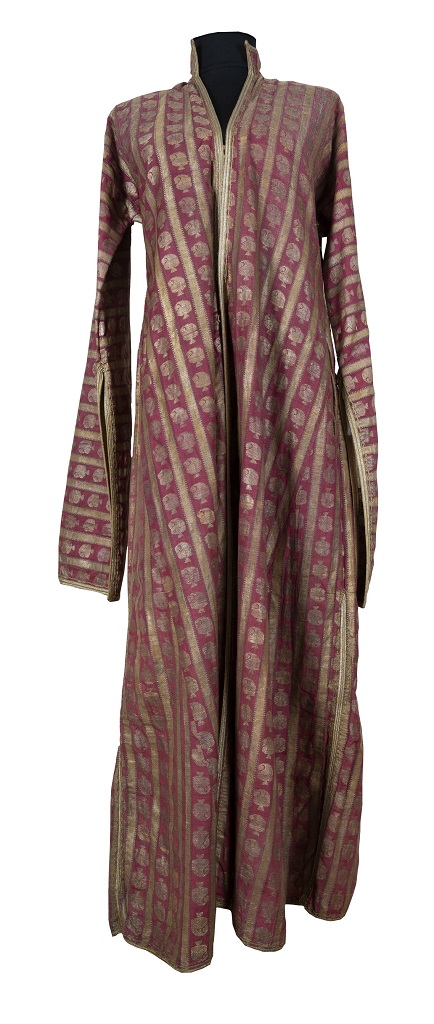
The long robe is handcrafted from Trieste silk fabric with metallic-thread embroidery. It dates to the 18th century and is a component of the Oriental-style boyar costume. It is long, with wide, long sleeves and deep side slits at the hem. The burgundy silk features stylised floral bands arranged vertically and horizontally (on the sleeves), with alternating lines and palmettes. The floral composition is inspired by Turkish Baroque. The selvedges are reinforced with metal strips.
It features bands of plant motifs in Turkish Baroque style. The “vase of flowers” motif is surrounded by scrolls and tendrils with stylised wildflowers and lily of the valley. The motif is repeated on the back of the garment. The hems and collar are trimmed with gold-thread braid.
Mihaela-Cristina Verzea,
Curator of the exhibition
Photographs taken by Florin Ghimiș,
photographer of Neamț National Museum Complex
More on the same topic
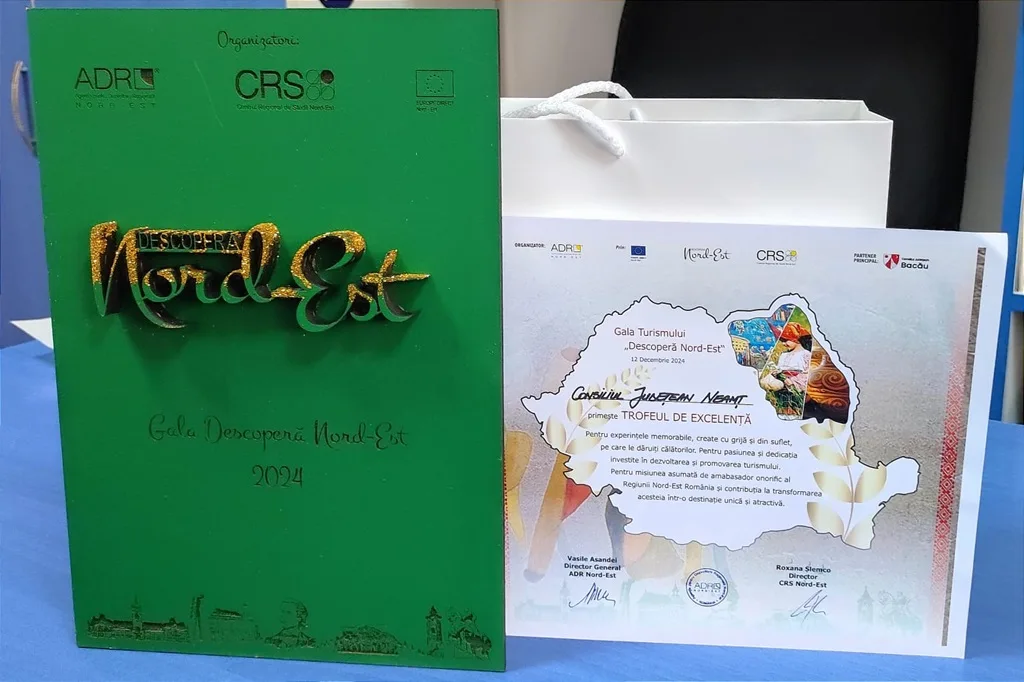
Neamț Awards at the Discover North-East Tourism Gala, 2024
The awards were presented at the 9th edition of the Discover North-East Tourism Gala on December 12, 2024: Newcomer – Award for new locations/attractions/tourist products or emerging tourist destinations: Zenzia Glamping Piatra-Neamț. Poem Rural Piatra-Neamț.
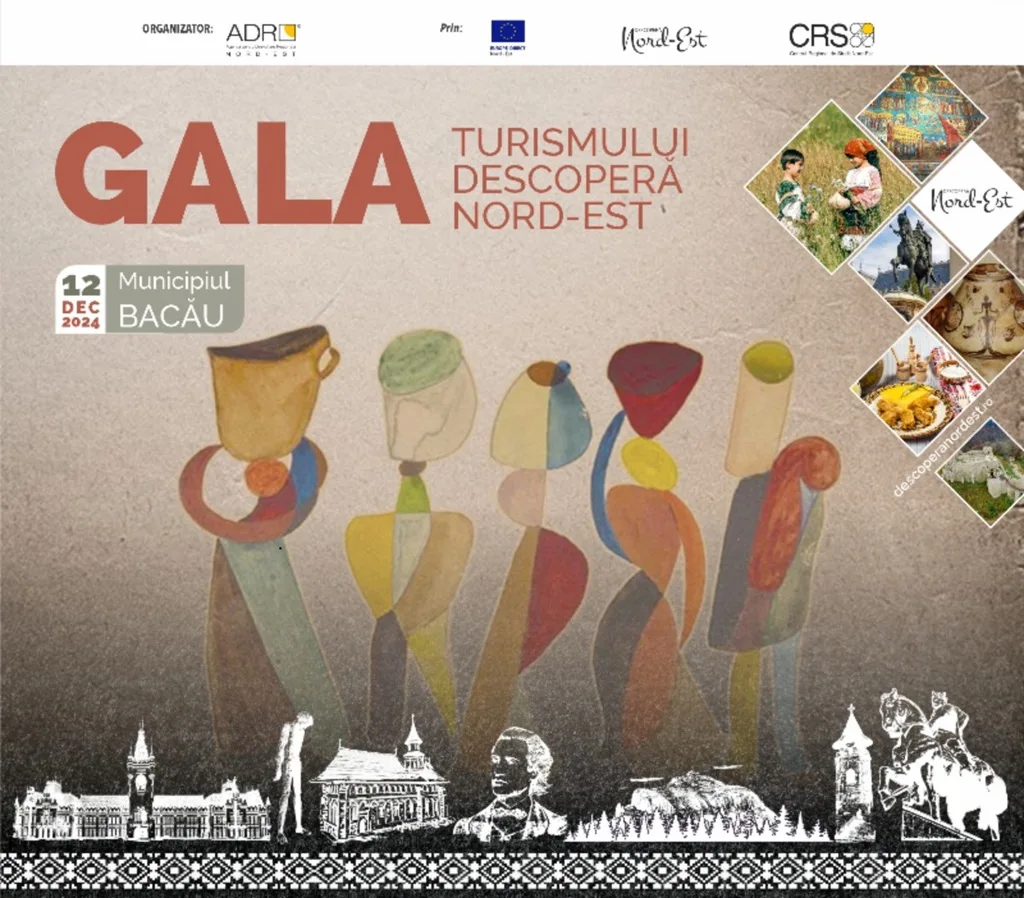
Excellence in Developing Tourism in Neamț at the 9th Edition
On December 12, 2024, we celebrate the tourism initiatives of Neamț County, alongside those from the North-East Region of Romania—a uniquely beautiful and rich area that deserves to be discovered by tourists.

Nominations for Destination of the Year 2025
In the category Enchanted Realms – Geographical areas or localities with a rich treasure of nature, history and tradition our proposal is: The city of Bicaz and its surroundings.