The Exhibition Stories. The Era of Ruler Mihail Sturdza (1834-1849) – “An Era of the Image”
From East to West. “The change in dress” in the Romanian Principalities
We return with the exhibition’s stories and reveal a new page in the history of dress in the Romanian Principalities in the first half of the 19th century. Artists of this era such as Joseph August Schöefft, Constantin Lecca, Ion Negulici and others have handed down portraits of the first princes appointed under the Organic Regulations. Through cultural objects from the collection of the National Museum of History of Romania, displayed in the exhibition “Periplu istoric. De la Tudor Vladimirescu la renașterea națională”, we will evoke the military and civilian attire worn by Mihail Sturdza, the ruler of Moldavia appointed under the Organic Regulations. The son of Grand Chancellor Grigore Sturdza was appointed ruler in April 1834, with Russian support.
In 1835 the Mihăileană Academy was founded, the first institution of higher education in Moldavia; an engineering school, a girls’ school, a fine arts school, a school of arts and crafts and a natural science museum were also inaugurated. Legally, administrative interference in the judiciary was eliminated. Courts were created at the district and village levels, a commercial tribunal was established in Galați and a correctional tribunal in Iași, and the French criminal code was translated into Romanian.
Socially, the boyar ranks were assimilated into the civil administration and, by two decrees issued at the beginning of 1844, the Roma enslaved by the Church and the state, respectively, were freed. In 1848, the ruler of Moldavia, Mihail Sturdza, refused to accept those of the 35 points of the Petition-Proclamation concerning the dissolution of the General Assembly and the establishment of a citizen guard. The prince avoided the outbreak of a revolution by arresting some representatives of the liberal-democratic and liberal-moderate groups in Moldavia. He abdicated in June 1849.
The era of Mihail Sturdza is also “an era of the image”, historian Sorin Iftimi tells us, “in the sense that society is opening up to portraiture and ever more members of society commission foreign painters to paint their likenesses”.
Moreover, researcher Tudor-Radu Tiron states that “Prince Mihail Sturdza was inclined towards the solemn side of things”, as evidenced by the organisation of the magnificent celebrations of his enthronement, supervised by the police chief Gheorghe Asachi, the erection of the impressive “Obelisk of the Lions”_ in Copou Park in Iași, as well as the measures for renewing military and civilian uniforms. “The careful cultivation of his own image”_ can also be demonstrated through the vast iconography associated with Mihail Sturdza (oil and watercolour works) through which_ “the ruler’s likeness, rendered in countless ways (…) was popularised in a manner that today we might call propagandistic”_, the same author notes.
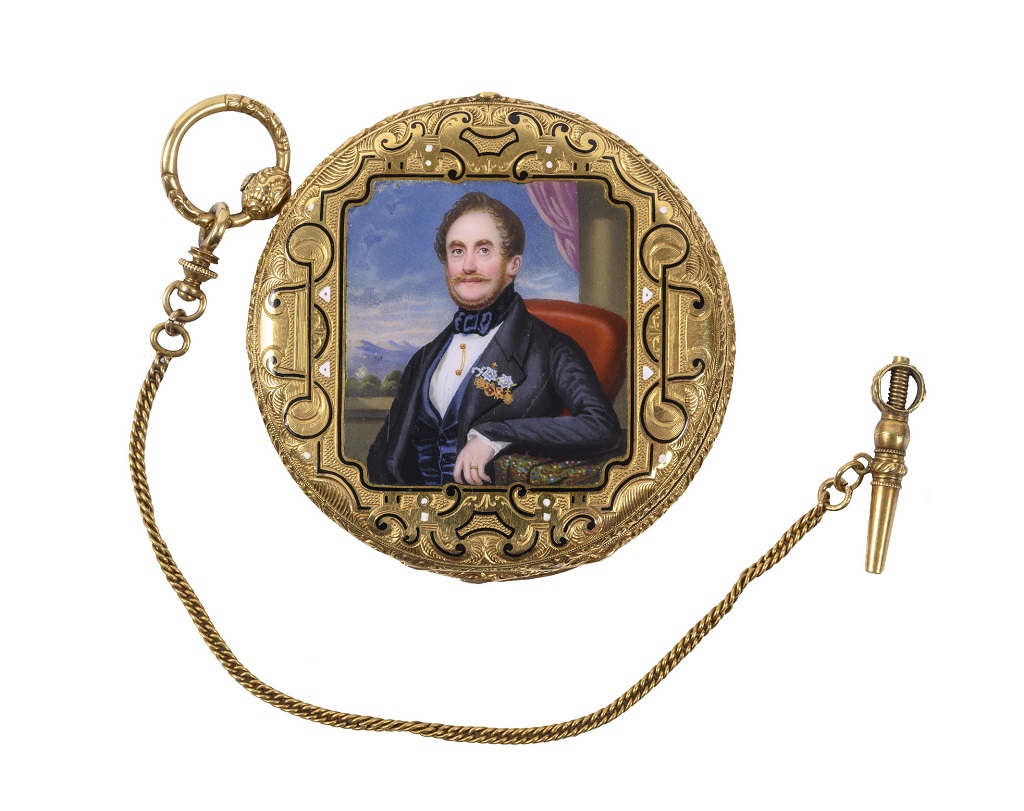
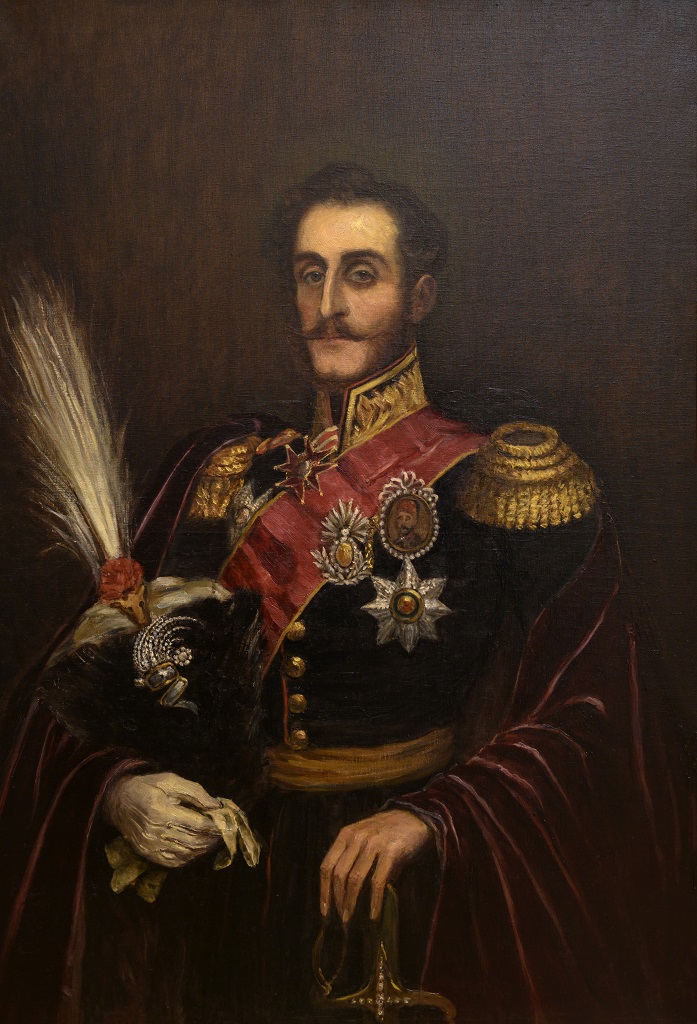
We are fortunate to have two works from the rich iconography mentioned above in our exhibition project: an unsigned, undated oil painting, with the stretcher and canvas stamped in black “COULEURS MOIRINAT PARIS 184 Faubourg Saint-Honoré”, depicting one of the official portraits of Prince Mihail Sturdza, and a portrait of him enamelled on the outer case of a pocket watch.
The first portrait appears to have been inspired by an official painting by Joseph August Schöefft from 1835-1837, when he painted in Moldavia at the prince’s commission, a work described in detail by historian Sorin Iftimi in his article “Cu Mihail Sturdza, în căutarea portretelor pictate de Joseph August Schöefft”. Mihail Sturdza is shown wearing the military attire prescribed for the princes of the Principalities by Regulamentele Organice, specifically the uniform of Moldavia’s local militia, with the rank of general. The tunic was made of navy-blue woollen cloth, with a single-breasted front fastened with gold-coloured metal buttons bearing Moldavia’s coat of arms. The tunic’s high collar, edged with gold braid and embroidered with oak leaves, indicates the rank of general. The epaulettes, trimmed with thick gold bullion fringe, also denote his senior rank. His left hand rests on his investiture sword, whose guard, the only visible part of the sword, is set with diamonds. The red moiré sash of the“Sf. Ana” Order, edged in yellow, runs over his left shoulder, while the Order’s star-shaped badge is worn on the right side of his chest; Mihail Sturdza received the decoration from Tsar Nicolae I at the beginning of his reign.
Around his neck, Mihail Sturdza wears another Russian decoration, the Order of Saint Stanislas, class II. On the left, we can see the decorations of the suzerain power: the medallion bearing the sultan’s portrait, received at his investiture, alongside the diamond-set NishanIftihar Order (Order of Glory). In his gloved left hand, he holds a black sable hat with a white satin crown. The plume holder is made of diamonds, while the white heron plume, received from the sultan when he was granted the throne, is strikingly large. Mihail Sturdza has a solemn expression, conscious of the weight of his mission as prince.
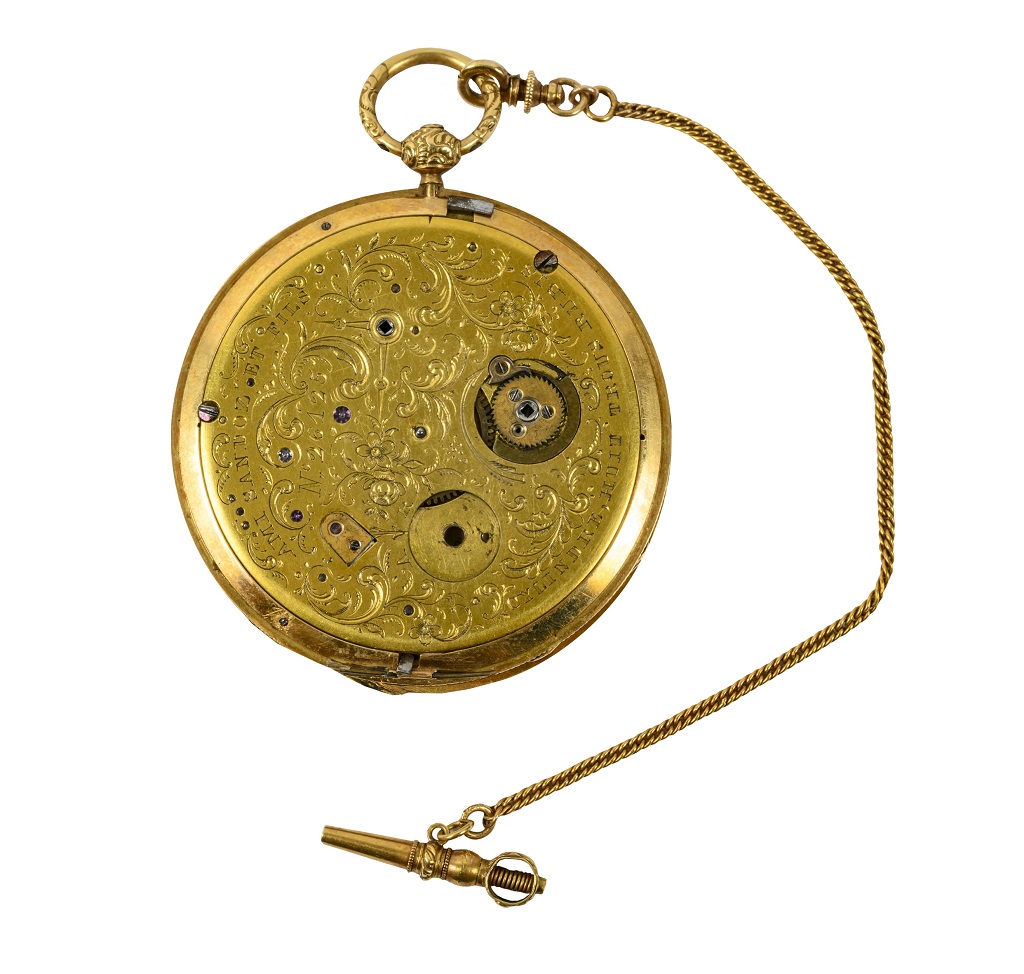
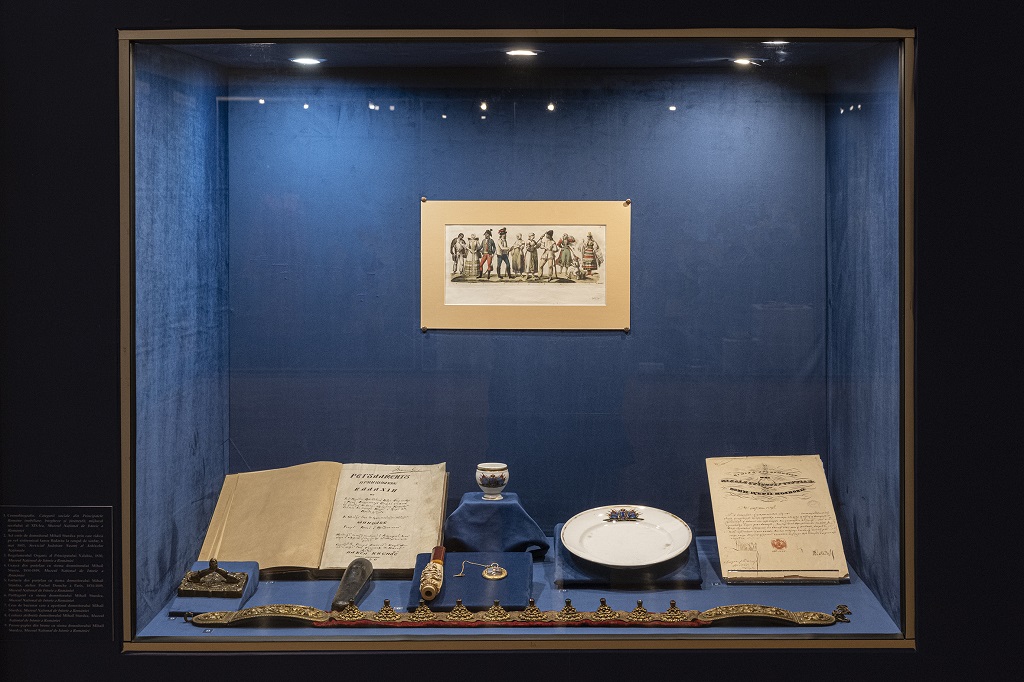
“Beyond telling the time, watches are true jewels, created with the collaboration of many artists”. This definition also aptly describes the other heritage object we would like to present to you. The pocket watch, an object with commemorative significance, draws our attention to the prince in civilian dress. In the first half of the century, after men's dress adopted Western styles in 1830 – 1840, “men continued to wear a great deal of jewellery: first, several rings, including a signet ring on the index finger; then, a fob, another seal and a watch key hung from one end of a thick gold chain, with the watch at the other end (…). In the second half of the century, greater restraint emerged in this respect too, with the number of rings sometimes reduced to just the wedding band_” (Adrian-Silvan Ionescu)_. The case of the watch that belonged to Prince Mihail Sturdza has three covers made of 18 K gold. The front cover features his portrait in polychrome enamel, surrounded by a geometric pattern in black and white enamel. The dial is enamelled, with Roman numerals and Breguet hands; the movement is manually wound (with a key), with a cylinder escapement and 8 jewels. The movement cover is inscribed and numbered: “AMI SANDOZ ET FILS/ 6125/ CYLINDRE HUIT TROUS RUBIS”.
Before describing the ruler’s attire, we offer a few observations on men’s clothing in the period 1830-1848, drawn from art historian Adrian-Silvan Ionescu: “Civilian men’s dress underwent few significant changes throughout the nineteenth century. Between 1830 and 1848 both tailcoats and frock coats were very tight and fitted to the body. The chest and shoulders were padded so that the wearer appeared broader in the chest and shoulders than he actually was, emphasising his wasp waist. The sleeve extended above the shoulder line, was very tight on the arm and flared at the wrist, reaching down to the base of the fingers. The skirts of the coats were widely flared and pleated, like a woman’s skirt. The shawl collar was fashionable in the third decade of the century. At that time lapels with three notches were still worn. This delicate silhouette conformed to the Romantic ideal of morbid, consumptive beauty. Being corpulent was a real tragedy at that time and, consequently, it was not uncommon for men to wear corsets, even the most slender, to accentuate their slenderness (…). There was a difference between the daytime shirt and the evening shirt, which had a starched and pleated front, more visible with a tailcoat than with a frock coat, jacket or suit jacket, which were worn with waistcoats less low-cut than the evening waistcoat. The collar was fastened with two studs, one at the back of the neck and the other in front. The daytime shirt could have mother-of-pearl buttons, or, more modestly, casein ones, but the evening shirt had to be fastened with studs made of precious materials: in the 1840s and 1850s, gold set with rubies, sapphires, emeralds or other coloured stones (…). Neckwear was indispensable for any respectable man. Only people of very humble backgrounds, workers and itinerant traders went about with their collars open and without a tie. Like the whole outfit, the neckwear was sober, usually black or grey for the morning, rarely in other colours or made of material with stripes, dots or a decorative woven pattern, and white for the evening. It was a strip of silk wrapped once or twice around the collar – in 1825-1830 even several times, raising and thickening the neck in a stiff, tight grip – and tied at the front in a bow. This bow, from which the bow tie originated, had longer or shorter ends, according to fashion. The Romantics – the later participants in the 1848 revolutionary movement – preferred a simple knot, without a bow, with the ends left to hang on the chest, giving a deliberately careless air. But how much variety there was in the way of tying, in the width or narrowness of the silk strip, in the length of the ends, in their aggressive upward orientation or, conversely, their nonchalant downward orientation, or even their concealment beneath the shirt collar!”
Mihail Sturdza is depicted seated in a brick-red armchair, wearing an elegant Western suit, evidence that he had abandoned Oriental dress. We note that the prince’s hair colour is very close to Mihail Sturdza’s natural shade (this detail was altered in official portraits, as red hair was thought to betray a difficult temperament). The figure is set in a carefully rendered interior. In the background, a balcony opens up a view of the landscape. The prince’s demeanour is much more relaxed.
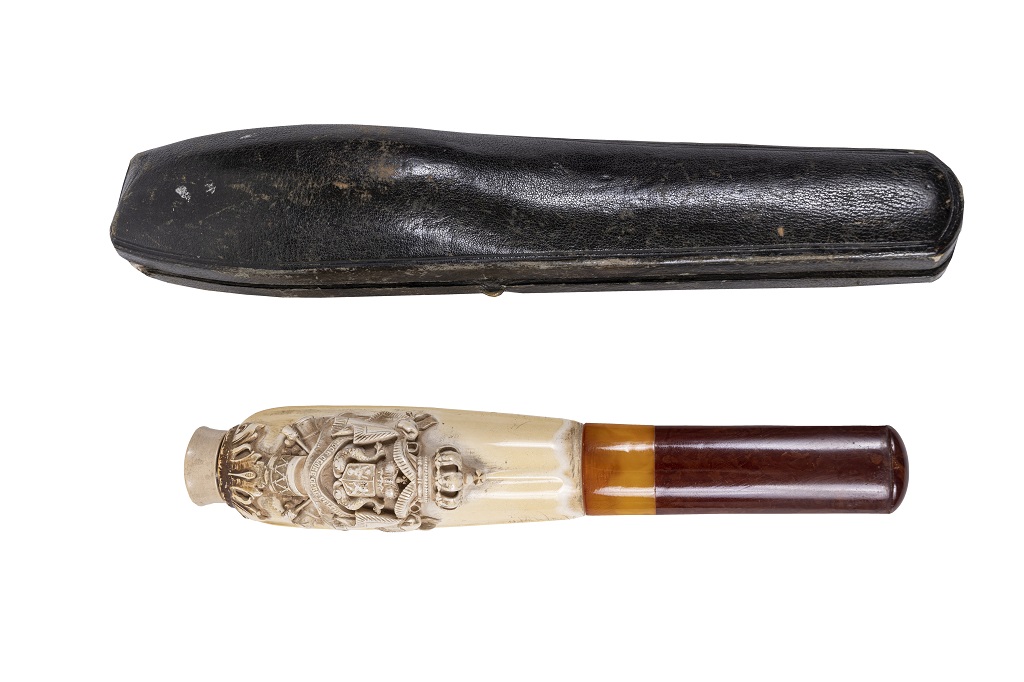
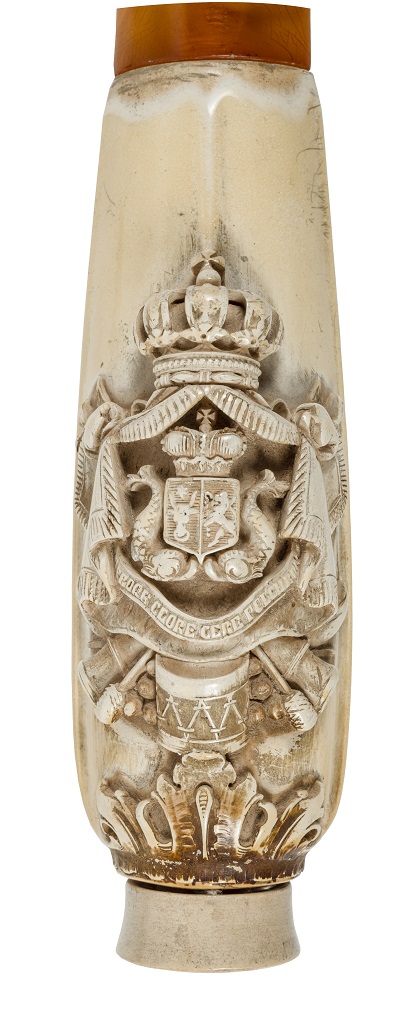
Another object in our exhibition seems to be part of this story. It is Prince Mihail Sturdza’s cigarette holder, a striking and valuable cultural artefact classified in the Treasure category of the national cultural heritage, and an object of modernity. Cylindrical in shape and slightly rounded towards its lower end, it is made of yellow and red amber and ivory, with a meerschaum mouthpiece. Prince Mihail Sturdza’s personal coat of arms is depicted on the ivory section. The shield, topped by a princely crown and divided into two quarters, depicts a bison’s head with a star between its horns in the first quarter and a lion in the second, and is flanked by two dolphins facing each other. The ribbon bears the Sturdza family motto: UTROQUE CLARESCERE PULCHRUM, meaning “It shines on both sides”.
In other words, “it is beautiful to shine through both aspects” (the family’s nobility and personal merits). And if we think only of the late Mihai Dimitrie Sturdza, “the historian of the Romanian aristocracy_”_, the motto of the family of Moldavian princes has stood the test of time.
Selective bibliography:
Al. Alexianu, Mode și veșminte din trecut. Cinci secole de istorie costumară românească, vol. II, Ed. Meridiane, 1987, p. 307-319.
Florin Georgescu (ed.), Artă și istorie. Portrete din colecția de pictură a Muzeului Național de Istorie a României, Bucharest, 2016, p. 60.
Sorin Iftimi, Portrete din colecția Sturdza, in Cercetări Istorice (new series), XXXIX, Iași, 2020.
Adrian-Silvan Ionescu, Modă românească și modernizare europeană 1830-1920, in Muzeul Național, XIV, Bucharest, 2004, pp. 166-176.
Florentina Limbran, Ceasul de buzunar, obiect de măsurare a timpuluiși de podoabă, in București. Materiale de istorie și muzeografie, XVIII, Bucharest, 2003, p. 149-151.
Tudor-Radu Tiron, Proiectul celei dintâi decorații românești, in Cercetări Istorice (new series), XXXVI, Iași, 2017, p. 270-271.
http://clasate.cimec.ro/detaliu.asp?k=F7B06DB70F2C492EBA3982B34021154E
https://muzeulvirtual.ro/imagini/ceas-de-buzunar-ami-sandoz-fils/
Mihaela-Cristina Verzea,
curator of the exhibition
Photo gallery:
Photographs taken by Florin Ghimiș,
Photographer of the Neamț National Museum Complex
More on the same topic
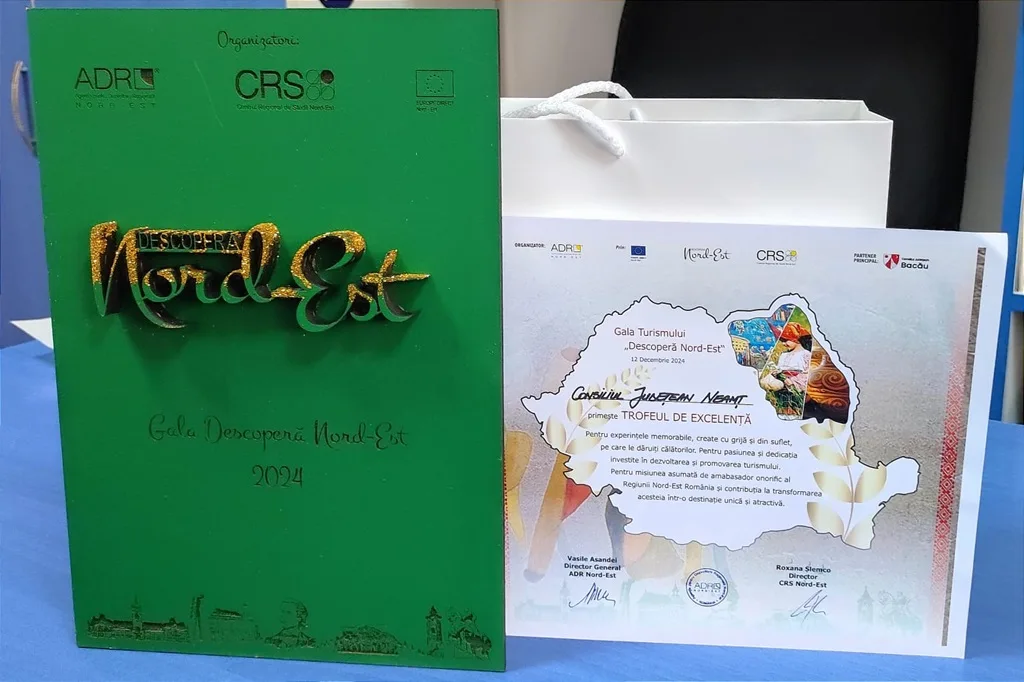
Neamț Awards at the Discover North-East Tourism Gala, 2024
The awards were presented at the 9th edition of the Discover North-East Tourism Gala on December 12, 2024: Newcomer – Award for new locations/attractions/tourist products or emerging tourist destinations: Zenzia Glamping Piatra-Neamț. Poem Rural Piatra-Neamț.
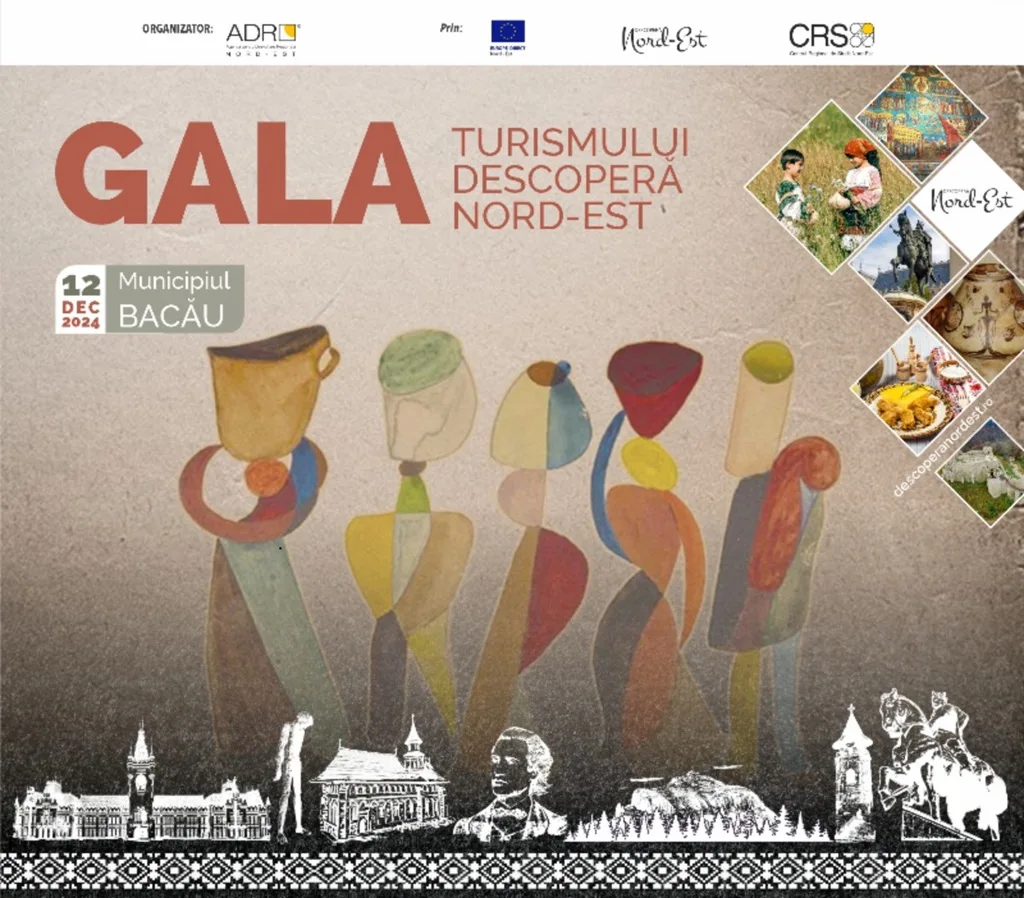
Excellence in Developing Tourism in Neamț at the 9th Edition
On December 12, 2024, we celebrate the tourism initiatives of Neamț County, alongside those from the North-East Region of Romania—a uniquely beautiful and rich area that deserves to be discovered by tourists.

Nominations for Destination of the Year 2025
In the category Enchanted Realms – Geographical areas or localities with a rich treasure of nature, history and tradition our proposal is: The city of Bicaz and its surroundings.