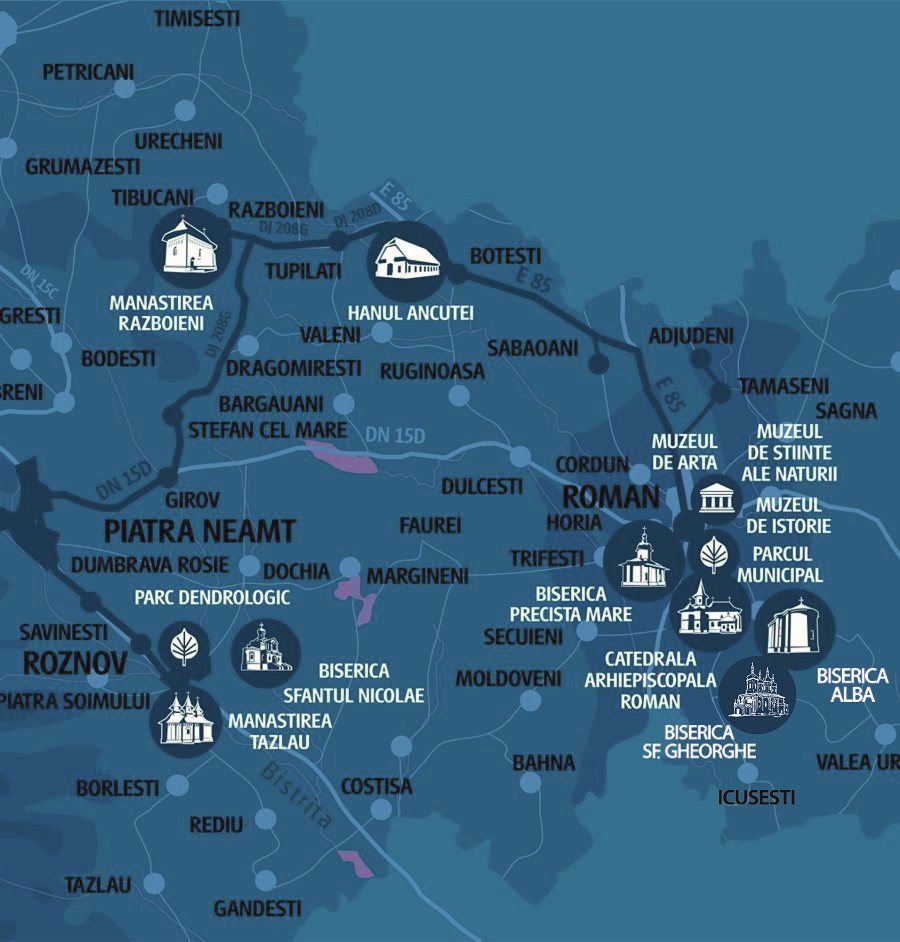
Holiday in Neamț: Route V – Roznov – Războieni – Roman
Coming from Bacău along the Bistrița, turn at Roznov onto the road towards the ancient forests of the Tazlău Valley. Here you will find a village of houses with verandas and carved pillars, in the centre of which rises the white Tazlău Monastery, built by Stephen the Great.
Then head to another of the ruler’s foundations, Războieni Monastery, built on the site of the bloody battle of Valea Albă. Descend among the gentle hills towards the plain, as far as the crossroads at Ancuța's Inn.
The hosts will receive you as cheerfully as the famous innkeeper in Sadoveanu’s stories and will offer you a place to rest and feast as in days gone by. After you have eaten and rested, try a tour of the museums and churches in Roman, a place where culture has turned the pages of a turbulent history.
Route duration: 4–5 days
Route length: 53 km and can be travelled by car, motorcycle or bicycle
How to reach Roznov:
from Bucharest via DN2(E85) to Bacău and then via DN15 to Roznov; from the west of the country via DN15 and DN12C; from Suceava via DN15C and then via DN15; from Iași via E85 to Roman; by train; through the airports of Iași, Bacău, Suceava and from there by road.
Where it is located:
Tazlău Monastery is 36 km south of Piatra Neamț: in Roznov, turn left off DN15 (coming from Bacău), then follow DJ 156A and DJ 156C; Saint Nicholas Church in Roznov and Roznov Dendrological Park are immediately near the roundabout in Roznov; Războieni Monastery is 31 km from Piatra Neamț: in the village of Girov, turn left off DN 15D (heading towards Roman), then follow DJ 208G to Războieni.
Tourist attractions:
- Monastery Tazlău
- Church of Saint Nicholas Roznov
- Dendrological park Roznov
- Monastery of Războieni
- Ancuța's Inn
- History Museum Roman
- Art Museum Roman
- Natural Sciences Museum Roman
- Municipal Park Roman
- Archiepiscopal Cathedral Roman
- White Church Roman
- Great Precista Church Roman
- Church of Saint George Roman
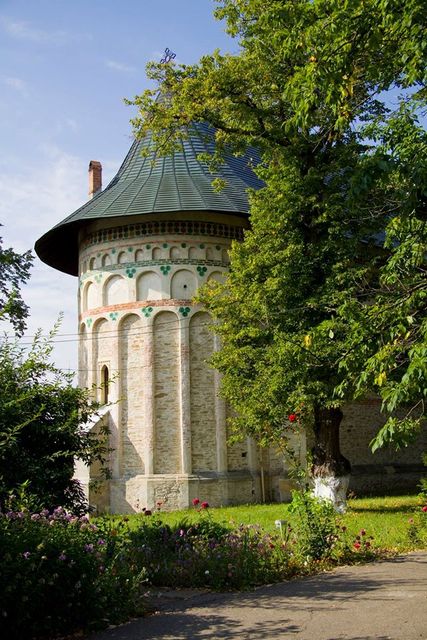
Monastery Tazlău
With roots dating back to the beginning of the 15th century, the monastery expanded in 1496-1497, when Stephen the Great built the masonry church “Nativity of the Mother of God” here – one of the great voivode’s most imposing foundations. For almost three centuries, the monastery developed spiritually and economically, also housing a school of clerks and scribes who copied manuscripts of the time. Its decline began when the monasteries of Moldavia were placed under the authority of the Patriarchates of Constantinople and Jerusalem. The fire of 1879 marked the end of a stage of monastic life here. The monastery was turned into a parish church and functioned as such until 1990, when it resumed its role as a monastery for monks at the foot of Măgura Tazlăului. Info tel. 0233 298298
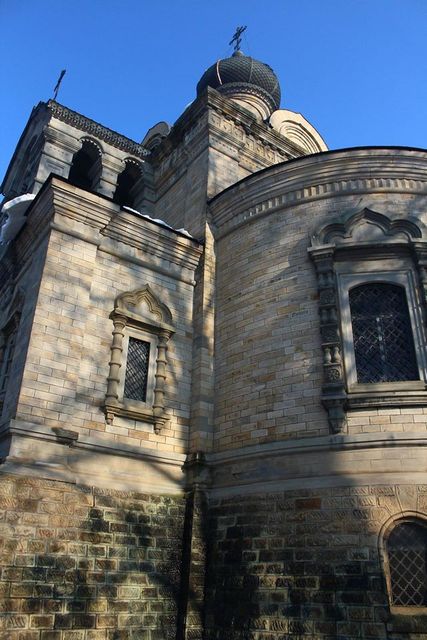
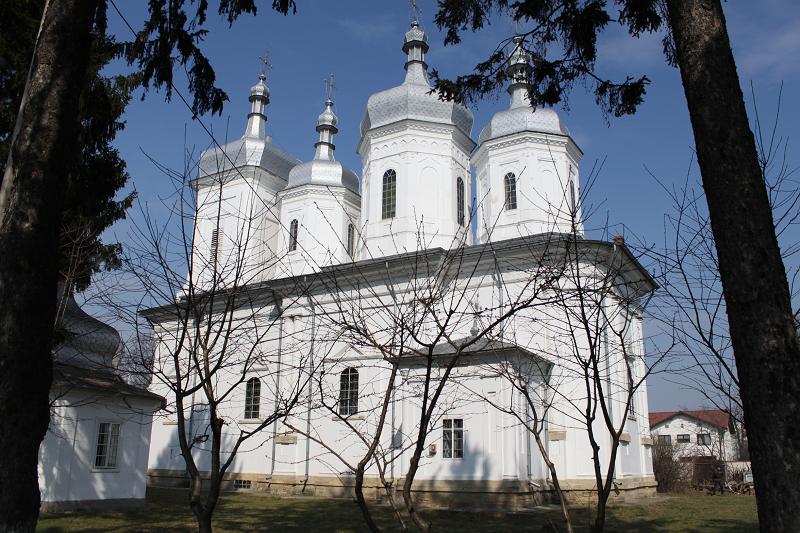
Saint Nicholas Church Roznov
It is a building erected at the end of the 19th century by the renowned politician of the time, Colonel Gheorghe Ruset Roznovanu, in memory of his son Alexandru, who died at the age of 20. Surrounded by Roznov Dendrological Park, the church impresses with its architecture, unusual for the area. With close ties to Russia and its nobility, the Roznovanu family built this church in the Russian style, with stone walls forming an equal-armed cross topped by the onion dome characteristic of Slavic church towers. Inside, the gilded bronze iconostasis, made in Moscow between 1890-1892, impresses with its size and rich ornamentation. The harmonious painting was executed by Costin Petrescu, the same artist who painted the Romanian Athenaeum. Info tel. 0233 667126
Roznov Dendrological Park
Located on your route, on national road 15, the park provides a shady place of rest and recreation beneath centuries-old trees, covering an area of 3 ha. Oaks, beeches, chestnuts and rare species such as silver fir, white pine, Japanese acacia, yellow acacia, maple, elm and pine await you to enjoy their richly coloured foliage and the fresh air.
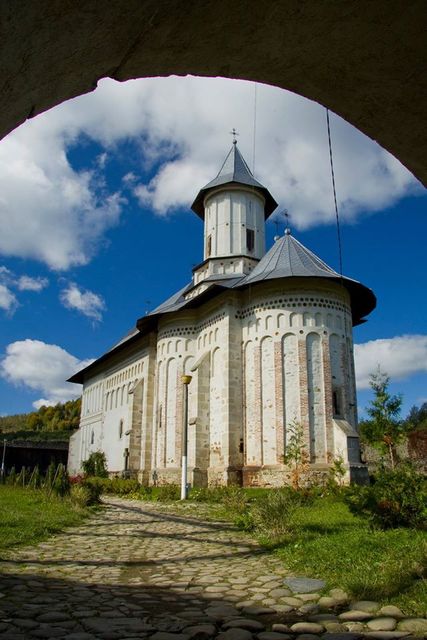
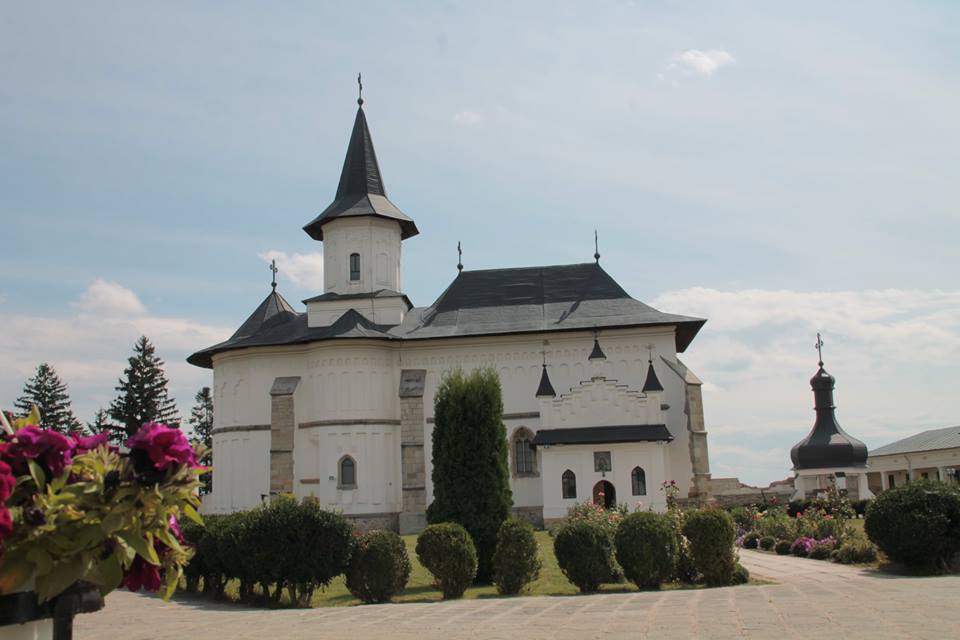
Războieni Monastery
Located in the centre of the village of the same name, the monastery was founded by Stephen the Great in 1496, in honour of the Moldavian soldiers who fell in the battle against the Turks at Valea Albă (1476). The inscription on the south wall of the Church of the Holy Archangels Michael and Gabriel describes Moldavia’s defeat in the war for country and faith, and states that the church was built to preserve the memory of the soldiers who supported him. The monastery is unique among Stephen the Great’s church foundations: it serves as a mausoleum housing the remains of the fallen soldiers beneath the paving slabs of the altar area and the narthex. Info tel. 0233 292912
Ancuța's Inn
Once a stopping place for travellers or “carters from Țara de Sus”, situated at a crossroads, built like a fortress in an isolated spot and enlivened by people whose stories each seemed more “terrible or astonishing” than the last, the inn still preserves the atmosphere of bygone times, offering traditional dishes and skilfully prepared specialities from Anița’s pantry. Info tel. 0233 781400
History Museum Roman
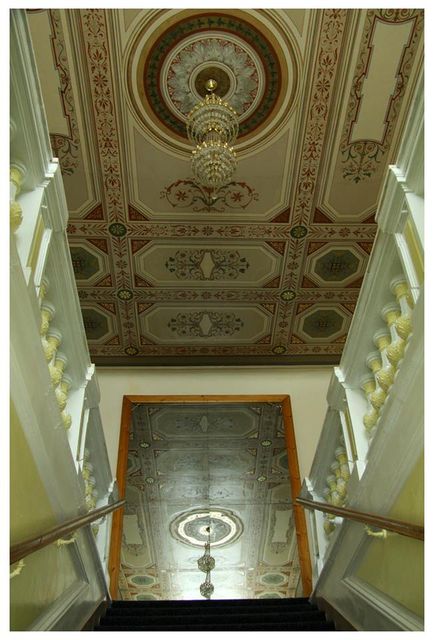
Here you can discover an impressive collection of over 170,000 objects, including rare and valuable pieces such as the Cucuteni A Neolithic hoard, finds from the Dacian necropolis at Văleni, a hoard of metal and bone ornaments from the Cucuteni A-B culture, a necklace of deer canine teeth comprising over 220 pieces – the largest of its kind in south-eastern Europe – objects from the Free Dacian period and the medieval period of Roman Fortress, as well as a hoard of Roman coins discovered in the Roman area. Negruzzi Palace, which houses the museum, will delight you particularly with its ceiling paintings and decorative work, created in 1884 by Ludwig Brenner, as well as its exterior architecture in the Baroque style of the late 19th century. Information tel. 0233 727726
Roman Art Museum
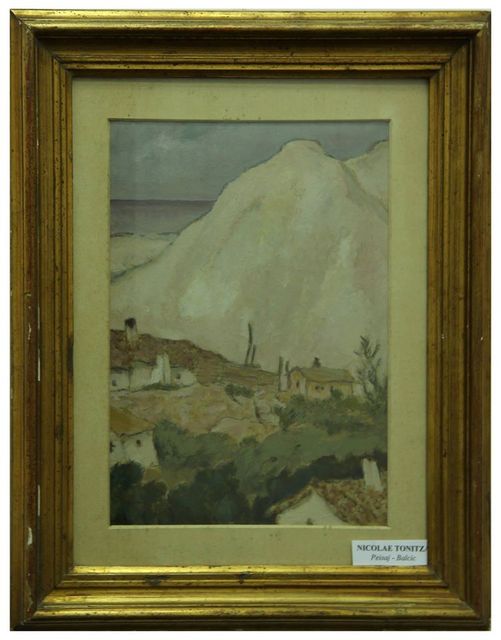
It includes collections of paintings, sculpture, graphic art and decorative works by artists from Roman or by artists who passed through this town on their way to becoming established in national art. The permanent exhibition is often complemented by temporary exhibitions that explore diverse styles of contemporary art. Info tel. 0233 744011
Roman Natural Sciences Museum
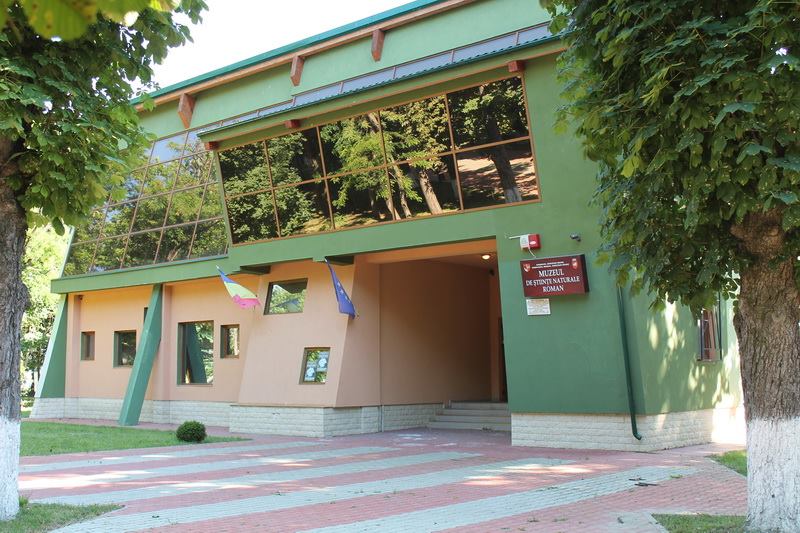
Located in the Municipal Park, in a modern building that blends harmoniously with its surroundings, the museum offers an important and enjoyable opportunity to learn about nature through both its permanent and temporary exhibitions. The permanent exhibition includes plant and animal species specific to the ecosystems of forests, meadows and floodplains in the Roman area. The exhibits were collected through research in the area where the Moldova and Siret rivers meet. Info tel. 0233 742528
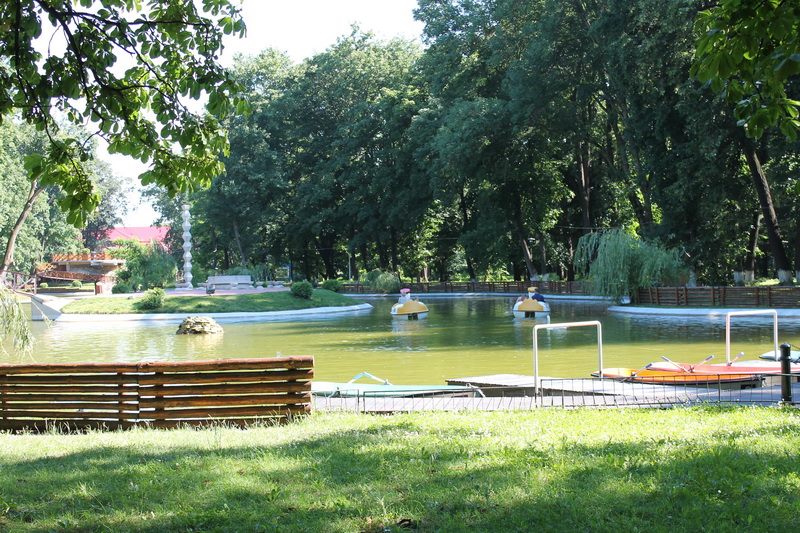
Roman Municipal Park
Unique in Europe for the diversity of tree and shrub species growing around the recreational lake, the park offers you a moment of rest and contemplation. Along its quiet paths, you can discover the “Writers’ Rotunda”, which brings together busts of Creanga, Eminescu, Sadoveanu, Alecsandri, Caragiale, Vlahuță, Kogălniceanu, Miron Costin and Enescu, as well as the monument to Ion Ionescu de la Brad.
“Saint Parascheva” Archiepiscopal Cathedral, Roman
Founded by Petru Rareș and his son Ilaș, the Cathedral Complex is a monument of religious architecture that has become an important cultural centre for the area over its 500 years of existence. Highlights include the unique icon of Cuvioasa Parascheva, the patron saint of Moldavia, and the exceptionally beautiful paintings inside the church. The Bell Tower is also monumental and striking, with 5 levels housing an impressive research library. Information tel. 0233 731683
White Church, Roman
Founded by Ștefan Tomșa II and built in 1615, then rebuilt in 1695 by the sword-bearer Vasile Cantacuzino, the White Church will catch your eye with its 1695 inscription bearing the Cantacuzino coat of arms and monogram, its expressive paintings in vivid colours, and its iconostasis. Although not of historical value, the iconostasis was created in 1922 and features rich and varied sculptural elements. Info tel. 0726 335696, 0722 347507
Precista Mare Church, Roman
Built in 1569 by Lady Ruxandra Lăpușneanu, the church has endured numerous hardships and the vicissitudes of time, yet still retains the bell tower, the Holy Table, the founding inscription and many other ecclesiastical treasures. It is located near the Archdiocese Complex in Roman, where you can easily appreciate the elegance and sobriety of its exterior, the precise carving of its iconostasis and its interior murals, painted using the fresco technique in the Neo-Byzantine style. Info tel. 0722 915 623
St. George Church, Roman
St. George Church in Roman, whose history is longer and more complex than previously thought, is linked to the fortified town of Roman, which for a time was the most important military, ecclesiastical and economic centre of Lower Moldavia. It is situated in the lower part of the town, south of “Ulița lui Borș”, in an area first known as “Sat al Poslușnicilor” and then as “Mahalaua Popăuți”, on what is now Soldat Porojan Street. Although not very large, the slender and harmonious forms of St. George Church in Roman give it a monumental appearance. Its main structure has an impressive volume and a symmetrical composition in the Russian neoclassical style. It is ship-shaped, with four slender towers. Its architectural plans were brought from Odessa by its founder, Grigore Done, who came from the Hotin region.
Museum opening hours: April-September: 10:00-18:00; October-March: 09:00 -17:00
Activities we suggest:
- fishing in the lakes: Budești, Făurei commune; Complex Dănăilă, Roman; Ferma Caritas, Săbăoani commune; La Moldovean, Dragomirești commune; Simionești, Cordun commune; Trifești, Trifești commune, and in Unghi pond, Dragomirești commune, info tel. 0233 292 876
- SPA – Velvet & Beauty at Hotel Roman;
Events we invite you to:
-June: Sânziene Festival, 24 June – Tupilați commune’s celebration day, when the annual fair and funfair take place alongside folk performances;
-July: Roznov Festival – the third Sunday of July; Războieni Festival – the last Sunday of July – a folk-style event bringing together amateur groups from the area and commemorating the great battle of Valea Albă (1476) in which the army of Stephen the Great defeated the Turks; exhibitions and sporting competitions are also held;
-August: “The Transfiguration” – the patronal feast of Nechit Monastery – 6 August;
-September: “The Nativity of the Mother of God” – the patronal feast of Tazlău Monastery – 8 September; Festival of Inns – Tupilați;
-October: “Saint Parascheva” – the patronal feast of Roman Archiepiscopal Cathedral – 14 October;
-November: “The Holy Archangels Michael and Gabriel” – the patronal feasts of Războieni Monastery and the White Church in Roman – 8 November; “Sadoveniana” traditional gathering at Hanul Ancuței;
-December: “Saint Nicholas the Hierarch” – the patronal feast of the church in Roznov, 6 December; Traditional Customs Festival – Tazlău;
Accommodation:
Tazlău: CASA BUNICII Guesthouse ***, tel. 0745 244 770, 0747 281 650;
Roznov: AKIRA Guesthouse **, tel. 0233 665 727;
Săvinești: CASA DRUMEȚULUI Guesthouse ***, tel. 0233 281 147, www.casadrumetului.ro;
Dumbrava Roșie: Motel BALCOST ***, tel. 0233 282 240, www.motelbalcost.ro; Guesthouses: OCTOGON ***, tel. 0233 282 292; BYBLOS ***, tel. 0233 280 993, www.pensiuneabyblos.ro; CASA EDELWEISS ***, tel. 0233 217 502; ANDRA ***, tel. 0233 282 559; CLASSIC ***, tel. 0233 282 290, www.pensiuneaclassic.ro; RUSTIC ***, tel. 0233 280 393, www.pensiunea-rustic.ro;
Girov: Motel ANA***, tel. 0233 290 221, www.motelana.ro; ELENA Guesthouse ***, tel. 0233 290 770;
Dulcești: Motel CONDOR ***, tel. 0233 761 001;
Tupilați: HANU ANCUȚEI ***, tel. 0233 781 400; HANUL RĂZEȘILOR ***, tel. 0730 608 141, www.hanulrazesilor.ro;
Secuieni: RALUCA Guesthouse ****, tel. 0233 743 731;
Trifești: IOANA Guesthouse ***, tel. 0745 073 418;
Roman: Hotels: ROMAN ***, tel. 0233 742 600, www.hotel-roman.ro; MARIKO INN ***, tel. 0233 742 525, www.mariko.ro; ZARA ***, tel. 0233 733 731, www.hotelzara.ro;
Horia – Cotu Vameș: Motel IMPERIAL ***, tel. 0233 747 111.
More on the same topic

Neamț receives five nominations across four categories in Destinația Anului
We have good news for everyone who loves Neamț County and all its beauty: it is among the finalists in the Destinația Anului 2024 competition, with five nominations across four categories: Piatra Neamț in the Inspiring Cities category.

Military firefighters bring competition and lots of adrenaline to Târgu Neamț
Târgu Neamț is hosting the 3rd zonal stage of the professional emergency situation competitions, in which representative teams from several counties of the country will participate: Bacău, Botoșani, Iași, Neamț, and Suceava.
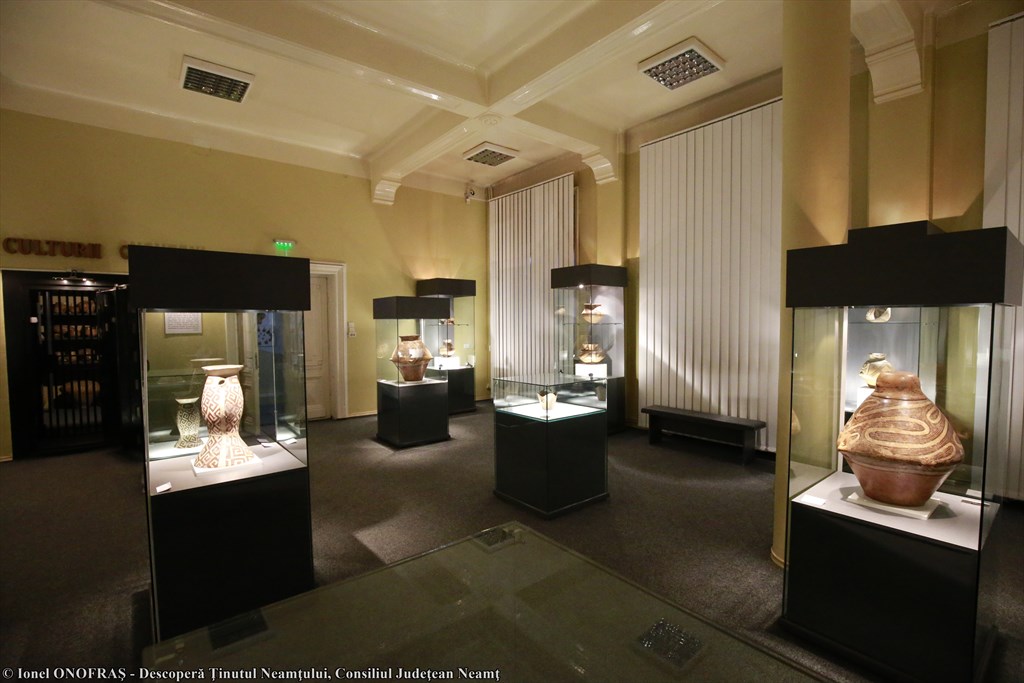
Discover, in Piatra Neamț, the most important Eneolitic art collection from the South-East of Europe
Photo Gallery: Nationally one of the kind, both history and art museum, it currently hosts the most spectacular artefacts, famous objects that belong to the Cucuteni–Trypillia Culture, which is in…