“G. T. Kirileanu” Library Piatra Neamț – “Maluri de Prut – Basarabia Necunoscută” (VII)
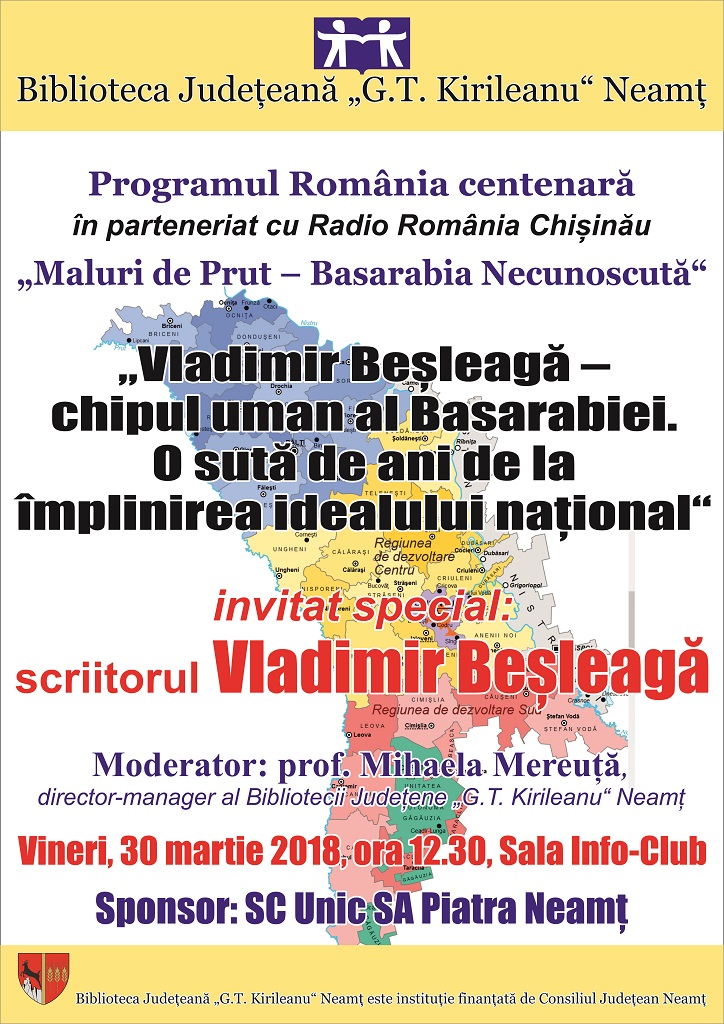
”Vladimir Beșleagă – the human face of Basarabia. A hundred years since the fulfilment of the national ideal”
A new “Maluri de Prut – Basarabia necunoscută” debate at the County Library
G.T. Kirileanu County Library Neamț, in partnership with Radio România Chișinău, is organising another meeting as part of the România Centenară cultural project “Maluri de Prut – Basarabia necunoscută”, with one of the most important contemporary Romanian writers from Basarabia as its special guest, on Friday 30 March, starting at 12:30.
Under the theme ”Vladimir Beșleagă – the human face of Basarabia. A hundred years since the fulfilment of the national ideal”, the event aims to introduce audiences in Neamț to significant historical and cultural developments that have shaped the lives of people on the left bank of the Prut, including Transnistria, over the past century, through the work and personality of writer Vladimir Beșleagă.
“The Union of 1918 was a moment of great beauty and great historical importance for our entire nation. The Romanian nation state was consolidated. It was a great miracle. The great dream came true then. And our great dream is still to be fulfilled. As long as the dream lives within us, it has a 99 per cent chance of becoming reality. In the circumstances of our century and our civilisation, returning to our homeland, our people and our roots takes different forms. The very fact that thousands upon thousands of citizens of Republica Moldova hold Romanian citizenship is part of Reunification. The fact that thousands upon thousands of young people from Basarabia study on the right bank of the Prut is part of Union”, says Vladimir Beșleagă in an interview with Radio Chișinău.
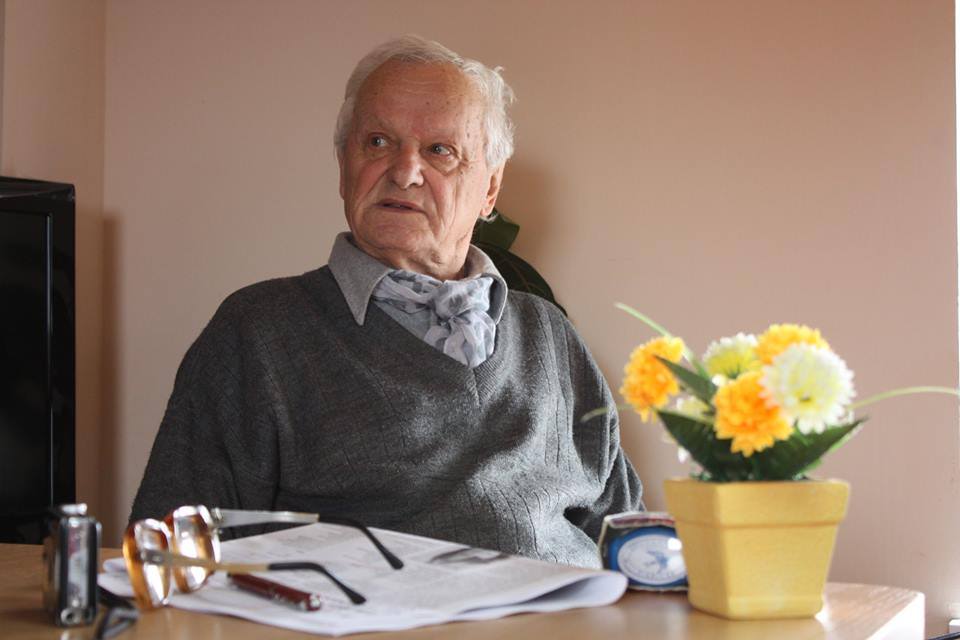
Vladimir Beșleagă
Born in the village of Mălăiești, in Transnistria, on 25 July 1931, the writer Vladimir Beșleagă experienced the horrors of the Second World War as a child. He was one of the leaders of Mișcarea de Eliberare Națională and campaigned for a return to Romanian values on the left bank of the Prut, alongside Grigore Vieru, Ion Ungureanu, Ion Vatamanu, Leonida Lari, Ion and Doina Aldea Teororovici, Lidia Istrati and others.
On one of the writer's birthdays, Basarabian journalist Vitalie Ciobanu wrote about Vladimir Beșleagă in Contrafort magazine: “Vladimir Beșleagă comes from Transnistria – today a hostile territory, estranged from Moldova and the Romanian spirit. As a child, he experienced the terrifying realities of the Second World War, in which Basarabians suffered a double tragedy, finding themselves in opposing trenches on either side of the front. This biographical experience, which shaped his artistic sensibility, was reflected in the novel «Zbor frânt», published in the ’70s and considered the pinnacle of post-war Basarabian literary prose. He also wrote the only Basarabian novel kept “in the drawer”, «Viața și moartea nefericitului Filimon», which was published only during the years of liberalisation under Gorbachev. With his extensive knowledge of philosophy and literature and command of several foreign languages, Mr Beșleagă is also appreciated for his journalism. His volumes of “Transnistrian dialogues” and those devoted to Soviet repression in Basarabia skilfully combine a historian's meticulousness with finely observed descriptive detail, documentary rigour with the keen eye of a great writer. Beșleagă is one of our few intellectuals who, having lived through “troubled times”, has faced his past with clarity and argued vigorously for an “ethics of memory” in public and literary life”, wrote Vitalie Ciobanu in issue no. 7-8 of “Contrafort” magazine, July-August 2011.
In the ’90s, Vladimir Beșleagă became involved in the National Revival Movement and served as a member of the first Parliament of independent Moldova. The prose writer is a strong supporter of young writers, attends literary circles and creative writing workshops, takes part in debates and is very active in social life. He is considered “a true model of literary mentorship and intellectual engagement”.
The manuscript of his novel “Noaptea a treia”, written in the Latin alphabet, is held at the Literature Museum in Iași. “I wanted it to stay there because it is safer”, the author says. He has also made donations to the Romanian Literature Museum in Chișinău. It holds the manuscripts of several novellas, as well as that of the novel “Zbor frânt”.
Age: 86; education: Faculty of Philology (1955); doctoral studies, with the thesis “Liviu Rebreanu, romancierul”, which he did not defend because his supervisor, Vasile Coroban, was dismissed from the University; Awards and honours: State Prize of the RSSM (1978), honorary title of People's Writer (1991), Order of the Republic (1996), awarded the Order of “Cultural Merit” at the rank of Commander, category A – “Literature”, by the President of Romania (2016).
He made his debut in 1956 with the children's book “Zbânțuilă”. The novel “Zbor frânt” (1966) is considered one of the most remarkable works of Romanian literature from Basarabia. He also published the novels: “Viața și moartea nefericitului Filimon…” (originally titled “Noaptea a treia”, written in 1970 but published only after the fall of communism), “Acasă” (1976), “Ignat și Ana” (1979), “Sânge pe zăpadă” (1985).
Last year, more than 30 years after work on it began (1981), the extensive historical novel “Cumplite vremi” was published. The work impresses both through its scale (4 volumes comprising 3 books, each with a prologue, 35 chapters and an epilogue, totalling 2,213 pages in the Cartier edition, 2017) and through its ability to portray a sweeping panorama of a historical moment remembered chiefly for a sudden incident with dramatic consequences, including symbolic ones: the execution without trial of the erudite chronicler and politician Miron Costin on the hasty orders of Prince Constantin Cantemir, father of Dimitrie Cantemir.
“Maluri de Prut – Basarabia Necunoscută”
“Maluri de Prut – Basarabia Necunoscută” is a cultural project run by G.T. Kirileanu County Library Neamț and Radio România Chișinău, involving cultural and educational activities, research and information activities, and discussion meetings with special guests from the left bank of the Prut on topics such as Romanian-language education in Transnistria, famine and deportations in Basarabia, the press and freedom of expression in Republica Moldova, Basarabian literature during the Soviet period, and economic, social and cultural relations between the two banks of the Prut. The project is supported by Neamț businessman Vasile Ouatu, an honorary citizen of the city of Orhei, known for championing the Basarabian cause and closer ties between the two banks of the Prut.
Managing director,
Mihaela Mereuță
More on the same topic

Neamț County, an Ambassador for Local Traditions and Values in Brussels
Neamț County showcased its values, traditions and development potential on the European stage during European Week of Regions and Cities, held in Brussels from 12 to 14 October.

Solo painting exhibition – Florin Mareș
Starting Saturday, 10 October 2026, the Art Museum in Roman opens a new solo exhibition by the visual artist Florin Mareș of Roman.

Book launch: “Regina Maria a României. Din viață în eternitate” by historian Narcis Dorin Ion
Neamț National Museum Complex invites audiences in Neamț to the launch of “Regina Maria a României.