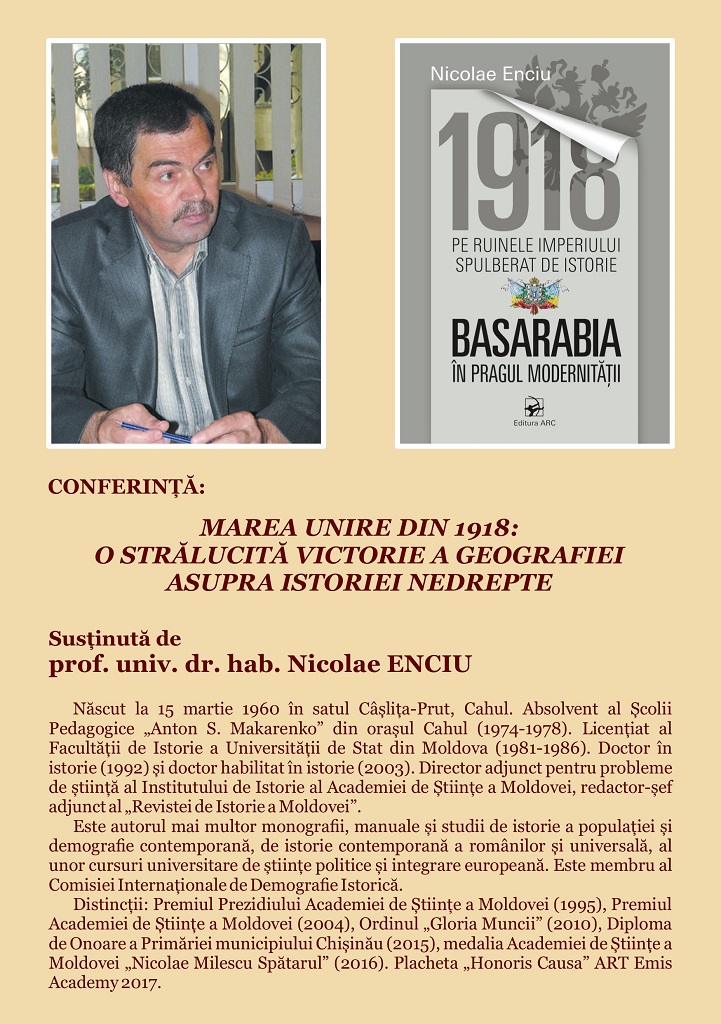
The Great Union of 1918: A brilliant victory of geography over an unjust history
Anniversary lecture and recitals
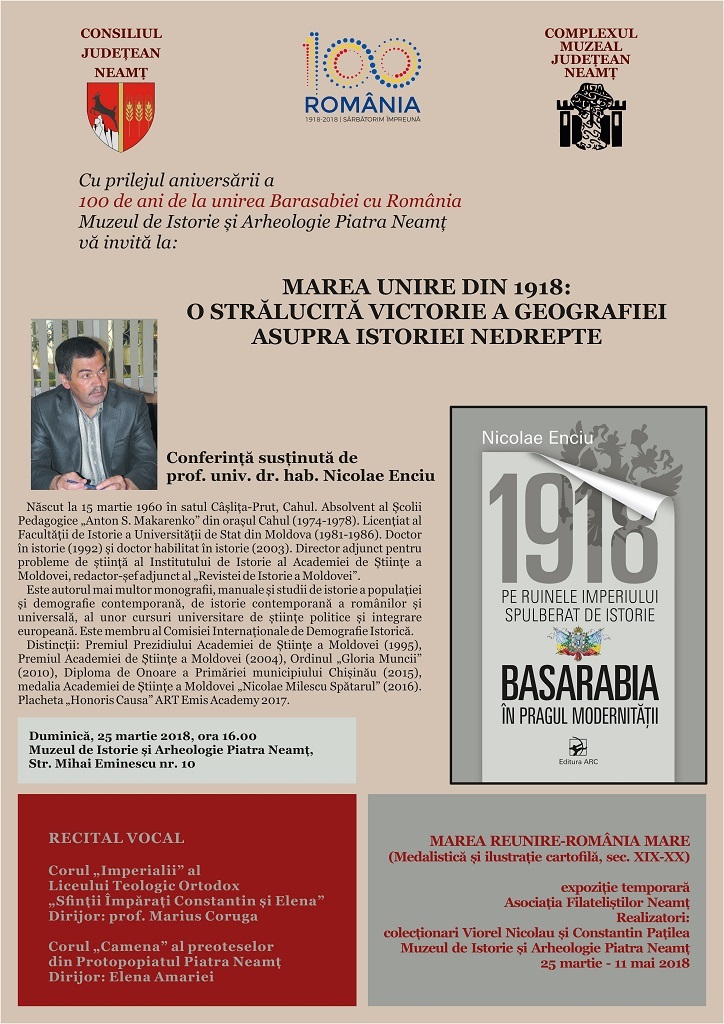
25 March 2018, at 16.00, at the Piatra Neamț Museum of History and Archaeology, 10 Mihai Eminescu Boulevard, Piatra Neamț
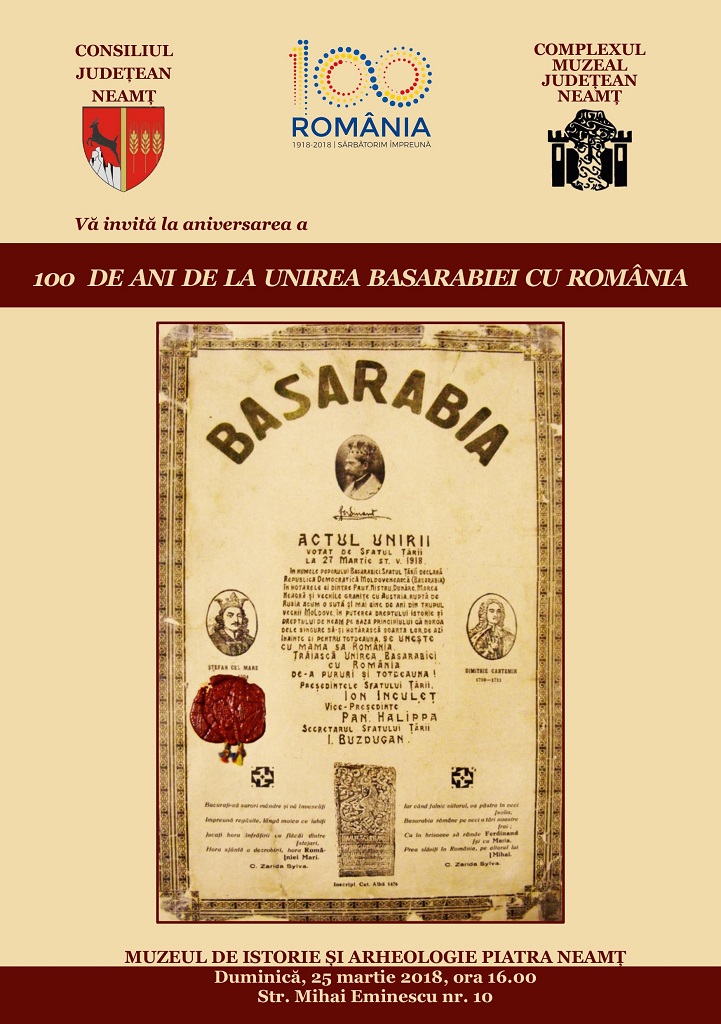
The act uniting Basarabia with the motherland, voted on 27 March/9 April 1918 and signed by Ion Inculeț, president of Sfatul Țării, vice-president Pan. Halippa and I. Buzdugan, secretary of that legislative body, restored the historic Romanian province to its natural borders: In the name of the people of Basarabia, Sfatul Țării declares that the Moldavian Democratic Republic (Basarabia), within its borders between the Prut, the Dniester, the Danube, the Black Sea and the old borders with Austria, torn by Russia from the body of old Moldavia more than a hundred years ago, by virtue of historical rights and national rights, and on the principle that peoples alone should determine their own destiny, unites from this day forward and forever with its MOTHER, ROMANIA. Long live the union of Basarabia with Romania, forever and always!
To mark 100 years since this fundamental step in the creation of the Romanian unitary nation state, Neamț County Museum Complex will organise a major event on 25 March 2018, at 16.00, at the Piatra Neamț Museum of History and Archaeology.
To open the event, Professor Nicolae Enciu, who holds a doctorate and habilitation, will deliver a lecture on the theme Marea Unire din 1918: O strălucită victorie a geografiei asupra istoriei nedrepte and present his latest book, published by ARC in March 2018, entitled 1918. Pe ruinele imperiului spulberat de istorie. Basarabia în pragul modernității, a study of “the reintegration of Basarabia into the Romanian cultural and civilisational sphere, from which it had been forcibly torn in 1812”.
Historian Nicolae Enciu was born on 15 March 1960 in the village of Câșlița-Prut, Cahul. He graduated from the “Anton S. Makarenko” Teacher Training School in the town of Cahul (1974-1978), earned a degree from the Faculty of History at the State University of Moldova (1981-1986), a doctorate in history (1992) and a habilitation in history (2003), and is deputy director for scientific affairs at the Institute of History of the Academy of Sciences of Moldova and deputy editor-in-chief of “Revista de Istorie a Moldovei”. He is the author of several monographs, textbooks and studies on population history and contemporary demography, contemporary Romanian and world history, and university courses on political science and European integration. His areas of expertise and research interest include contemporary Romanian and world history, contemporary demography and population history, political science and the history of the European Union. He has received the following honours: the Presidium Prize of the Academy of Sciences of Moldova (1995), the Prize of the Academy of Sciences of Moldova (2004), the “Gloria Muncii” Order (2010), the Diploma of Honour from Chișinău City Hall (2015), and the “Nicolae Milescu Spătarul” medal of the Academy of Sciences of Moldova (2016).
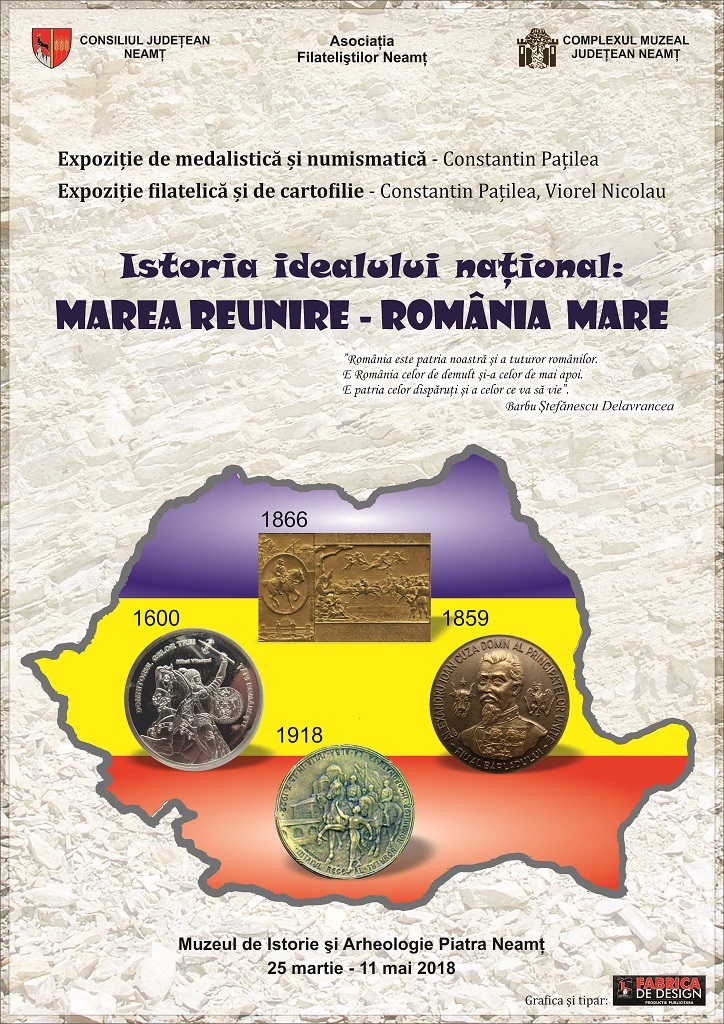
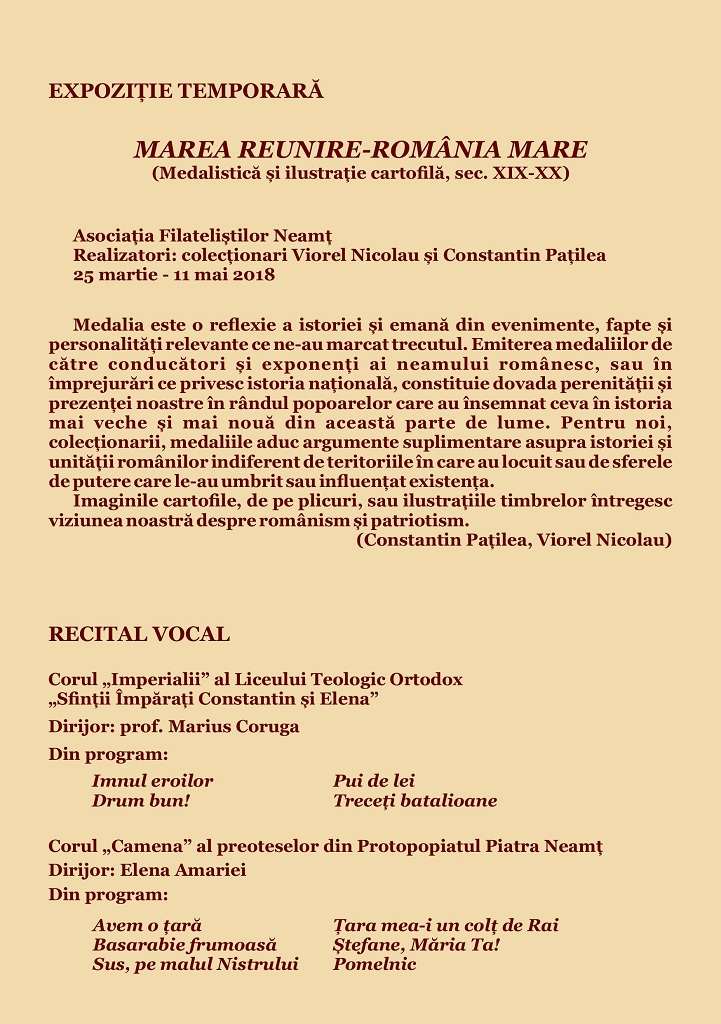
On the same occasion, collectors Viorel Nicolau and Constantin Pațilea invite audiences in Neamț to explore the “history of the national ideal” through an impressive collection of medals and postcard illustrations. According to the curators of the temporary exhibition Marea Reunire-România Mare: A medal reflects history and emerges from significant events, deeds and figures that have shaped our past. Medals issued by leaders and representatives of the Romanian nation, or on occasions connected with national history, bear witness to our enduring presence among the peoples who have played a part in the earlier and more recent history of this part of the world. For us collectors, medals provide further evidence of the history and unity of Romanians, regardless of the territories they inhabited or the spheres of power that overshadowed or influenced their existence. Postcard images on envelopes and stamp illustrations complete our vision of Romanian identity and patriotism.
Inspired by a deep reverence for the past, our event also has an artistic element that will stir in each of us a sense of belonging to one nation through language, history, faith and tradition. Thanks to excellent collaboration with the Piatra Neamț Deanery, the Imperialii Choir of the Sfinții Împărați Constantin și Elena Orthodox Theological High School and the Camena Choir of priests’ wives from the Piatra Neamț Deanery will give a vocal recital during the event.
Dr Mihaela-Cristina Verzea
Photo gallery:
More on the same topic
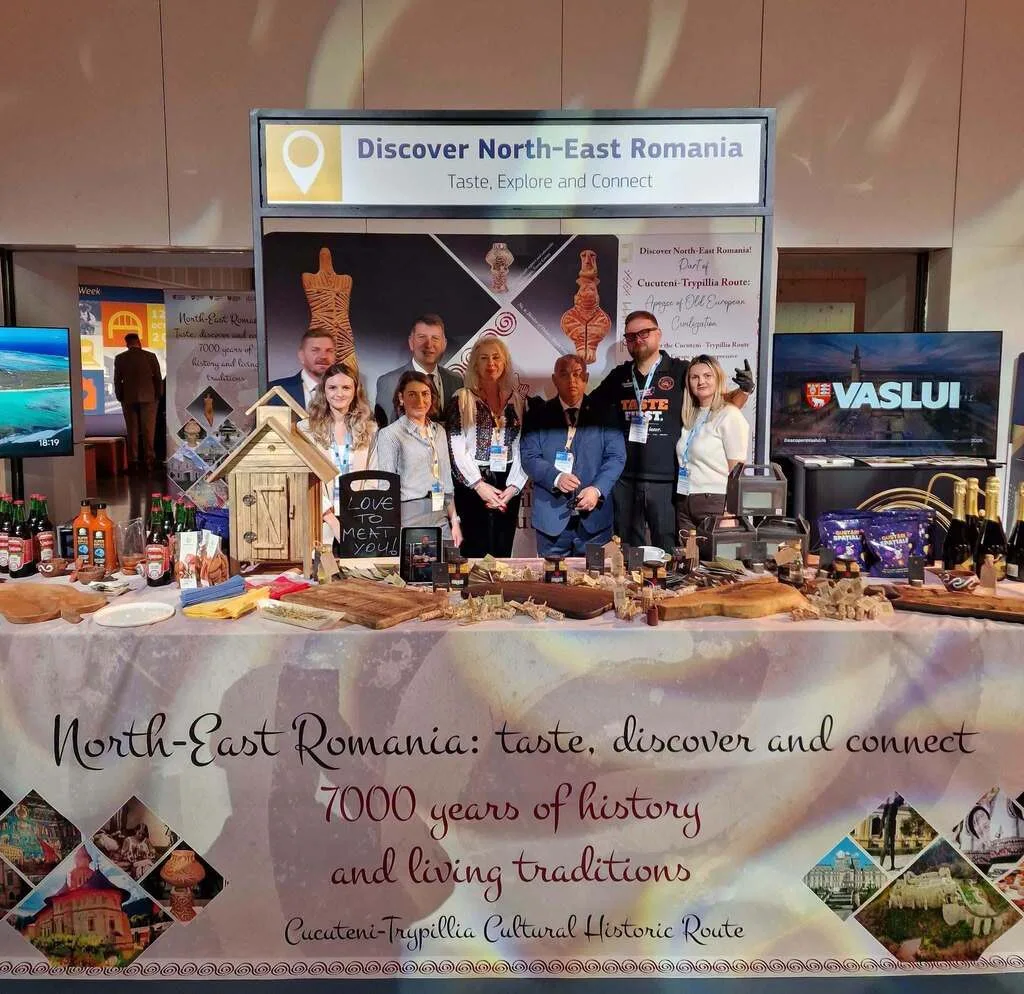
Neamț County, an Ambassador for Local Traditions and Values in Brussels
Neamț County showcased its values, traditions and development potential on the European stage during European Week of Regions and Cities, held in Brussels from 12 to 14 October.
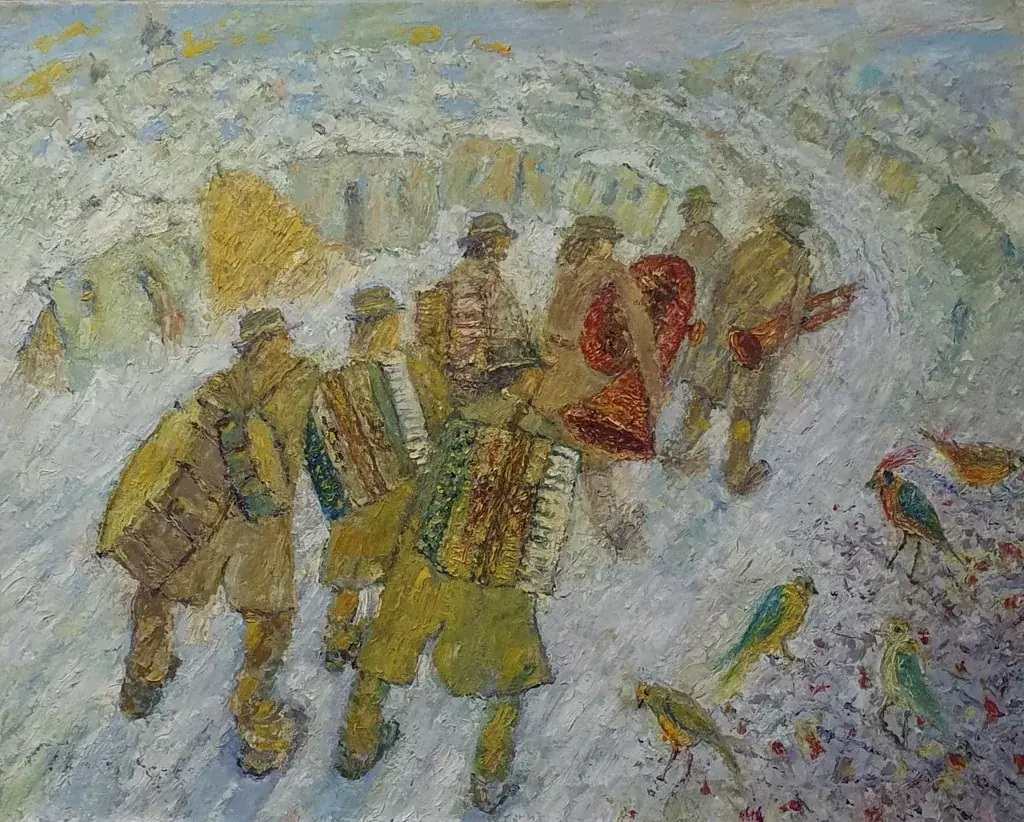
Solo painting exhibition – Florin Mareș
Starting Saturday, 10 October 2026, the Art Museum in Roman opens a new solo exhibition by the visual artist Florin Mareș of Roman.
Book launch: “Regina Maria a României. Din viață în eternitate” by historian Narcis Dorin Ion
Neamț National Museum Complex invites audiences in Neamț to the launch of “Regina Maria a României.