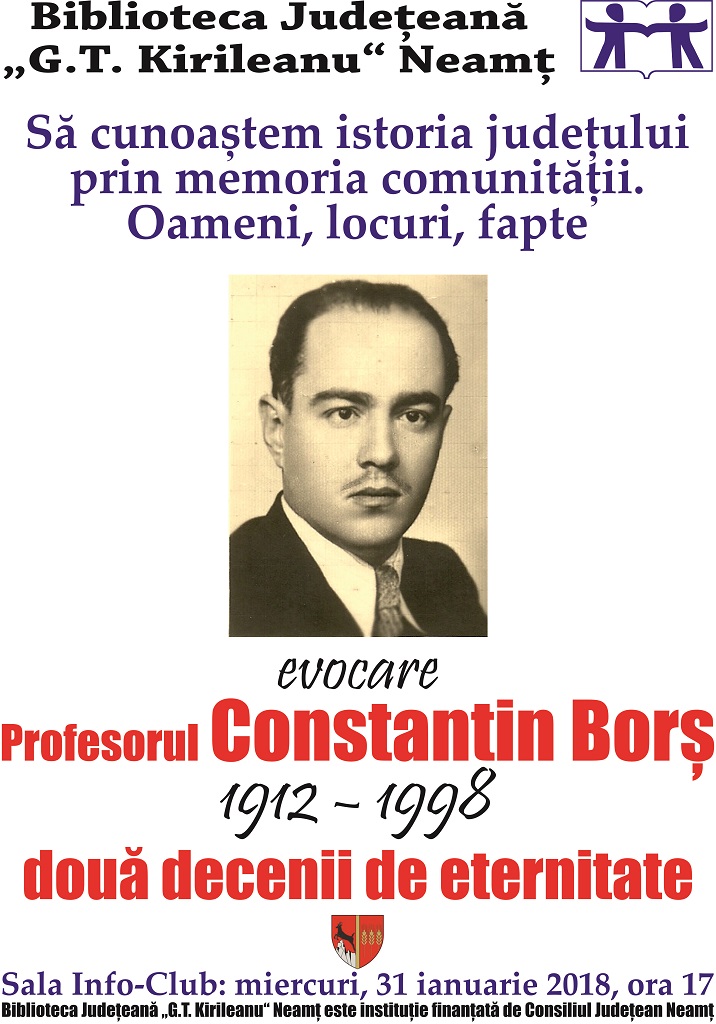
Remembering teacher Constantin Borș at the County Library
Remembering teacher Constantin Borș
at the County Library
Press release
G.T. Kirileanu County Library Neamț is organising an event commemorating the distinguished teacher Constantin Borș (1912-1998), two decades after his death, on Wednesday, 31 January 2018, at 17:00 in the Info-Club Room.
The commemoration of one of the region’s most renowned teachers is part of the project “Discovering the County’s History through Community Memory. People, Places, Events”, whose first event, held on Thursday, 16 November 2017, under the title “Săvinești-Roznov Industrial Complex”, brought together numerous figures from economic and cultural life who helped shape the city of Piatra Neamț and the entire county as they are today.
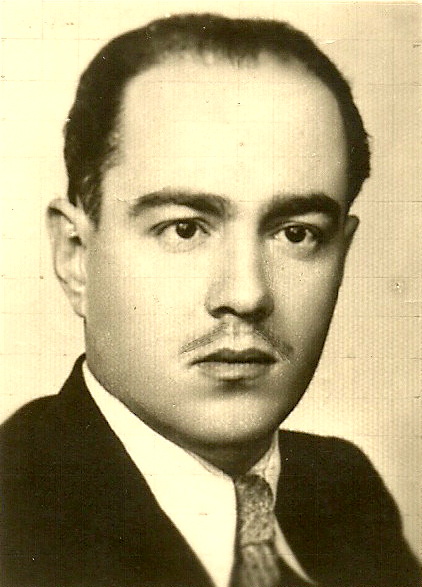
Constantin Borș
“The fact that some of a teacher's former pupils – whether that teacher taught mathematics or another subject – remember their teacher with a particular respect cannot, I believe, be a teacher's “secret”. Rather, it is an ideal that every teacher strives – sometimes in vain – to fulfil throughout their life”. (Constantin Borș)
A mathematician, writer and poet, Constantin D. Borș was one of the best-loved teachers in mathematics education in Neamț.
A distinguished teacher and an outstanding person, Constantin D. Borș was born on 13 May 1912, the youngest child in the family of forestry engineer Dimitrie Borș.
In December 1969, at his initiative, celebrations marked 20 years since the founding of the Piatra Neamț branch of the Society of Mathematical Sciences of the RSR, which had distinguished itself through its productive work. Efforts focused on two aims: professional development and modernising teaching. The branch’s practical work was guided by the academician Prof. Grigore C. Moisil and Prof. Dr A. Haimovici, a docent. A year earlier, the “National Meeting of Mathematicians” had taken place in Piatra Neamț (15–16 July 1968), where practical lessons with preschool children delighted the 70 participating teachers. The event received high praise from Gr.C. Moisil: “Piatra Neamț plays an important role in modernising mathematics teaching”.
In 2012, to mark 100 years since the birth of the local emeritus teacher (an honorary citizen of the city of Piatra Neamț since 1995), the Constantin Borș mathematics classroom was inaugurated at “Calistrat Hogaș”
“He was a short man, slightly cross-eyed, with a handsome mouth; he spoke barely above a whisper, was intelligent, sometimes scathing, yet exasperatingly shy. Despite his shyness, he was an exceptional teacher. He never taught my class, but once he came to cover for someone, and I was able to see how he taught. He called a boy up to the blackboard and gave him what seemed an ordinary exercise. An unfamiliar element emerged along the way, surprising the pupil and, indeed, the whole class: – But we've never done anything like this before! – And don't you want to? Borș asked him ironically. – Yes, I do! With a little nudge, the obstacle was overcome and the exercise solved. “It's called an exponential equation,” the teacher commented laconically. The new concept, the subject of the lesson, had therefore not been announced at the outset, as other teachers did, but defined only at the end, after the practical example had already established its meaning. The teacher Borș had not sat at his desk, but stood throughout, almost motionless, near the door. No other mathematics lesson has stayed more vividly in my memory than the one on the exponential equation”. (Ștefan Cazimir, writer and literary historian)
“I never saw him sitting down, whether on a chair, an armchair or a bench: in the classroom at school, he was always standing, his elbow resting on a windowsill (because he was cross-eyed, you could never tell whether he was watching the pupil at the blackboard or someone else); on the veranda of his house on Plutașului Street (not far from the junction with Bicazului Street, formerly I.V Stalin Street, formerly col. Roznovanu Street, a few dozen metres from the former home of the “Brauners”, whom I knew nothing about at the time!), he spoke to me countless times, at most leaning against the wooden railing; indoors, in the first room on the right, as I sat at the oval table reading him poems, I could sense him pacing behind me, until I received an affectionate flick on the head and heard: “You fool, you've got it!”, which meant he liked it. My relationship with “Mr Borș” was mainly literary. Among other things, he was the first to put George Călinescu's monumental “Istorie…” (the first edition) into my hands, he drew my attention to the poet and mathematician Ion Barbu, and he also alerted me to the publication of Nichita Stănescu's 11 elegies. Only much later, and from others, did I learn that he had belonged to the so-called “lost generation” of the last World War (see the cycle of poems “Jurnal de război”), that he had won a sonnet competition organised by “Contemporanul” magazine around 1946, finishing ahead of Ștefan Augustin Doinaș, who later became far more famous, and that he had signed his literary “output” (poems and articles) with the pseudonym Lucian Mircea”. (Emil Nicolae, poet and art critic)
“Without a class register, without ever picking up a piece of chalk, Constantin Borș opened up the wonderful world of mathematics to us, with gentleness, skill, marks of 2 and, above all, 10. It was truly spellbinding. I suddenly found that I loved geometry and trigonometry more than prose, so by the end of the year I was representing the school at the mathematics Olympiad, as well as being selected for literature… The incomparable “Costică” was, above all, a man of humanity, a father figure, a consummate teacher, an unforgettable example of great generosity of spirit and professionalism. One of the joys of my adolescence is the extraordinary good fortune of having been his pupil!” (teacher Mihai-Emilian Mancaș)
“Mr Borș was a model of the perfect teacher, a man who enriched the place through his presence, a specialist for whom mathematics was a constant throughout his life. A strong personality, the teacher Constantin Borș earned respect through tact, simplicity and naturalness, and succeeded in drawing all the county's teachers into a programme of continuous study and professional development, giving it new energy. Honest, generous and endowed with an unshakeable moral code, he can be considered one of the pillars of Romanian education”. (teacher Ana Catzaiti)
“I realised that the teacher Borș was interested not only in knowledge, not only in mathematics itself, but perhaps even more in the creative process of mathematical thinking and, I believe I am right to say, mathematical feeling. My colleague's pupils not only understood mathematics, they loved it too. And so I made a discovery, one that had been known since Pitagora: mathematics is far from dry; it is full of poetry, of moral rhythms with a marvellous power to educate. It all comes down to knowing how to make it so…” (Dumitru Almaș, writer)
“I wish to highlight the teacher Borș's inherent qualities: creative in developing mathematical reasoning, finely attuned to the movements of emotion, creative in passing knowledge on to the younger generation, a man of true humanity, with a harmonious, unshakeable moral and ethical character. A model of the perfect teacher”. (Professor Dr Docent Ion Creangă, “Al.I. Cuza” University Iași)
More on the same topic

Neamț County, an Ambassador for Local Traditions and Values in Brussels
Neamț County showcased its values, traditions and development potential on the European stage during European Week of Regions and Cities, held in Brussels from 12 to 14 October.

Solo painting exhibition – Florin Mareș
Starting Saturday, 10 October 2026, the Art Museum in Roman opens a new solo exhibition by the visual artist Florin Mareș of Roman.

Book launch: “Regina Maria a României. Din viață în eternitate” by historian Narcis Dorin Ion
Neamț National Museum Complex invites audiences in Neamț to the launch of “Regina Maria a României.