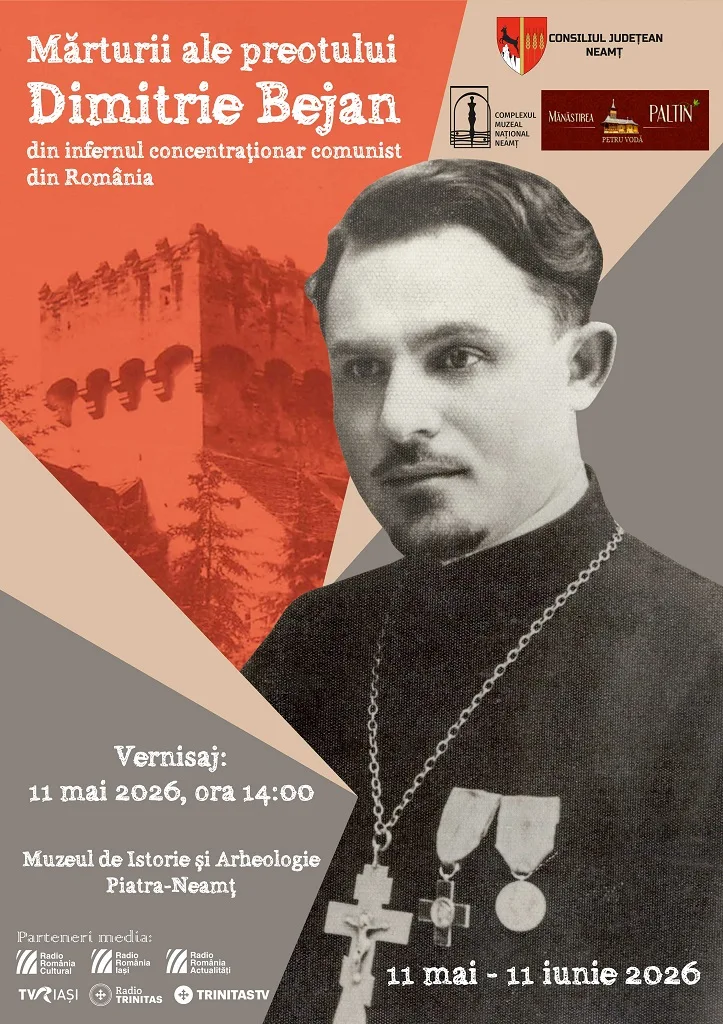
Commemorating the National Day of Martyrs of Romania’s Communist Prisons – Museum of History and Archaeology in Piatra Neamț
On 11 May 2026, at 14:00, Neamț National Museum Complex is organising a temporary exhibition at the Museum of History and Archaeology in Piatra Neamț to commemorate the National Day of Martyrs of Romania’s Communist Prisons, in accordance with Law number 127/2017, published in Monitorul Oficial on 31 May 2017.
The guests will be Mrs Cornelia Anichitei, niece of Father Dimitrie Bejan, and Father Aurel Florin Țuscanu, PhD, university lecturer, who will give a presentation entitled “Părintele Ioan Păvăluță, un martir al temnițelor comuniste”.
This exhibition project draws on research into documents held in the archives of Consiliul Național pentru Studierea Arhivelor Securității Statului and Arhivele Militare Naționale Române, aiming to honour the multifaceted character of Father Dimitrie Bejan, a confessor of the faith and one of the prominent opponents of the communist regime in București.
Father Dimitrie Bejan was mobilised to the front as a military chaplain with the rank of captain in the 6th Rifle Regiment, 14th Infantry Division, taking part in the campaign to liberate Basarabia and Bucovina from 22 June 1941. He was wounded twice at Vadul Nistrului, later taking part in military operations in the Odesa, Crimeea and Caucaz regions before being taken prisoner during the encirclement at Stalingrad on 20 December 1942. He was sentenced to death in Moscova in 1948 for writing and circulating a manuscript in the camp about the history of the Romanian provinces of Basarabia and Bucovina and their belonging to their motherland, România. According to his testimony, he was released from captivity in 1948, on 23 December 1948, at Focșani railway station, where he was taken into custody by the Romanian military authorities and interned in the Russian prisoner screening camp in the town. With a political dossier fabricated in the Soviet Union over his statements about the Romanian provinces of Basarabia and Bucovina, he was arrested in București on 14 April 1949 and, under sentence number 77 of 1950, sentenced to eight years of correctional imprisonment, to be served from the date of his detention. After 16 years of harsh imprisonment in Romania’s communist prison camp system, he was released from Aiud Prison on 31 July 1964, under Decree-Law number 311/1964. He remained under constant surveillance by the Romanian Securitate until 22 December 1989, when Nicolae Ceaușescu’s communist regime fell. He made no compromises with the oppressive system despite the treatment intended to exterminate him in Romania’s communist prisons, where he endured cold, hunger and a lack of medical care, as well as witnessing systematic beatings in maximum-security prisons across the country.
On this occasion, we would like to thank our partners at Paltin Petru-Vodă Monastery, led by the Very Reverend Stavrophore Nun Iustina Bujor, for helping to organise this event by lending objects from the monastery’s collection for display, bearing witness to the communist prison camp period in Romania, 1948-1964, and Mrs Cornelia Anichitei for making documents and objects from Father Dimitrie Bejan’s collection available for the exhibition.
More on the same topic

Neamț County, an Ambassador for Local Traditions and Values in Brussels
Neamț County showcased its values, traditions and development potential on the European stage during European Week of Regions and Cities, held in Brussels from 12 to 14 October.

Solo painting exhibition – Florin Mareș
Starting Saturday, 10 October 2026, the Art Museum in Roman opens a new solo exhibition by the visual artist Florin Mareș of Roman.

Book launch: “Regina Maria a României. Din viață în eternitate” by historian Narcis Dorin Ion
Neamț National Museum Complex invites audiences in Neamț to the launch of “Regina Maria a României.