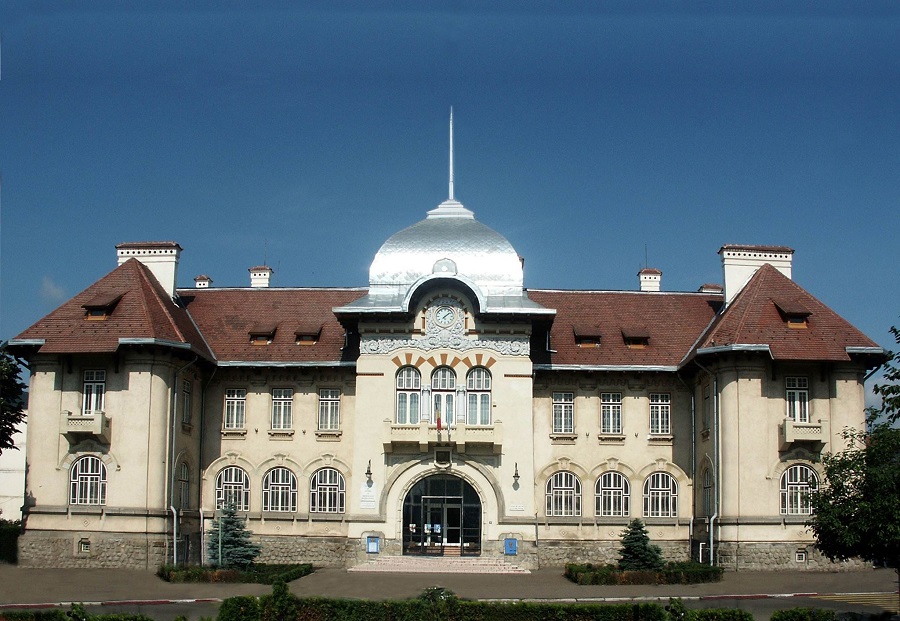
NEAMȚ COUNTY MUSEUM COMPLEX – round-table discussion on Wednesday, 5 April 2017
PRESS RELEASE
Leading specialists in the history of communism, historians Ana Maria Cătănuș and Igor Cașu, in Piatra Neamț
On Wednesday, 5 April 2017, the Museum of History and Archaeology Piatra Neamț will host a round-table discussion on the theme “A trăi în adevăr”. 40 de ani de la primele gesturi de disidență în România comunistă (1977). The year 1977 holds a particularly important place in the political history of Romania’s communist regime, which faced acts of dissent “on a disturbingly large scale” for the first time. Within the Party-State regime, which held a monopoly over information, thought and expression, anyone expressing “different opinions was considered a dissident and put their very existence at risk”. The history of dissent began in 1956, after the 20th Congress of the Communist Party of the Soviet Union, which ushered in an apparent “period of thaw”, with dissent emerging primarily in literature and history. The first act of dissent in Romania also came from a writer, Paul Goma, who in February 1977, impressed by the solidarity of the Czech intellectuals who had signed Charter 77, declared his support for this movement, which described itself as “a free, informal and open association of people with different opinions, beliefs and professions, united by the desire to campaign individually and collectively for respect for human rights and individual freedoms”. Romanians, Paul Goma said, were living under Romanian occupation, “ultimately more painful and more effective than foreign occupation”. The writer’s action was not an isolated one, as he succeeded in attracting several other signatories. The authorities responded by discouraging protesters through permission to emigrate, but also through pressure, demotion, subjecting “hostile elements” to criticism by their work collectives or assigning them to “useful work”. There were also cases of violent repression, such as that of the worker Vasile Paraschiv, who was abducted by Securitate, tortured and confined to psychiatric institutions.
This event, organised by Neamț County Museum Complex with the support of the institution’s management, represented by its director, Dr Iulian Ghercă, will also recall other important figures in the Romanian dissident movement: Father Gheorghe Calciu Dumitreasa, historian Vlad Georgescu, mathematician Mihai Botez and Doina Cornea.
We believe that these people, “who learnt to think for themselves rather than relying on a predetermined framework”, deserve the attention of the public in Neamț. Joining us will be students from Colegiul Național “Petru Rareș”, coordinated by teacher Dr Dorina Luminița Drexler, and from Colegiul Național “Calistrat Hogaș”, guided by teacher Dr Daniela Mătăsaru-Ionescu.
Our institution's guests will be historians Ana Maria Cătănuș and Igor Cașu, nationally and internationally recognised for their research into the history of communism. Ana Maria Cătănuș holds a doctorate in history from the “Nicolae Iorga” Institute of History, Academia Română (February 2012). Her doctoral thesis, Forms of Dissent in the Soviet and Eastern European Regions in the 1970s and 1980s. The Romanian Case, received the “Nicolae Bălcescu” award from Academia Română in December last year. She is currently a researcher at the National Institute for the Study of Totalitarianism, Academia Română; an editor of the journal “Arhivele Totalitarismului”, published by I.N.S.T.; a coordinating member of the “Florin Constantiniu” Centre for Russian and Soviet Studies at the National Institute for the Study of Totalitarianism, Academia Română; and the Romanian coordinator of the bilateral research programme on Dissent in Romania and the Soviet Union, part of the institutional partnership between the National Institute for the Study of Totalitarianism and the Institute of Balkan Studies of the Russian Academy of Sciences. Igor Cașu graduated from the Faculty of History at Alexandru Ioan Cuza University in Iași in 1995 and received a doctorate in history from the same institution (2000), with a thesis on “National Policy” in Soviet Moldova, 1944-1989. He was a Fulbright scholar (August – December 2000), an expert on the Commission for the Analysis of the Communist Dictatorship in Romania (2006) and vice-chair of the Commission for the Study and Assessment of the Totalitarian Communist Regime in the Republic of Moldova (2010). He was a reporter for Radio Europa Liberă, contributing to the Living History programme (2010-2011). He is currently a professor and director of the Centre for the Study of Totalitarianism within the Faculty of History and Philosophy at the State University of Moldova.
Dr Mihaela-Cristina Verzea
More on the same topic

Neamț County, an Ambassador for Local Traditions and Values in Brussels
Neamț County showcased its values, traditions and development potential on the European stage during European Week of Regions and Cities, held in Brussels from 12 to 14 October.

Solo painting exhibition – Florin Mareș
Starting Saturday, 10 October 2026, the Art Museum in Roman opens a new solo exhibition by the visual artist Florin Mareș of Roman.

Book launch: “Regina Maria a României. Din viață în eternitate” by historian Narcis Dorin Ion
Neamț National Museum Complex invites audiences in Neamț to the launch of “Regina Maria a României.