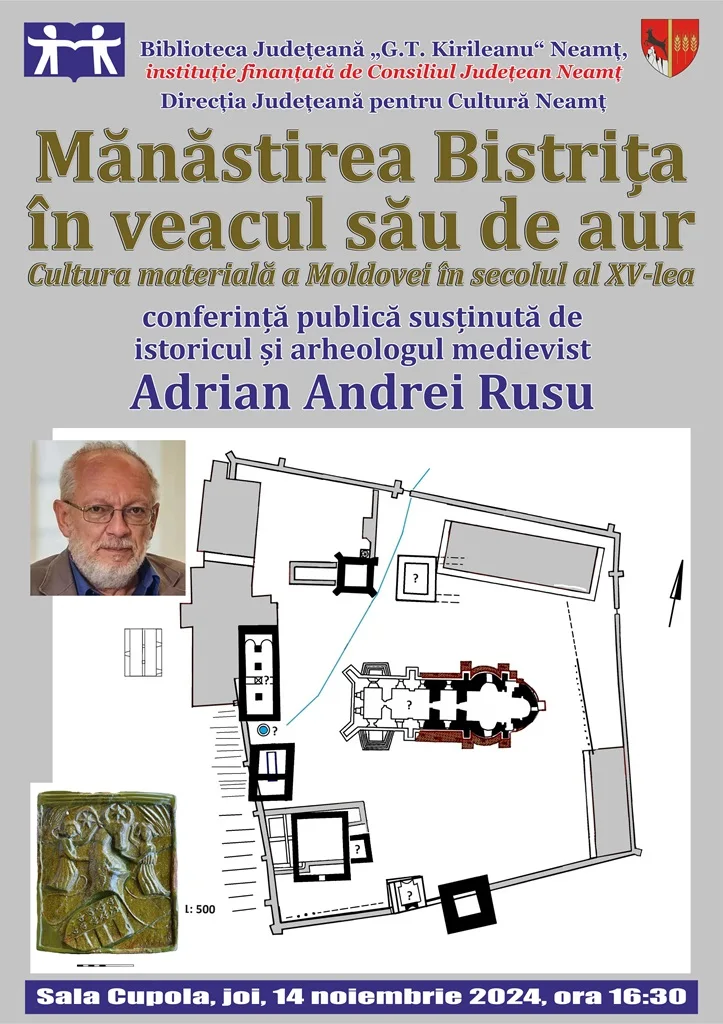
Public conference on the golden age of the Bistrița Monastery, at the County Library
The G.T. Kirileanu County Library Neamț, in collaboration with the Neamț County Directorate for Culture, is hosting the public conference “Mănăstirea Bistrița în veacul său de aur. Cultura materială a Moldovei în secolul al XV-lea”, presented by medieval historian and archaeologist Adrian Andrei Rusu, on Thursday, 14 November 2024, at 16:30 in the Cupola Hall. “Alexandru cel Bun built the church dedicated to the Mother of God, together with what was very probably a tower, too often regarded as a bell tower, an entire group of ‘princely houses’ that were true palaces by the standards of the time, and protective structures for the complex that were not perimeter walls. It possessed remarkable adornments that would be difficult to find elsewhere (distinctive frescoes imitating ancient mosaics, glazed floors with curved cut-outs, gilded windowpanes with no later surviving counterparts). Before discussing its own ceramic production, it should be noted that this site had the highest proportion of imports recorded to date by archaeology in Moldavia of that period. The presence of high-quality imported ceramics and, above all, glass demonstrates that these were primarily possessions of the ruler’s ‘houses’. The same category of vitrified products revealed a flow of imports from Italy, previously unattested for the first half of the 15th century, and convincingly established that local achievements did not stem from a single source of influence. Instead, they demonstrated a remarkable convergence of influences on Moldavia. They reinforced the evidence of the stove tiles, which could only have come from the nearest western regions.
But the architecture suggests Serbian elements, and the pottery, complex syntheses from the northern Black Sea region. From these possessions, pieces were selected for practical use or as models and became part of the monastery’s holdings. The century’s picture was completed by what Ștefan cel Mare brought to Bistrița, probably only after 1476: a new church (still very poorly understood), a bell tower with a chapel, an abbot’s residence, and other ambitious buildings that remained unfinished. The great era of semi-luxury pottery ended, and stove tiles entered a different phase of their history, which until recently had not been divided at the middle of the century. A very schematic presentation… The new findings from archaeology are truly overwhelming. They change our understanding of the first ruler’s reign and round out that of the next,” explains Adrian Andrei Rusu.
Adrian Andrei Rusu
Adrian Andrei Rusu (b. 1951) is a historian and medieval archaeologist. His historical scholarship comprises more than 20 published volumes and around 160 published studies and articles.
Although born and educated in Transylvania, in recent years he created the collection and display of stone monuments at Putna Monastery and produced a substantial volume dedicated to material culture during the reign of Ștefan cel Mare. Between 2017 and 2024, he supervised archaeological research at Bistrița Monastery. The resulting material, now being finalised, will form the basis of two substantial volumes proposed for publication in 2025.
More on the same topic
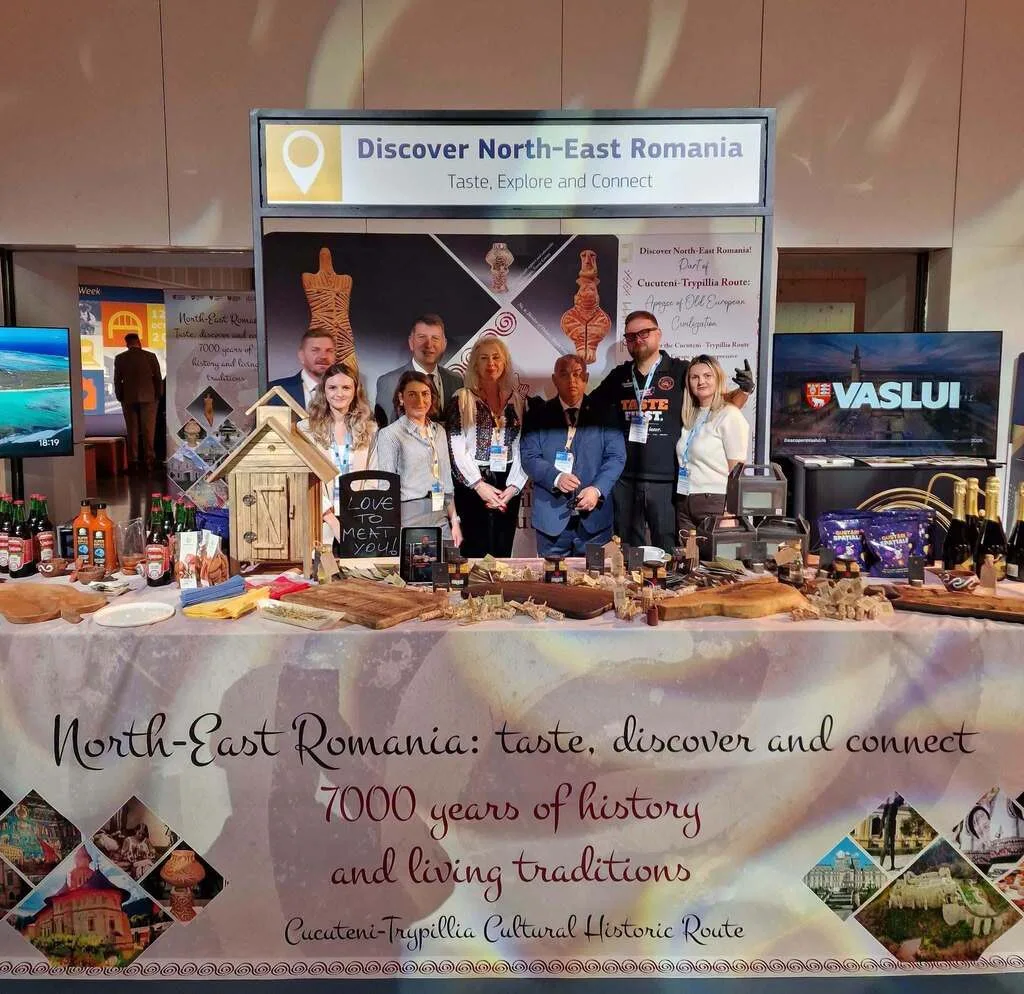
Neamț County, an Ambassador for Local Traditions and Values in Brussels
Neamț County showcased its values, traditions and development potential on the European stage during European Week of Regions and Cities, held in Brussels from 12 to 14 October.
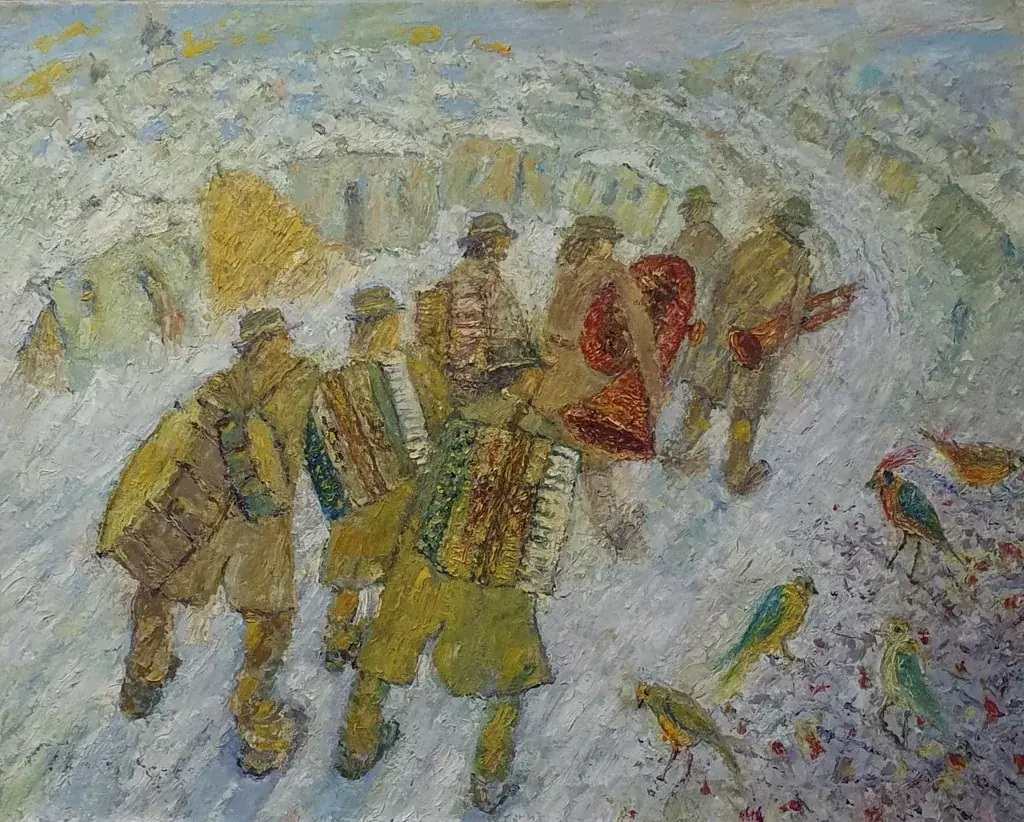
Solo painting exhibition – Florin Mareș
Starting Saturday, 10 October 2026, the Art Museum in Roman opens a new solo exhibition by the visual artist Florin Mareș of Roman.
Book launch: “Regina Maria a României. Din viață în eternitate” by historian Narcis Dorin Ion
Neamț National Museum Complex invites audiences in Neamț to the launch of “Regina Maria a României.