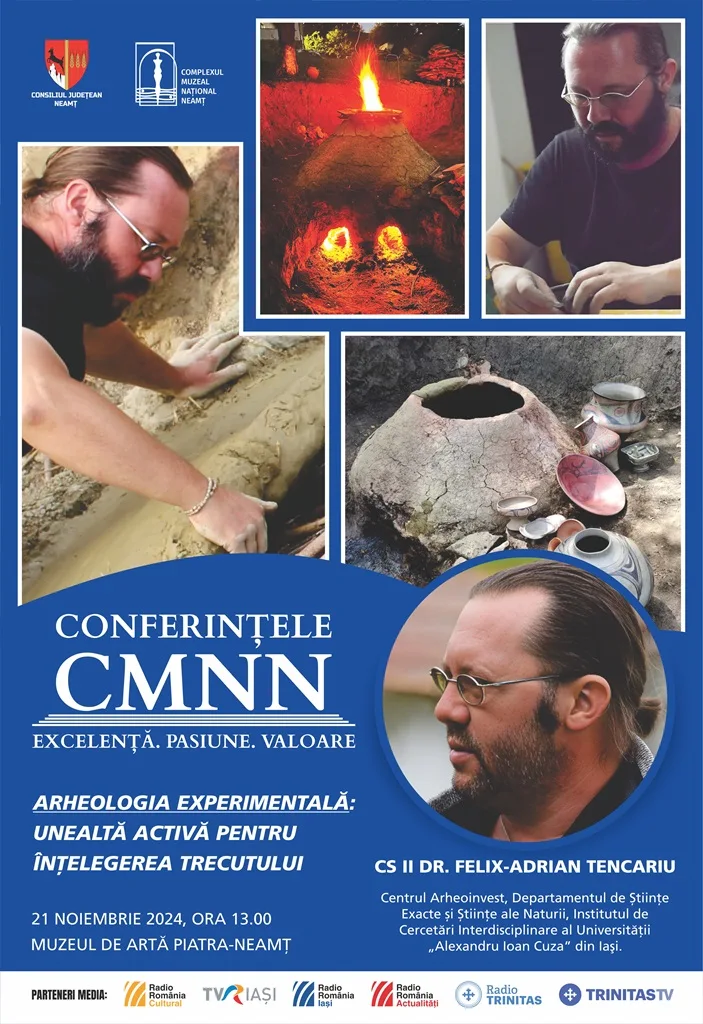
Experimental archaeology: an active tool for understanding the past (21 November, at 13:00) at the Piatra Neamț Museum of Art
Experimental archaeology is a scientific method of archaeological research that seeks to reproduce past techniques documented by archaeology or presumed to have existed.
Experiments provide information unavailable through traditional methods, allowing archaeologists to interpret situations that have no parallels in human behaviour documented by written or ethnographic sources. Experimental archaeology helps make archaeological discoveries and knowledge more accessible and easier to understand. Through simulations, demonstrations and public experiments, the wider public can gain a better understanding of the past and the significance of archaeological discoveries.
Dr Felix-Adrian Tencariu is a Grade II research scientist at the Institute for Interdisciplinary Research – Department of Exact Sciences and Natural Sciences, Arheoinvest Centre at “Alexandru Ioan Cuza” University in Iași. As an archaeologist, he has led or been part of research teams on numerous excavations at prehistoric sites, primarily studying cultural expressions of the Precucuteni-Cucuteni-Tripolie civilisation. The most significant archaeological sites where he has uncovered remains of the Neolithic and Eneolithic world are Cucuteni-Cetățuie, Ruginoasa-Dealul Ruginii, Isaiia-Balta Popii and Târgu Frumos-Baza Pătule (Iași County), Poduri-Dealul Ghindaru, Fulgeriș-La trei cireși (Bacău County). He served on the scientific organising committee for the first three Arheoinvest congresses (2011, 2012, 2013), as well as on the organising committee for the First International Congress on the Anthropology of Salt (2015).
He has led or participated in numerous research projects on the ethnoarchaeology of salt, interdisciplinary research using non-invasive methods and experimental archaeology. Throughout his career, he has participated in or coordinated experimental archaeology projects involving the reconstruction and burning of Eneolithic dwellings, the production and use of briquetage vessels to recrystallise salt from brine, and the making of pottery and firing installations. His doctoral thesis explored pottery-firing installations used by prehistoric and protohistoric civilisations in what is now Romania, and was published in 2015 by “Alexandru Ioan Cuza” University Press.
The latest publication edited by Felix-Adrian Tencariu, Despre artefacte și oameni: arheologia experimentală și înțelegerea trecutului, published in 2024, presents the paradigms and history of experimental archaeology and some of the most revealing experiments in which he has participated.
The event will take place on Thursday, 21 November, at Piatra Neamț Art Museum, starting at 13:00.
More on the same topic

Neamț County, an Ambassador for Local Traditions and Values in Brussels
Neamț County showcased its values, traditions and development potential on the European stage during European Week of Regions and Cities, held in Brussels from 12 to 14 October.

Solo painting exhibition – Florin Mareș
Starting Saturday, 10 October 2026, the Art Museum in Roman opens a new solo exhibition by the visual artist Florin Mareș of Roman.

Book launch: “Regina Maria a României. Din viață în eternitate” by historian Narcis Dorin Ion
Neamț National Museum Complex invites audiences in Neamț to the launch of “Regina Maria a României.