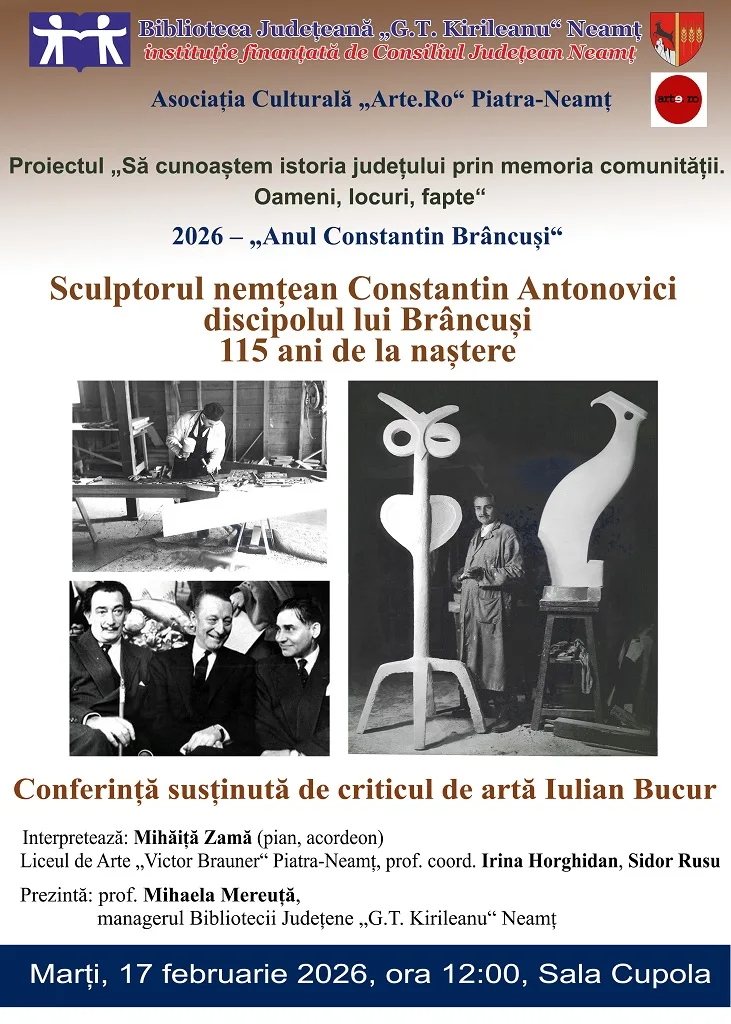
Constantin Antonovici, disciple of Brâncuși, commemorated at the County Library
The G.T. Kirileanu County Library Neamț, in partnership with the Cultural Association “Arte.Ro” Piatra Neamț, is organising the event “The sculptor from Neamț Constantin Antonovici, disciple of Brâncuși, on the 115th anniversary of his birth”, on Tuesday, 17 February 2026, starting at 12:00, in the Cupola Hall.
The conference, part of the series of events dedicated to the Year of Constantin Brâncuși, will be presented by art critic Iulian Bucur, coordinator of the Ethnography Section of the “Iulian Antonescu” Museum Complex, Bacău.
Mihăiță Zamă, a student in the tenth grade at the Victor Brauner Art High School Piatra Neamț (coordinating teachers: Irina Horghidan and Sidor Rusu), will perform two of his own compositions on piano and a major work of classical music on accordion.
Constantin Antonovici was the only artist to receive a written letter of recommendation from Constantin Brâncuși, issued on 9 May 1951 before Antonovici emigrated to Canada: “M. Antonovici Constantin a beaucoup de talent pour la sculpture et travaille avec acharnement” (“Mr Antonovici Constantin has a great talent for sculpture and works diligently”).
With works in all the great museums of the world, Antonovici is regarded as Brâncuși’s most faithful successor. The owl is the favourite theme of his works, through which he sought to carry Brâncuși’s idea of flight towards new horizons.
Even though famous artists such as Isamu Noguchi, Henry Moore, Jacques Lipchitz, Wilhelm Lehmbruck, Alexander Archipenko, Jean Arp and Amedeo Modigliani collaborated with Brâncuși, no one worked more closely with the man hailed as the father of modern sculpture than Antonovici. “Brâncuși was my initiator in art. From him I learned respect for the material and the utmost exactness. He accepted me as a pupil because I knew the craft. That is the secret of the years spent beside my great Master. Brâncuși did not act like an ordinary teacher. He would place the piece in your hand and tell you: ‘Do it!’”, said Constantin Antonovici in 1968, in a conversation with Olga Bușneag for the magazine Astra.
The National Museum of Bucovina in Suceava holds the only collection of Constantin Antonovici’s sculpture in the country, thanks to donations made by the sculptor’s testamentary legatee, Ștefan Benedict of New York.
The G.T. Kirileanu County Library has in its collections a copy of the book “Sculptor of owls” signed by Constantin Antonovici.
The event is part of the project “Let us learn about the county’s history through community memory. People, places, deeds” and will be presented by Prof Mihaela Mereuță, manager of the County Library.
Constantin Antonovici
He was born on 18 February 1911, in Ștefan cel Mare commune, in Neamț County.
He graduated in 1939 from the Academy of Fine Arts in Iași, where his teachers were Ion Mateescu, the half-brother of George Topîrceanu, and the painter Nicolae Tonitza. “At that time, more than 90 per cent of the students, because of poverty, gave up and took up another trade. In Iași we entered the first year with 50 students and only 4 graduated,” Antonovici recalled.
In 1940 he went to Zagreb, where he worked for six months in the workshop of the famous Croatian sculptor Ivan Meštović, whom he had met in Bucharest when Meštović was erecting the statue of King Ferdinand. Antonovici recounted that Meštović’s workshops “were a real factory, employing 800 workers, including 30 sculptors from all countries, even Japanese. The locomotive would come right into the heart of the workshops to fetch the statues. I was flabbergasted; I had never seen anything like that, not even in my dreams.”
He was admitted in 1942 to the Akademie der bildenden Künste in Vienna, where he specialised with the German artist Fritz Behn, who appointed him his assistant in the sculpture department. And here, as in Iași, of the 50 students admitted in the first year only 16 progressed to the second year and only 5 graduated.
In 1946 he won the competition for a wooden statue two metres high of Saint Joseph with the Child, a work placed in the Jesuit cathedral at Am Hof Square in Vienna.
He arrived in Paris in 1947 and, until 1951, had the privilege of working under Constantin Brâncuși's guidance at the famous studio at 11 Impasse Ronsin, in the XV arrondissement. “My journey to Brâncuși took seven years, but after many painful ordeals, I arrived. I found him. (…) What impressed Brâncuși most was my honest admission that I had been searching for him for 7 years,” recalled the sculptor from Neamț.
After two years spent in Montreal, Canada, Constantin Antonovici settled permanently in New York in 1953. “I was very lucky at the start in New York. The Anglican Church organised a competition for the erection of a statue of Bishop William Manning. I won it. I executed the statue in Carrara marble, from a four-tonne block. Following the competition I was also offered a free studio in the north wing of the Anglican cathedral ‘St John the Divine’,” said Constantin Antonovici.
The bust representing former US President Dwight Eisenhower is part of the White House collection. For this work he received a letter of thanks signed by President Richard Nixon.
Among the other classical busts he sculpted are those of Voltaire, Ludwig van Beethoven, Charles de Gaulle, Ciprian Porumbescu, Brâncuși, Homer, Moses, Mephistopheles, Dali and Paulette.
His work has been reviewed and appreciated by numerous art critics, including Alain Bosquet, Georges Boudaille, Michelle Seurier, Fritz Spitzer, Donelson F. Hoops, Ralph Fabri and many others.
Constantin Antonovici died on 5 February 2002, a few days before his 91st birthday, in a nursing home in New York.
References
“Of all the birds, the owl has a head shape very close to that of a human. Moreover, it represents wisdom and stood alongside the skull on humanists’ tables. It has a highly expressive appearance suitable for artistic interpretation. Superstition has led us to see the owl as a strange creature that brings bad omens – but it is a gentle, shy bird that does no harm to man” – Constantin Antonovici.
“Constantin Antonovici offers a rare example of sobriety and perfection, through an inner strength akin to music. He is one of the most gifted sculptors of his time. He creates within a line of purity and harmony in the remarkable zone between the abstract and the concrete. Antonovici, in the context of surrealism and cubism, can be compared with Jean Arp and Alberto Giacometti. Antonovici’s totemic figure was the owl,” poet and art critic Alain Bousquet.
“The search for simplicity and the essential leads him to a figurative style laden with folk symbolism, close, in feeling, to medieval sculpture. His style crystallises in the Owl series. The owl, a bird endowed with beneficial and jovial qualities, takes on numerous symbolic meanings, eventually becoming a kind of ‘logo’ of the artist’s originality” – Dictionary of Sculptors in Romania, 19th–20th Centuries, vol. I, A-G (editor Ioana Vlasiu), Romanian Academy Publishing House, Bucharest, 2011.
More on the same topic

Neamț County, an Ambassador for Local Traditions and Values in Brussels
Neamț County showcased its values, traditions and development potential on the European stage during European Week of Regions and Cities, held in Brussels from 12 to 14 October.

Solo painting exhibition – Florin Mareș
Starting Saturday, 10 October 2026, the Art Museum in Roman opens a new solo exhibition by the visual artist Florin Mareș of Roman.

Book launch: “Regina Maria a României. Din viață în eternitate” by historian Narcis Dorin Ion
Neamț National Museum Complex invites audiences in Neamț to the launch of “Regina Maria a României.