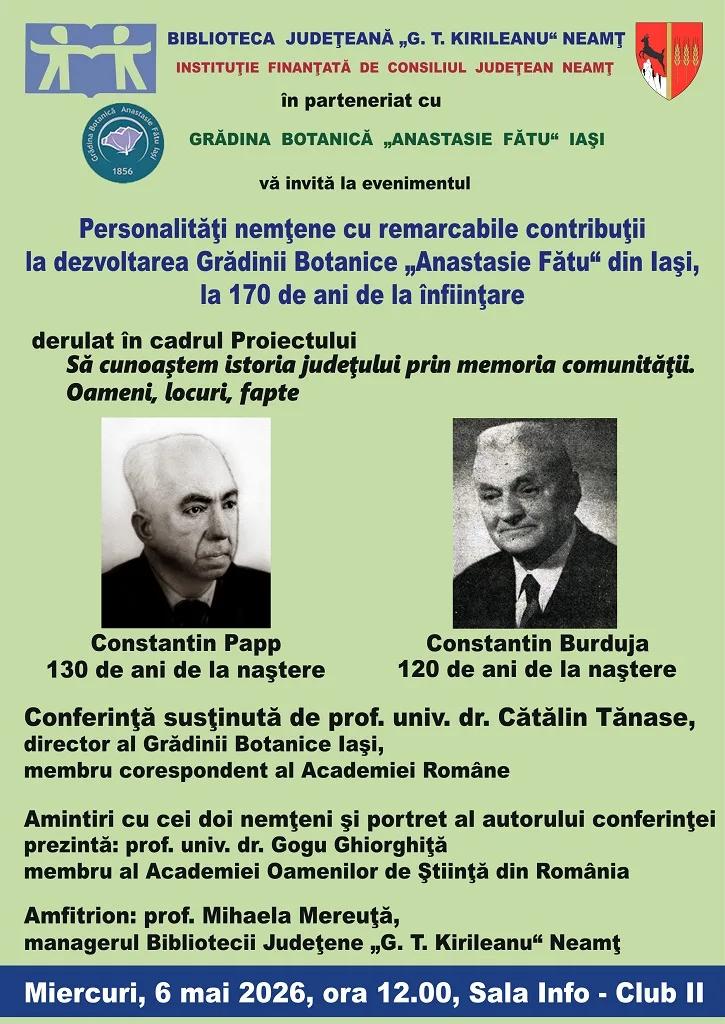
Remembering the figures who helped develop the Botanical Garden in Iași, at G. T. Kirileanu County Library Neamț
G.T. Kirileanu County Library Neamț, in partnership with “Alexandru Ioan Cuza” University in Iași and “Anastasie Fătu”
Botanical Garden in Iași, is organising the event “Figures from Neamț Who Made Outstanding Contributions to the Development of ‘Anastasie Fătu’ Botanical Garden in Iași, 170 Years since Its Foundation” on Wednesday, 6 May 2026, at 12.00, in the Info-Club II Hall. Part of the project “Discovering the County’s History through Community Memory. People, Places, Deeds”, this commemorative event, hosted by Professor Mihaela Mereuță, Manager of the County Library, aims to bring renewed attention to two leading members of Romania’s scientific community, both from Neamț County: Constantin Papp, 130 years since his birth, and Constantin Burduja, 120 years since his birth.
The event will be honoured by the presence of Professor Cătălin Tănase, PhD, director of Anastasie Fătu Botanical Garden in Iași and a corresponding member of Academia Română, who will give a lecture devoted to the two figures. Professor Gogu Ghiorghiță, PhD, a member of Academia Oamenilor de Știință din România, will share previously untold recollections of the figures being honoured, as well as a portrait of Professor Cătălin Tănase, PhD.
Cătălin Tănase
Born on 19 February 1962 in Epureni commune, Vaslui County, he studied at the Faculty of Biology at Alexandru Ioan Cuza University in Iași during 1981-1985 and 1990-1992, graduating top of his year.
In 1998, he defended his doctoral thesis entitled “Systematic and Ecological Research on Micromycetes in the Rarău Massif”, under the supervision of Professor Mihai Mititiuc.
He has taught and conducted research as an assistant lecturer (1992), lecturer (1996), associate professor (2002) and professor (2008) at the Faculty of Biology at Alexandru Ioan Cuza University in Iași.
He teaches courses in Mycology, Plant Pathology, Cryptogam Systematics, Microbial Bioconversion and Biodiversity Conservation.
He was elected General Chancellor for 2008-2012 and subsequently served as Vice-Rector of Alexandru Ioan Cuza University in Iași between 2012 and 2020.
He has been director of Anastasie Fătu Botanical Garden in Iași since 2007.
He was elected a corresponding member of Academia Română in 2018.
Constantin Papp (1 January 1896 – 17 August 1972)
Biologist, university professor, director of the Botanical Garden (1937-1958) and one of Romania’s greatest bryologists.
He attended primary school and “Petru Rareș” High School in Piatra Neamț, graduating in 1914. A graduate of the Agricultural Department of the Faculty of Sciences in Iași (1922), with degrees from the Faculty of Pharmacy in Iași (1922) and the Natural Sciences Department of the Faculty of Sciences at the University of București, followed by its counterpart in Iași (1922), C. Papp defended his doctoral thesis in 1926, entitled “Contributions to the Study of Bryophytes in Moldavia”, under the supervision of Professor Al. Popovici.
After a period of specialist training in Germany at the Botanical Institute in Berlin – Dahlem, he published the highly acclaimed “Die Monographie der Gattung Melica L” in 1928.
He taught botany from 1935 until his retirement in 1964, when he was awarded the title of professor emeritus.
A member of Academia de Științe din România, C. Papp wrote over 130 scientific works on floristics, taxonomy, chorology and pharmacology, most of them in bryology, a field to which he contributed the renowned monograph “Briofitele din România” (1970).
He also wrote the monograph on the genus Melica in the major work “Flora României” and assembled an extensive collection of bryophytes, held in the herbarium of the Faculty of Biology in Iași.
Constantin Burduja (24 February 1906 – 26 July 1983)
Biologist, university professor, director of the Botanical Garden (1958-1962) and founder of the school of plant morphology and anatomy at the University of Iași.
High School in Piatra Neamț, graduating in 1931. With a degree from the Natural Sciences Department of the Faculty of Sciences at the University of Iași (1935), C. Burduja defended his doctoral thesis, “A Contribution to the Study of the Flora and Vegetation of the Roznov-Neamț Depression”, in 1949, under the supervision of his predecessor C. Papp.
He taught geobotany, phytogeography and plant morphology until his retirement in 1971, continuing to serve as a consultant professor and doctoral supervisor.
An unrivalled specialist in floristics and ecology, the author of over 100 scientific works on the vegetation of Moldavia and Dobrogea, and a pioneer of comparative, ecological and experimental plant anatomy studies, C. Burduja is cited in various surveys and treatises published abroad.
Alongside the renowned botanist E. Țopa, he is considered one of the founders of the new botanical garden on Dealul Copoului.
Anastasie Fătu Botanical Garden, Iași
The Botanical Garden, established in 1856, bears the name of its founder, the physician and naturalist Anastasie Fătu. It is Romania’s first university botanical garden and also the largest in the country, distinguished by its wealth of plant species and the special conservation measures it employs.
Work to establish the botanical garden on Dealul Copou began in 1963 and has continued and expanded ever since. At its current site, it covers 87.95 hectares and is organised into 10 sections: Systematics, Phytogeography, the Greenhouse Complex, the Flora and Vegetation of Romania, the Forest-Steppe of Moldavia, Biology, Useful Plants, the Arboretum, Ornamental Plants and the Rose Garden.
The Botanical Garden’s collections currently comprise 7,780 plant taxa from different biogeographical regions, grown under protection and outdoors. The natural setting provides excellent conditions for conserving the gene pool of native and exotic plants, as well as for education, research and recreation.
The Botanical Garden in Iași owes its unique character to the outstanding heritage value of its scientific collections and its section for people with visual impairments, where plant species rich in essential oils have explanatory labels in Braille.
There are also two silver lime trees grown from suckers collected from Teiul lui Eminescu and planted in 1981 in the Biology Section.
From February to August, collections of azaleas, camellias, orchids, crotons, cacti, bonsai, tulips, irises, daffodils, roses and dahlias are displayed. From September to November, chrysanthemums, fruit, seeds, ornamental cabbages, beetroot, peppers and pumpkins have been exhibited under the title “Flori de toamnă” since 1976, attracting over 330,000 visitors from Romania and abroad each year.
The Botanical Garden collaborates with over 450 institutions in Romania and abroad. It has been a founding member of Asociația Grădinilor Botanice din România since 2000, and a member of International Plant Exchange Network (2009) and Botanical Gardens of Coimbra Group Universities (2011).
The Botanical Garden includes a herbarium (with over 47,812 sheets), a library (16,140 books and 6,950 journals and periodical volumes) and a museum with fruit and seed specimens and samples of various native or exotic woods.
Among the Botanical Garden’s publications, Journal of Plant Development is published in Open Access format and has been assigned the DOI (Digital Object Identifier) prefix 10.47743 since volume 25/2018. The Botanical Garden’s journal publishes one volume a year, online and in print (ISSN-L 2065-3158). The journal is available in full text in international databases and is also included in other electronic indexing services.
Source: Alexandru Ioan Cuza University, Iași
More on the same topic

Neamț County, an Ambassador for Local Traditions and Values in Brussels
Neamț County showcased its values, traditions and development potential on the European stage during European Week of Regions and Cities, held in Brussels from 12 to 14 October.

Solo painting exhibition – Florin Mareș
Starting Saturday, 10 October 2026, the Art Museum in Roman opens a new solo exhibition by the visual artist Florin Mareș of Roman.

Book launch: “Regina Maria a României. Din viață în eternitate” by historian Narcis Dorin Ion
Neamț National Museum Complex invites audiences in Neamț to the launch of “Regina Maria a României.