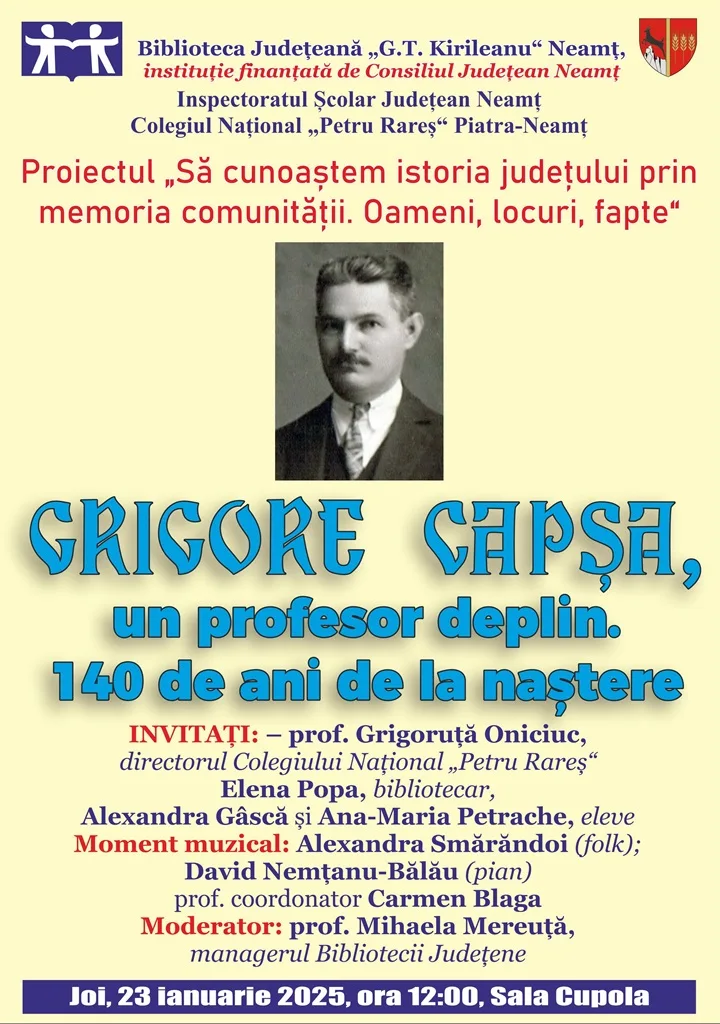
Commemoration “Grigore Capșa – a consummate teacher. 140 years since his birth”, at the County Library
The G.T. Kirileanu County Library Neamț, in partnership with Neamț County School Inspectorate and the National College “Petru Rareș” Piatra-Neamț, organises the commemoration “Grigore Capșa – a consummate teacher. 140 years since his birth”, as part of the Project “Getting to know the county’s history through community memory: People, places, deeds”. The event will take place on Thursday, 23 January 2025, starting at 12:00, in the Cupola Hall.
Mathematics teacher Grigore Capșa was the headmaster of “Petru Rareș” High School in Piatra-Neamț between 1 September 1927 and 31 August 1931. He succeeded headmaster V.A. Trifu, who died on 2 May 1927. He retired in 1945, but continued teaching until the age of 71. Among his students was the late teacher Gheorghe Amaicei, former president of the Teachers’ Association of Neamț.
The guests at this commemoration of the personality and distinguished work of teacher and headmaster Grigore Capșa are teacher Grigoruță Oniciuc, director of the National College “Petru Rareș”, librarian Elena Popa and the pupils Alexandra Gâscă and Ana-Maria Petrache. Musical contributions will be provided by pupils Alexandra Smărăndoi (folk: Dascăl drag, Colo-n vale la izvor) and David Nemțanu-Bălău (piano: Hungarian Sonata by Richard Clayderman, Waltz Op. 64 No. 2 and Waltz Op. 69 No. 2 by Frédéric Chopin), under the coordination of teacher Carmen Blaga. The event will be moderated by teacher Mihaela Mereuță, manager of the County Library.
Grigore Capșa
Grigore Capșa was born on 23 January 1885 in the village of Frunzeni, in Cândești-Neamț commune, into the family of priest Pavel Capșa. He attended “Roman-Vodă” High School in Roman, where his teacher was Calistrat Hogaș, and “Petru-Rareș” High School in Piatra-Neamț, graduating in 1906. At “Petru Rareș”, he was a classmate of army corps general Nicolae Dăscălescu in the science stream.
Later he studied in the Mathematics Department of the Faculty of Sciences at the University of Iași. He obtained a degree in mathematics in October 1910; his teachers included Dimitrie D. Pompeiu, Aurelian Mănescu, Ion Rallet, Constantin Climescu, Neculai Culianu and Victor Costin. He graduated from the Pedagogical Seminar in 1911. He obtained a degree in law in 1914.
He taught at several schools in the country: Târgu-Jiu, Roman, Craiova, Caracal, Piatra-Neamț (“Petru-Rareș” High School and the “Gheorghe Asachi” Boys’ Normal School, serving as director of both).
The words with which he sketched the portrait of Leon Mrejeriu, founder and president of the Teachers’ Association in Neamț (1912-1936), vice-president of the General Teachers’ Association council, president of the Union of Cooperatives in Moldova, deputy and vice-president of the Chamber of Deputies, remain strong and moving: “Leon Mrejeriu could have become rich, but material gain did not tempt him. Although he travelled on foot, the mud did not touch him. In politics, when it came to serving the public good, he did not concern himself with whether he was serving an opponent.”
Order, punctuality, conscientiousness and discipline among pupils were his constant preoccupations. In 1928, the school-leaving exam for the 106 candidates from “Petru Rareș” in the June session ended in a painful failure. Only 34 succeeded, after 50 failed the written tests and 22 the oral exam. Among those who passed the June 1928 baccalaureate were the writer Dumitru Almaș, real name Dumitru Ailincăi, and Aurora, the daughter of teacher Grigore Capșa. Grigore Capșa wrote in the newspaper “Avântul” that “although the result was indeed rather disastrous, it would be unjust not to note the astounding lack of preparation of some candidates! I saw some who did not know the borders of the country, did not know a single county in Bukovina nor even where the Danube enters the country. I saw candidates claiming that the Latins lived in the north of Dacia. I also saw candidates in the science stream, aspiring to be engineers or mathematics teachers, who could not write the equations of a simple straight line, angle bisectors or coordinate axes. All these and many other shortcomings are outrageous. Therefore, candidates presenting themselves in the autumn session should no longer rely on pleading, patronage or other shameful proposals.”
He is the author of “School Overwork” (1939) and the memoir “Memories of a Turbulent Life” (2017).
He had four children, two daughters: Aurora and Ecaterina, and two sons: Tiberiu and Eugen.
He died on 22 October 1971, aged 86.
References
“Among my teachers, Grigore Capșa had the longest teaching career – 46 years – continuing to teach, due to a lack of staff, until the venerable age of 71. (…) In the eight years I had him as a teacher, he never missed or was late for a single lesson, even when he was ill, when his car broke down, or when there were blizzards, thunder and torrential rain, although his home was about four kilometres from the school. If any parent had the temerity to visit him at home and leave his wife, Mrs Zulnia, a tub of cheese, a lamb, a bundle of smoked trout wrapped in fir branches or other treats intended to sweeten relations between teacher and pupil, he would shout in front of the class: So-and-so, tell your father to come and take back his cheese (or lamb, or fish), because it’s going rotten; otherwise I’ll hand him over to the police. (…) In January 1955 I organised the celebration of the 70th anniversary of his birth at the restaurant in the former public garden. Over 30 of his former students, spanning several generations, attended. Taking the floor, he named me among his famous pupils. If he did not do so out of kindness, he surely confused me with my brother, the mathematics teacher. In 1970, at our reunion on the 30th anniversary of graduation, he was still full of energy; he read to us from his notebooks his notes and impressions of the people he had known. Shortly after this we accompanied him to his final resting place” – Alecsandru Iftimie, teacher of Romanian language and literature, author of the volume “Monografia Liceului Petru Rareș (1869-1969)”.
“We highlight the practical management skills of headmaster Gr. Capșa, evident in the valuable improvements he has made. The assembly hall with its new furnishings is a jewel of the school and his creation, as is the cinema installed in it, whose screenings many townspeople have attended. The beautification of the school façade, the flowerbeds in front, the levelling of the grounds and the replacement of the fence with beautiful iron railings – all accomplished within this year alone – speak for themselves of his diligence in managing the school. The strict order and discipline in pupils’ lives, both at school and in society, attest to his care for their education. The teaching and education provided at the school, the pleasing end-of-year results and the harmony among the teachers all demonstrate his excellent teaching methods and his delicate tact as headmaster, parent, colleague and mentor to all (…)” – the newspaper Reformatorul, 1929.
More on the same topic

Neamț County, an Ambassador for Local Traditions and Values in Brussels
Neamț County showcased its values, traditions and development potential on the European stage during European Week of Regions and Cities, held in Brussels from 12 to 14 October.

Solo painting exhibition – Florin Mareș
Starting Saturday, 10 October 2026, the Art Museum in Roman opens a new solo exhibition by the visual artist Florin Mareș of Roman.

Book launch: “Regina Maria a României. Din viață în eternitate” by historian Narcis Dorin Ion
Neamț National Museum Complex invites audiences in Neamț to the launch of “Regina Maria a României.