Remembering priest Gheorghe Verșescu at the County Library
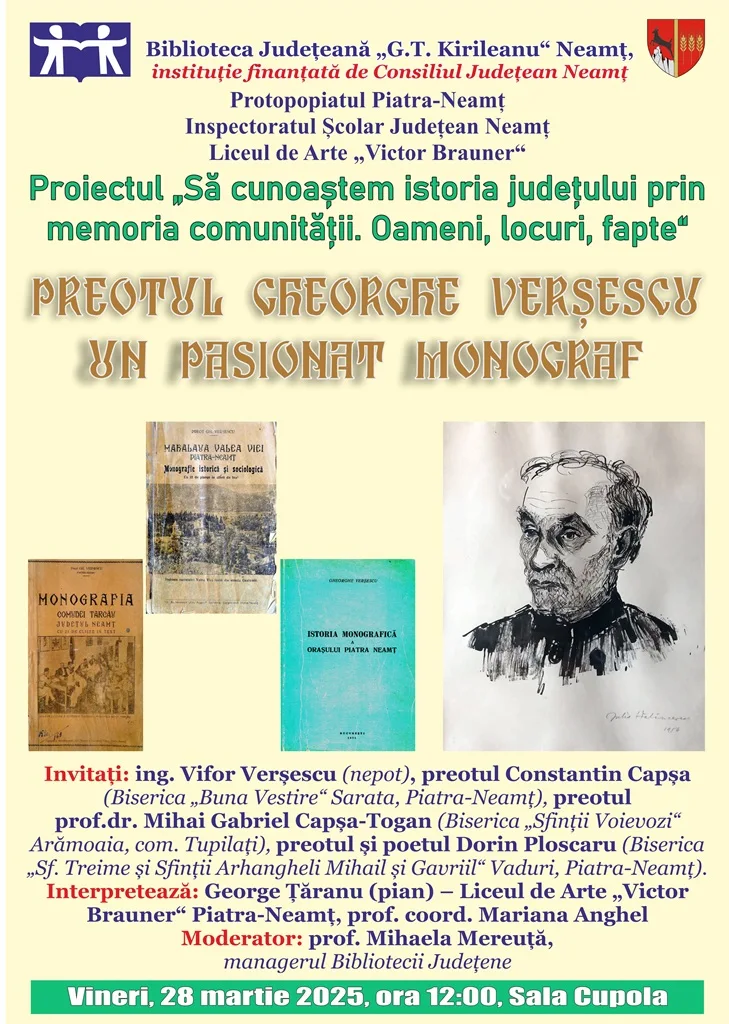
The G.T. Kirileanu County Library in Neamț – in partnership with the Piatra-Neamț Deanery, Neamț County School Inspectorate and the Victor Brauner School of Arts in Piatra-Neamț – is organising a commemorative event, “Priest Gheorghe Verșescu – a passionate monographer”. The event, part of the project “Discovering the county’s history through community memory. People, places, deeds”, will take place on Friday, 28 March 2025, starting at 12:00, in the Cupola Hall.
The guests at this commemorative event are his grandson, engineer Vifor Verșescu, the son of lawyer Ștefan Verșescu; priest Constantin Capșa (the “Annunciation”
Church, Sarata, Piatra-Neamț); priest and professor Dr Mihai Gabriel Capșa-Togan (the “Sfinții Voievozi” Church, Arămoaia, Tupilați commune); and priest and poet Dorin Ploscaru (the “Holy Trinity and the Holy Archangels Michael and Gabriel” Church, Vaduri).
The meeting will include musical pieces performed by pianist George Țăranu, a Year 11 student at the Victor Brauner School of Arts in Piatra-Neamț, under the guidance of Prof Mariana Anghel. The moderator of the event will be Prof Mihaela Mereuță, manager of the County Library.
Priest Gheorghe Verșescu is the author of three important documentary works, produced following the methodology proposed by the sociological school of Dimitrie Gusti and Traian Herseni: “Monografia comunei Tarcău, județul Neamț, cu 21 de clișee în text” (1942), for which he received the “Năsturel-Herescu” honourable mention from the Romanian Academy; “Mahalaua Valea Viei, Piatra-Neamț. Monografie istorică și sociologică, cu 21 de planșe în afară de text” (1943); and “Istoria monografică a orașului Piatra-Neamț” (1971) – praised not only by specialists but also by the general public. “Monografia comunei Tarcău…” was reissued in 2005 by Nona Publishing House. The publication of the volume “Istoria monografică a orașului Piatra-Neamț” in 1971 was made possible by his son Ștefan Verșescu, as a gift for his father's 83rd birthday. Priest Gheorghe Verșescu was also distinguished by his warm heart and erudition; guiding people, caring for their souls and providing religious education were central to his work.
Gheorghe Verșescu
He was born on 17 April 1888, in the village of Todirești, Vascani commune, Suceava County, as the son of priest Ioan and Ecaterina Verșescu, originally from the village of Verșești, Neamț County.
He attended primary school in his native village and in Pașcani, then the Theological Seminary at Roman and Iași. He graduated in theology from the faculty in Bucharest in June 1911, at the top of his class.
He married Domnica, daughter of priest Gavril Danielescu, from the village of Popești, Farcașa commune, Suceava County, on 30 December 1912.
He was ordained a priest on 5 February 1913 and appointed parish priest at Valea Glodului, in Suceava County.
He became parish priest of Tarcău on 1 April 1914, where he served for 13 years, until 15 April 1927, also teaching at the school in Tarcău.
From May 1927, he served for over three decades at the “Sf. Voievozi” Church in Piatra-Neamț, near Eternitatea Cemetery, distinguishing himself through numerous worthy deeds. After painstaking documentation, research and interpretation, his work “Mahalaua Valea Viei, Piatra-Neamț. Monografie istorică și sociologică, cu 21 de planșe în afară de text” (1943) was published by the “Gheorghe Asachi” Printing House.
His articles were published in the journals “Romanian Orthodox Church”, “New Ecclesiastical Review” and “Crucea”, and in the local newspapers “Reformatorul”, “Telegraful” and “Avîntul”.
He knew German and Hebrew, and was skilled in writing and deciphering documents in Church Slavonic.
He was a religion teacher at the boys’ high school “Petru Rareș”, at the girls’ high school (now the National College “Calistrat Hogaș”), the girls’ orphanage, and at Primary School No 4 “Jean Théophile Raux and George Lalu” in Valea Viei (now the Forestry Technical College).
He had two daughters: Iulia (Hălăucescu), a painter, and Elena (Actis), a teacher, and two sons: Mihai (an accountant) and Ștefan (a lawyer). From his son Ștefan he had two grandchildren: Vifor and Sanda.
In 1971, two years before his death, his final work appeared: “Istoria monografică a orașului Piatra-Neamț”, thanks to his son, the lawyer Ștefan Verșescu. Priest Gheorghe Verșescu also left manuscripts of a monographic history of Agapia and Bistrița monasteries, a history of Neamț Citadel, and monographs of Târgu Neamț and Todirești commune, his birthplace; he was also probably preparing a novel entitled “Cornul de fildeș”.
He died aged 85 and was buried in Eternitatea Cemetery on 25 August 1973, with 14 priests officiating, most of whom were nephews of the priest's wife, Domnica.
References
“The past of our people must not be forgotten or abandoned. The virtues of our ancestors should forever shine in our memory and that of our descendants, as a strong encouragement for great and uplifting deeds. (…) Alongside the religious books, this monograph should be on your tables, as a true testimony of the worth of the people of Tarcău in the past and as a pledge of your love for the ancestral land, steeped in the blood of forebears” – Gheorghe Verșescu, about “Monografia comunei Tarcău, județul Neamț, cu 21 de clișee în text”.
“Father Gh. Verșescu’s monograph includes extensive material on Tarcău Parish, the school in the village of Tarcău, Tarcău during the war of 1916-1918, the new settlements, the Albina Cooperative, Tarcău Forest District, Tarcău Hermitage, etc., as well as a sociological monograph of Tarcău commune, presenting numerous statistical figures that clearly reflect the commune’s social conditions in 1940” – Nestor Camariano, about “Monografia comunei Tarcău, județul Neamț, cu 21 de clișee în text”.
“We owe this joy, however, not to an author laden with titles, but to an exceptional priest, ennobled by his service to others, a scholar who devoted his life to building culture and serving as an example in ecclesiastical life, bringing about many achievements that endure over time. A true pioneer, Father Gheorghe Verșescu was and will remain forever alive in the hearts of the descendants of those he wrote about with such fervour, portraying their life, dress, traditions and faith” – Prof. Gheorghe Bunghez, about “Monografia comunei Tarcău, județul Neamț, cu 21 de clișee în text” (reissued).
“People may accuse me of praising the residents of this neighbourhood too much. From these descriptions, it would seem that they are the most accomplished people, that they have attained moral perfection, that they are an ideal people, apart from the noted deviations. My answer is this: a community’s character is determined by the majority, not the minority. The majority gives the community its distinctive qualities. Shortcomings have also been pointed out in the appropriate places. But the sins of some cannot tarnish the qualities of the population of an entire locality” – Gheorghe Verșescu, about “Mahalaua Valea Viei, Piatra-Neamț. Monografie istorică și sociologică, cu 21 de planșe în afară de text”.
“Local readers from the city and its districts will be able to discover much historical information about the troubled and turbulent past of both the settlements and the region. We thank those who appreciate the effort and toil invested over many years, and ask those who find shortcomings to point them out to us or write a new monograph. For the history of a fact or event can be reconstructed in a new light if new documents are discovered. In describing the past, based on the limited information available, our constant concern throughout the writing of this monograph has also been to present contemporary achievements alongside the vestiges found within the settlement of Peatra Neamțului” – Gheorghe Verșescu, about “Istoria monografică a orașului Piatra-Neamț”.
“The monographer uses a sober yet warm style, handling sentences confidently and exercising sound judgement in assessing the documents. He brings a wealth of previously unpublished material, gathered from archives and people’s memories, and supplements his chapters on the interwar period with illuminating reproductions from the press of the time. Without being carried away by local patriotism that leads to exaggeration, he narrates objectively and, above all, to the point, while always drawing parallels between what Piatra-Neamț once was and what it is today” – Alexandru Arbore, about “Istoria monografică a orașului Piatra-Neamț”.
“My father was very modest and never highlighted either his qualities or his truly remarkable achievements, which still retain their value today. Reserved, he kept his worries to himself without telling us what concerned him or what problems he faced. (…) I know he was always busy, always away from home. Very often he went to the city library or the State Archives. There he researched his planned works, but he was also always busy because he had many duties in addition to his usual parish responsibilities, which he never neglected” – the painter Iulia Hălăucescu (daughter).
More on the same topic
Neamț County, an Ambassador for Local Traditions and Values in Brussels
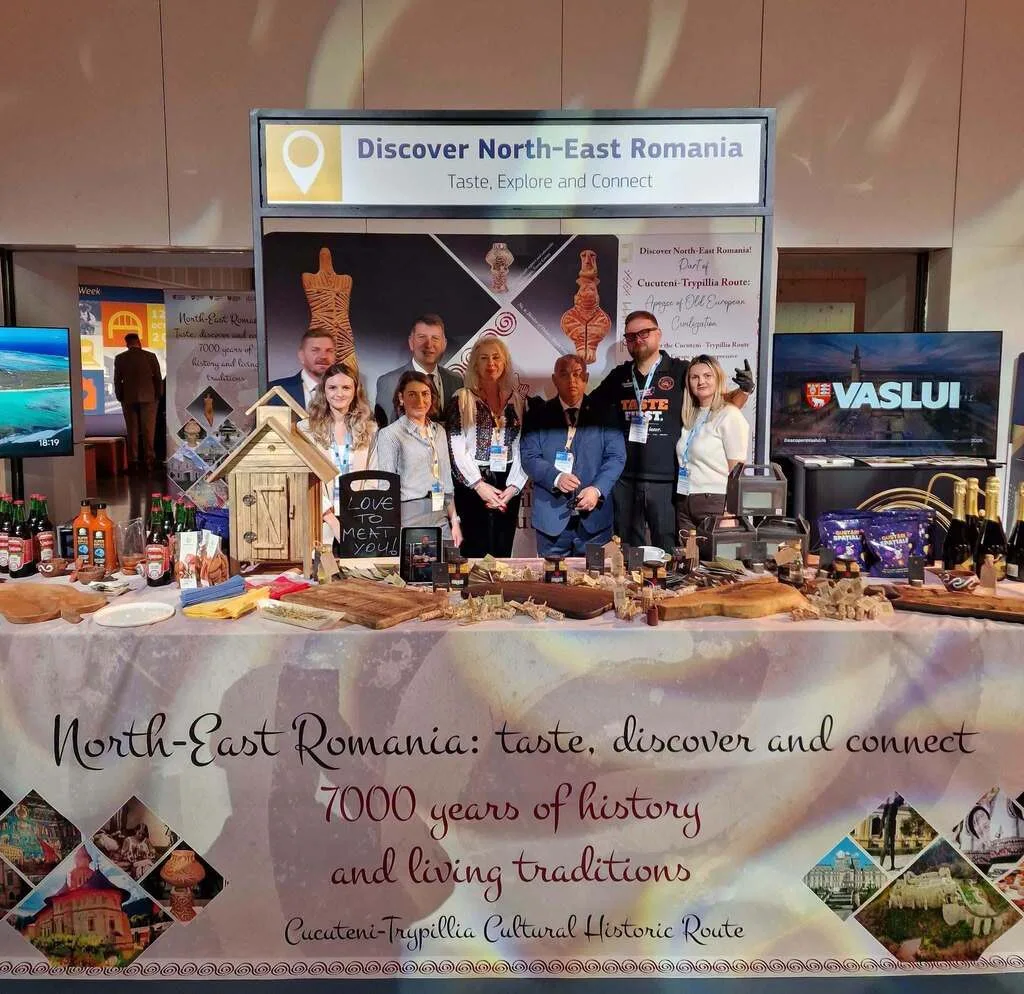
Neamț County showcased its values, traditions and development potential on the European stage during European Week of Regions and Cities, held in Brussels from 12 to 14 October.
Solo painting exhibition – Florin Mareș
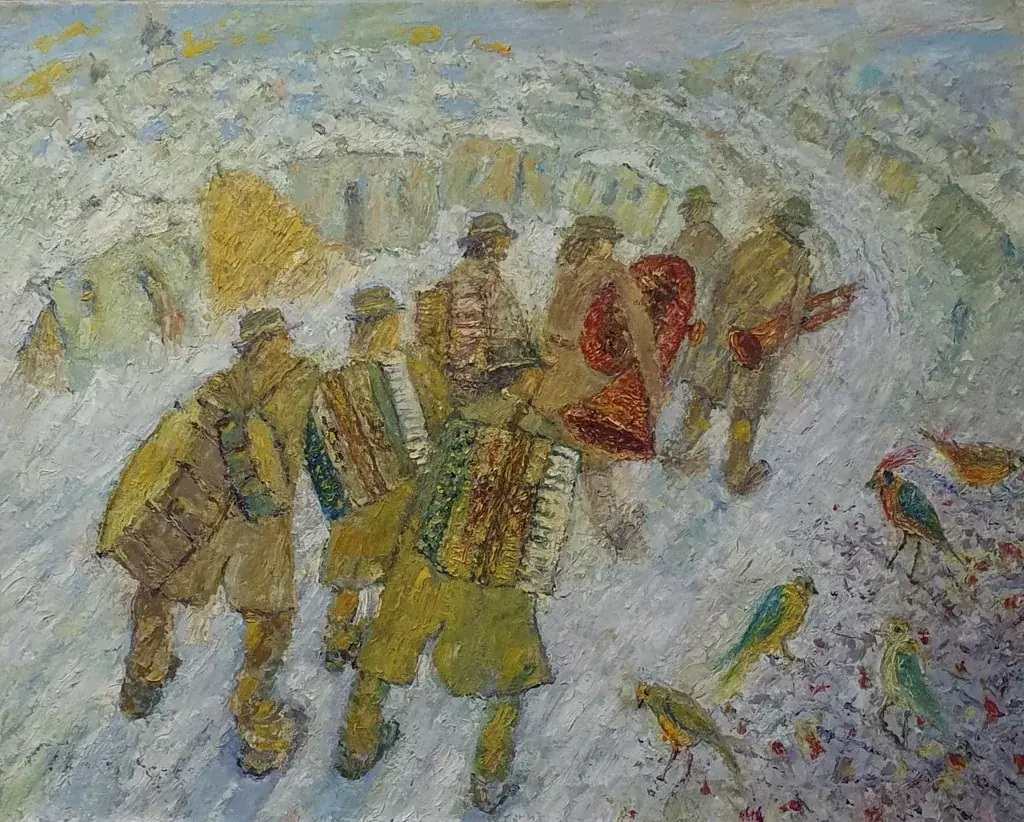
Starting Saturday, 10 October 2026, the Art Museum in Roman opens a new solo exhibition by the visual artist Florin Mareș of Roman.
Book launch: “Regina Maria a României. Din viață în eternitate” by historian Narcis Dorin Ion
Neamț National Museum Complex invites audiences in Neamț to the launch of “Regina Maria a României.