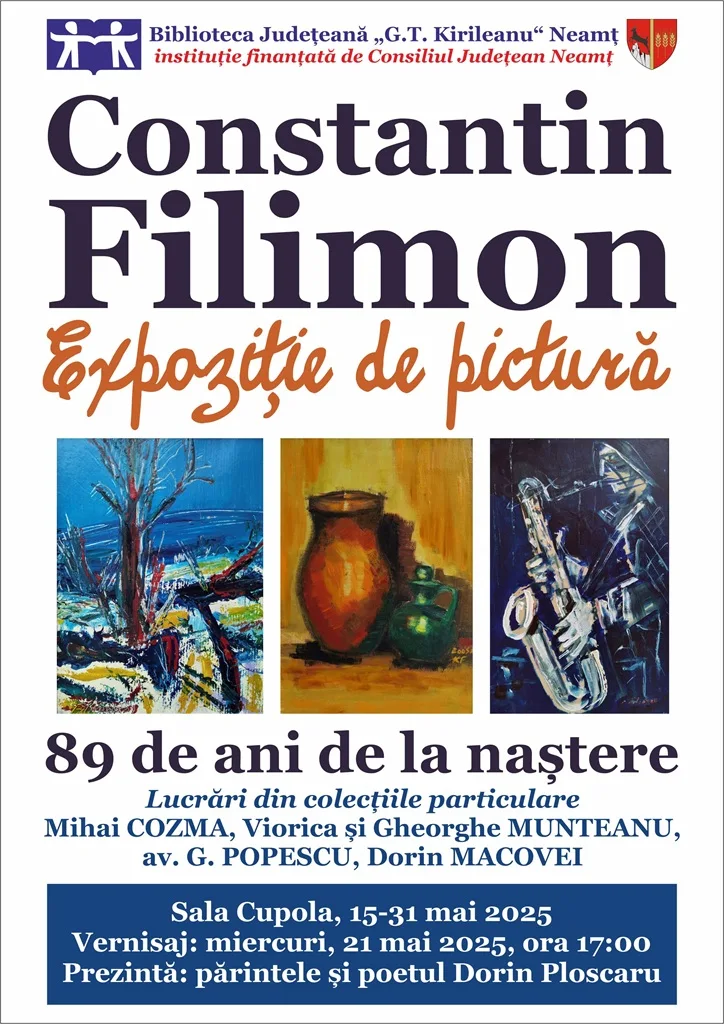
Painting exhibition “Constantin Filimon – 89 years since birth”
The G.T. Kirileanu County Library Neamț is organising the painting exhibition “Constantin Filimon – 89 de ani de la naștere” in the Cupola Hall, from 15 to 31 May 2025. Its opening is scheduled for the feast day of the Holy Emperors Constantine and Helen, Wednesday, 21 May 2025, at 17:00. Priest and poet Dorin Ploscaru will introduce the exhibition, and Prof. Mihaela Mereuță, manager of the County Library, will host the event.
The works come from the private collections of Mihai Cozma, Dorin Macovei, Viorica and Gheorghe Munteanu, and attorney G. Popescu.
Constantin Filimon was born on 25 (21, according to his own testimony) May 1936, in Piatra Neamț. He graduated from the Bucharest Institute of Fine Arts, class of 1967, and completed the church painting course at the Bucharest Orthodox Patriarchate, class of 1969.
He made his debut in the group graduation painting exhibition at the University of Bucharest in 1967. Art critic Amelia Pavel noticed him at the Youth Athenaeum’s painting exhibition featuring “several young graduates, all employed in education as drawing teachers”. “C. Filimon, for example, seems to know quite clearly the path he must follow. His non-figurative compositions, or those with vague figurative allusions, all executed in a balanced, restrained expressionist style, reveal a lyrical artist concerned with coherence of expression”, noted Amelia Pavel in “România literară”, the weekly literature and art review, on Thursday, 11.03.1971, on page 29.
After completing his art studies, Constantin Filimon was employed by the Museum of Art of the Socialist Republic of Romania, where he was noticed by collector Jaques Zambaccian, nephew of the more famous Krikor Zambaccian.
After the earthquake on 4 March 1977, he decided to return to his hometown, Piatra-Neamț.
From 1978, Constantin Filimon was a teacher at the Popular School of Art in Piatra Neamț and at other schools in the county.
Later, for his application for admission to the Union of Visual Artists, Valentin Ciucă noted: “Constantin Filimon belongs to the endangered species of the ‘Cursed Painters’. His bohemian life is total, devastating, neurotic and all-consuming. His innate cleverness lets him see more clearly and further. He is intelligent and spontaneous, works furiously, succeeds where others fail, but also fails when something seems too easy to him. His life merges with painting and he does everything to make that known. The temperature of his existence constantly reaches the boiling point.”
I have felt solidarity with Constantin Filimon since the 1980s, when we, together with others, tried to rally the artistic energies in Piatra-Neamț around a branch of the Union of Visual Artists. He could have been among its first members. Solo exhibitions, art camps and endless discussions about art in the modest atmosphere of the studios on Tipografiei Street made Constantin Filimon a figure performing with ease to a score invented ad hoc. He fought to create an artistic climate based on respect and emulation, but he was the first to destroy it. Ignoring him, however, was impossible; the imprudent were frightened by his verdicts.
Professionally he has done his job. He taught children what the fine arts are, painted churches and saw his soul in his paintings. Tormented by profound ideas and gestures that must be definitive and brilliant, Constantin Filimon makes a spectacle out of anything. On his canvases or in his sketchbooks (probably several hundred), he seeks to portray the world and its people. He has expressive power and knows no limits. He is free and in permanent rebellion. He lacks neither artistic gift nor the will to fulfil it. Professionally he appears to be a modern artist who uses neurosis as a pretext for great art. He plays at being an expressionist and is friends with Toulouse-Lautrec. He is, surely, one of ours…”
He painted the churches of Zăpodeni (Iași), Muncel (Alba), Drăgești (Bihor), Verșești and Dănești (Neamț), and Tigveni Bârsești (Argeș).
He has taken part in numerous collective and solo exhibitions in the country, as well as in the USA and Canada (1980–1997), then in Mexico, Hungary, France, India and Venezuela.
He passed away in August 2013 and is buried in Eternitatea Cemetery in Piatra-Neamț.
More on the same topic

Neamț County, an Ambassador for Local Traditions and Values in Brussels
Neamț County showcased its values, traditions and development potential on the European stage during European Week of Regions and Cities, held in Brussels from 12 to 14 October.

Solo painting exhibition – Florin Mareș
Starting Saturday, 10 October 2026, the Art Museum in Roman opens a new solo exhibition by the visual artist Florin Mareș of Roman.

Book launch: “Regina Maria a României. Din viață în eternitate” by historian Narcis Dorin Ion
Neamț National Museum Complex invites audiences in Neamț to the launch of “Regina Maria a României.