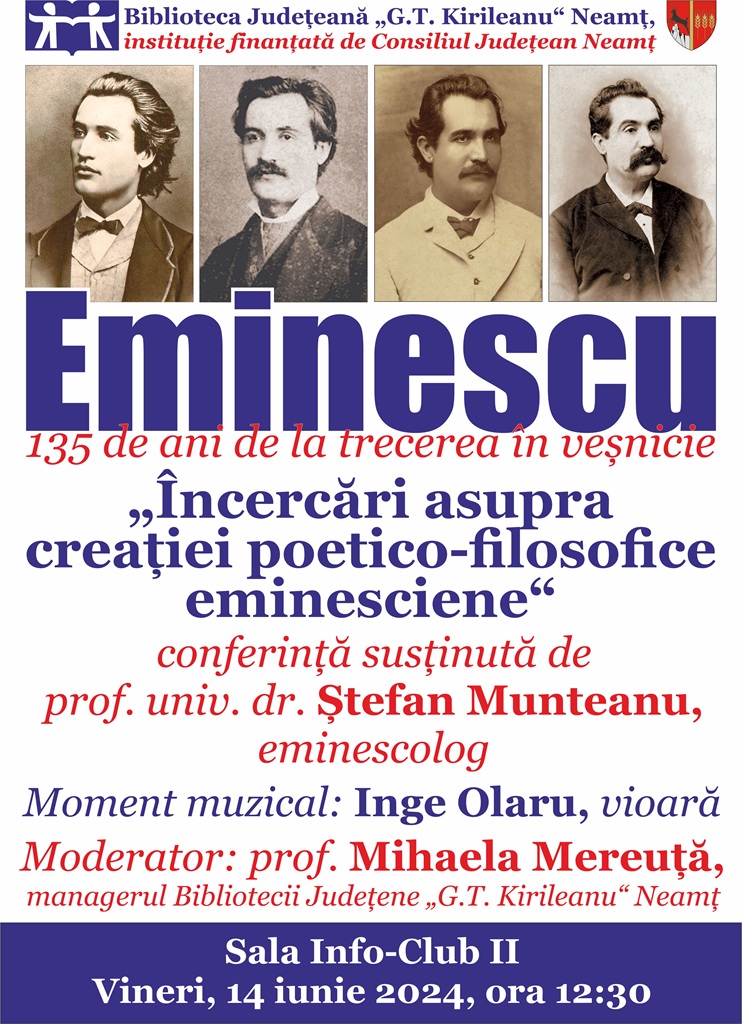
“Essays on Eminescu’s Poetic and Philosophical Work”, at the County Library
G.T. Kirileanu County Library Neamț will host the lecture “Essays on Eminescu’s Poetic and Philosophical Work”, delivered by Professor Ștefan Munteanu, PhD, marking 135 years since the death of the poet Mihai Eminescu.
The event will take place on Friday, 14 June 2024, at 12:30, in the Info-Club II Hall and will be moderated by teacher Mihaela Mereuță, manager of G.T. Kirileanu County Library Neamț. Inge Olaru will give a violin performance on this occasion.
Professor Dr Ștefan Munteanu – Eminescu scholar
He was born on 5 March 1951 in Găiceana commune, Bacău County.
He graduated from the Faculty of Philosophy (1980) and the Faculty of Law (1987), both at Al.I. Cuza University in Iași. PhD in philosophy (1997). The “Ion Petrovici” Prize, awarded by the Romanian Academy in 1999 for “Indian Philosophy and Eminescu’s Work”; the Romanian Writers’ Union Prize in 2003 for “Facets of the Romanian Philosophical Spirit”; the “Georgeta și Mircea Cancicov” Cultural Foundation Prize, Bacău, in 2005 for “Philosophical and Legal Aspects of the European Integration Process”.
He has taken part in prestigious international congresses and symposia, and his books (Dimensions of Indian Spirituality; Indian Philosophy and Eminescu’s Work; Drops of Philosophy; New Drops of Philosophy; Flashes of Insight into Eminescu; More Drops of Philosophy; Fields of Philosophy; Facets of the Romanian Philosophical Spirit, among others) have been well received by both academics and the general public.
Career
Social sciences teacher at No. 4 High School in Bacău (1980-1990); school inspector at the Bacău County School Inspectorate (1990); social sciences teacher at “Vasile Alecsandri” High School in Bacău; lecturer and doctoral candidate (1993-1997), then associate professor with a doctorate (1997-2000) at “Vasile Alecsandri” University in Bacău; associate professor with a doctorate (2000-2004), then professor with a doctorate (from 2004) at “George Bacovia” University in Bacău.
Critical assessments
“Self-assured, skilled in the methods of comparative study and well versed in both the doctrines of Indian philosophy and the philosophical essence of Eminescu's poetics, Ștefan Munteanu presents decisive arguments in his research for an understanding of Eminescu's work through its authentic universality” – Constantin CUBLEȘAN.
“Every encounter with Ștefan Munteanu is also a reunion with Eminescu. Few people have been so happily captivated by Eminescu as this Eminescu scholar, who says that “we are and will remain in Europe, united through Eminescu” and invites us, in Pascal's manner, to reflect in his presence; “If someone refuses to draw close to Eminescu, they have nothing to gain, while Eminescu has nothing to lose, for he had the strength to offer us everything without even asking whether we deserved it”. We believe that, since George Călinescu, few words so beautiful have been spoken about the man who confided in us with moving simplicity: “The god of genius drew me from the people, as the sun draws a golden cloud from the sea of sorrow”” – Ion FERCU.
“Clearly, Mr Ștefan Munteanu draws on a wide range of literature. As a philosopher, he is interested not only in the historical connections between Eminescu and India, but also in the poet's philosophical vocation, which requires a broader exploration of the European and, naturally, Romanian context. We might expect the author to present an erudite comparative study tracing sources, as the overwhelming majority of studies on Eminescu do. Yet this is not the case, although the sources are readily available to him. Or perhaps precisely for that reason. The comparative approach cultivated by Ștefan Munteanu does not trace sources and establish equivalences, as in G. Călinescu's “classic” assessment that Eminescu's philosophical thought was a “commentary on the margins of Schopenhauer's philosophy”. Rather, it brings to mind Etiemble's open, creative approach to comparison, following the principle “Comparaison n´est pas raison”” – Theodor CODREANU.
More on the same topic

Neamț County, an Ambassador for Local Traditions and Values in Brussels
Neamț County showcased its values, traditions and development potential on the European stage during European Week of Regions and Cities, held in Brussels from 12 to 14 October.

Solo painting exhibition – Florin Mareș
Starting Saturday, 10 October 2026, the Art Museum in Roman opens a new solo exhibition by the visual artist Florin Mareș of Roman.

Book launch: “Regina Maria a României. Din viață în eternitate” by historian Narcis Dorin Ion
Neamț National Museum Complex invites audiences in Neamț to the launch of “Regina Maria a României.