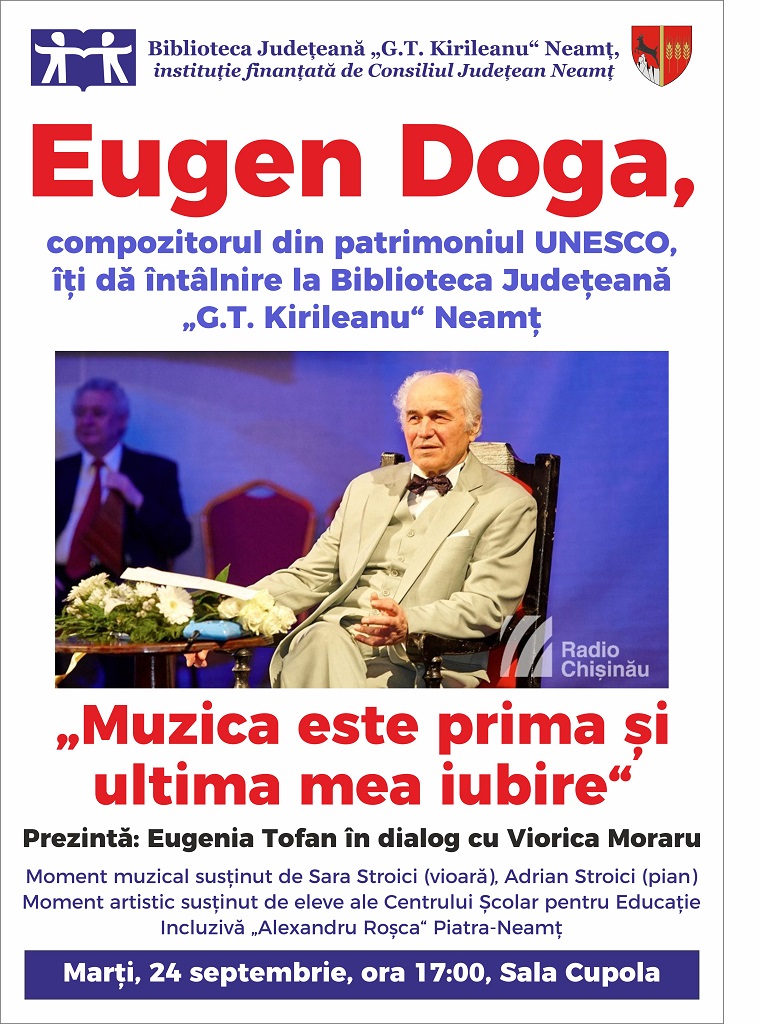
Meet Eugen Doga at G.T. Kirileanu County Library Neamț
Eugen Doga, the composer recognised as part of UNESCO’s heritage, is coming to G.T. Kirileanu County Library Neamț. “Music Is My First and Last Love” is the title of the heartfelt gathering that will take place at G.T.
Kirileanu County Library Neamț on Tuesday, 24 September, at 17.00, in the Cupola Room. At the gathering, admirers of the great composer will have the opportunity to learn about episodes from the maestro’s life and hear stories behind some of his compositions, told by Eugen Doga himself.
“Music Is My First and Last Love”
The presentation will be given by Eugenia Tofan, from the Academia de Științe a Moldovei – who manages the composer and academician Eugen Doga’s events diary and has promoted the celebrated artist’s public profile for many years – in conversation with Viorica Moraru.
The event will include a musical performance by Sara Stroici (violin) and Adrian Stroici (piano), as well as an artistic performance by female pupils from Centrul Școlar pentru Educație Incluzivă “Alexandru Roșca” Piatra Neamț.
Eugen Doga was born in 1937 in the village of Mocra, east of the Nistru River, then part of the Moldavian Autonomous Soviet Socialist Republic within the Ukrainian SSR, and now a territory occupied by a separatist regime supported by the Russian Federation.
Mihai Eminescu’s work has shaped much of Eugen Doga’s music. In an interview with Radio România Chișinău, the composer says he cannot live a single day without Eminescu, even though he came to his work late.
Mihai Eminescu’s work and the turbulent love between the poet and Veronica Micle have shaped the composer’s music in recent years. The volumes “Dialogurile dragostei” were published in 2017, featuring arias and romances by the composer Eugen Doga, inspired by the overwhelming love between our great poet Mihai Eminescu and Veronica Micle.
“Everything by Eminescu that comes into my hands stirs me ever more deeply. I believe these two great figures in the history of Romanian culture, particularly literature, but also music, were made for each other. I believe many works would never have been written if the two had not met. Veronica was a brilliant poet. She wrote few poems, but they are wonderful. She did not devote herself to writing; she had other things to contend with, a difficult life, widowed young with two children and no means of support, yet she still tried to write poetry. Extraordinary poems, with so much love, so much warmth, so much hatred, devotion, passion, such breadth of feeling. You do not find this in anyone else’s writing. Her longing truly knew no solace. She was an ember in the ashes. It is a pity that life did not breathe on that ember to turn it into a flame.
A book dedicated to the composer, “ABCDOGA. Un destin în Do major”, by art critic Larisa Turea, was recently launched in Chișinău.
Eugen Doga, composer
Eugen Doga studied cello at the music school in Chișinău under P.I. Baccinin (Pablo Giovanni Baccini, of Italian origin). He graduated from the Chișinău Conservatoire in cello (in 1960) and theory and composition (in 1965), and also completed a course in symphonic conducting.
He worked in the Radio Orchestra (1957-1962) and began composing music. In 1967, he made his debut in cinema, writing the music for the “Moldova-Film” studio’s film “Se caută un paznic”. He worked with the studios “Mosfilm”, “Dovjenko”, “Belarus-film” and “Ecran”, as well as studios in București, Munchen, Belgrad, Tașkent and elsewhere.
Eugen Doga has written music for around 200 films, including “Maria, Mirabela”, a Romanian-Soviet co-production. He had a fruitful collaboration with director Emil Loteanu on the films “The Fiddlers”, “A Gypsy Camp Ascends to Heaven”, “Anna Pavlova”, “My Gentle and Tender Beast”.
He composed the ballets “Luceafărul”, “Venancia” and “Regina Margot”, around a hundred instrumental and choral works, six quartets, music for 13 plays, hundreds of songs and romances, around 70 waltzes, works for various musical instruments and music for children.
The writings of the Romanian literary classic Mihai Eminescu and Veronica Micle hold a special place in Eugen Doga’s music. Over 50 compositions setting poems by Mihai Eminescu and Veronica appear in the work “Dialogurile dragostei”.
The “Eugen Doga” Music Salon welcomes hundreds of visitors invited to the composer’s home on various occasions, especially on Eminescu’s birthday. The salon aims to popularise music and bring together creative people, businesspeople, politicians and lovers of music, painting and poetry.
Eugen Doga composed the anthem of Chișinău and is an honorary citizen of Chișinău. The music school where the future composer began his musical studies, a pedestrian street in Chișinău and a minor planet numbered 10,504, orbiting between Saturn and Mars, all bear Eugen Doga’s name.
More on the same topic

Neamț County, an Ambassador for Local Traditions and Values in Brussels
Neamț County showcased its values, traditions and development potential on the European stage during European Week of Regions and Cities, held in Brussels from 12 to 14 October.

Solo painting exhibition – Florin Mareș
Starting Saturday, 10 October 2026, the Art Museum in Roman opens a new solo exhibition by the visual artist Florin Mareș of Roman.

Book launch: “Regina Maria a României. Din viață în eternitate” by historian Narcis Dorin Ion
Neamț National Museum Complex invites audiences in Neamț to the launch of “Regina Maria a României.