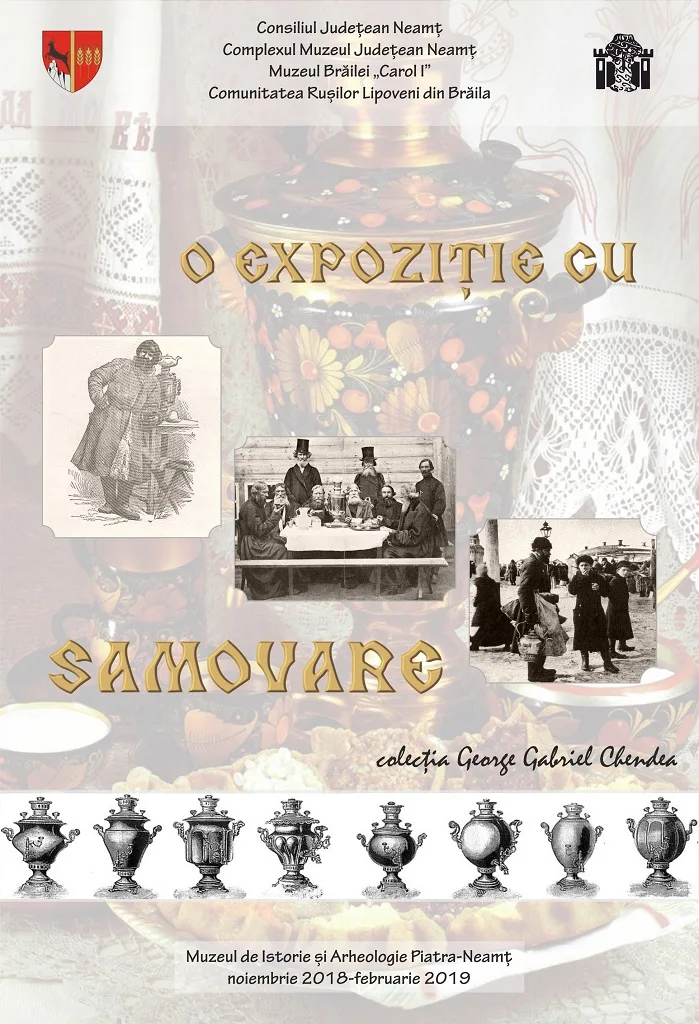
Temporary exhibition devoted to samovars
Temporary exhibition devoted to samovars at Piatra Neamț History and Archaeology Museum
From 27 November this year, visitors to Piatra Neamț History and Archaeology Museum will be able to see a temporary exhibition devoted to samovars.
The exhibition showcases the impressive collection belonging to Mr George Gabriel Chendea. Contributing organisers include the “Carol I” Museum of Brăila (with a series of paintings by artist Paul Petrov focusing on the same object – the samovar) and Comunitatea Rușilor Lipoveni din Brăila (with a series of photographs showing members of the community in traditional costumes gathered around this same object, which holds particular significance in the tea ceremony within Russian culture).
This is not the first exhibition about samovars organised by the Neamț museum; in 2015, the temporary exhibition Tabiet nemțean brought together samovars and antique lighters from the George Gabriel Chendea and Constantin Horghidan collections.
While the earlier exhibition featured around 50 pieces, this time visitors will be able to admire just over 100 samovars (along with other accessories used in making tea). They come from renowned workshops in Russia's Tula region (although there are also a few Polish examples) and date from the first half of the XIX century to the first half of the XX century (two electric samovars are also on display). Some of the best-known workshops represented are Voronțov, Gudkov, Vanukin, Rudakov, Morozov, Șemarin and Batașev (the workshop from which most of the pieces come).
A samovar is a vessel, usually made of brass (though it could also be made of nickel, a copper and zinc alloy, or even silver), in which water is kept at boiling point for a long time; the water is heated by charcoal or wood burning in a tube that runs through the centre of the vessel. At the top of the vessel sits a container holding strong, aromatic tea concentrate. This is diluted with hot water from the vessel.
The origins of the samovar are linked to tea. Towards the end of the XVIII century, tea became increasingly popular in Russian society, and it was during this period that production of the Russian tea vessel – the samovar – began.
Several samovar prototypes were manufactured in the Ural Mountains (at the factories of Nikita Demidov, who employed craftsmen from Tula), Moscow, Sankt Petersburg and other locations. The first samovar factory was founded in Tula (a town south of Moscow, famous for its gunsmiths) in 1778 by Nazar Lisitsyn (the Lisitsyn brothers are also credited with making the first copper samovar). While there were 8 samovar factories in 1826, their number had already reached 70 by 1896.
In the first 70 years, the workshops in Tula produced 120,000 samovars a year (by comparison, at the height of the Bolshevik era, production exceeded 2 million a year).
The design of samovars remained unchanged over time – what changed was their shape, the materials they were made from and their decoration.
Particular attention was paid to detail – the handles and tap could be shaped like dragon claws or grapevines, while the body of the samovar could be engraved by hand. Making a samovar involved 12 stages, with craftsmen specialising in each stage of production (interestingly, an entire village could specialise in making a single component – such as samovar handles). Final assembly and decoration took place in the factory.
At the beginning of the 20th century, there were around 170 different samovar models (portable samovars, stationary samovars and so-called kitchen samovars with three compartments for both cooking and boiling water).
The exhibition will be open until February next year.
We look forward to seeing you!
More on the same topic

Neamț County, an Ambassador for Local Traditions and Values in Brussels
Neamț County showcased its values, traditions and development potential on the European stage during European Week of Regions and Cities, held in Brussels from 12 to 14 October.

Solo painting exhibition – Florin Mareș
Starting Saturday, 10 October 2026, the Art Museum in Roman opens a new solo exhibition by the visual artist Florin Mareș of Roman.

Book launch: “Regina Maria a României. Din viață în eternitate” by historian Narcis Dorin Ion
Neamț National Museum Complex invites audiences in Neamț to the launch of “Regina Maria a României.