Stories from the exhibition. Tudor Vladimirescu's proclamations
In a speech commemorating Tudor Vladimirescu at Academia Română on 5 June 1921, historian N. Iorga said: “Tudor represents a further step in the political understanding of national and popular freedoms in these eastern lands.
He draws on “precepts”, which are not laws but natural rights as defined by Rousseau, to argue that the “fellow inhabitants of this country” must rise up against the bloodsucking “dragons”, who are, “as you know them all too well, the Greeks and our boyars, both ecclesiastical and political”. He invokes ecclesiastical law itself, for God, being good, can only stand with those who fight in his name to destroy evil”. The great historian reviewed the proclamations that encompass the entire political thought of the “national hero” of 1821, as Ioan C. Filitti described the leader of the 1821 movement. Three of the four documents he cited are also featured in our exhibition (the Proclamation of Padeș and the Petition Addressed to the Sublime Porte by Tudor Vladimirescu on Behalf of the People of Țara Românească, both dated 23 January 1821, and the Proclamation of Cotroceni dated 17 March 1821).
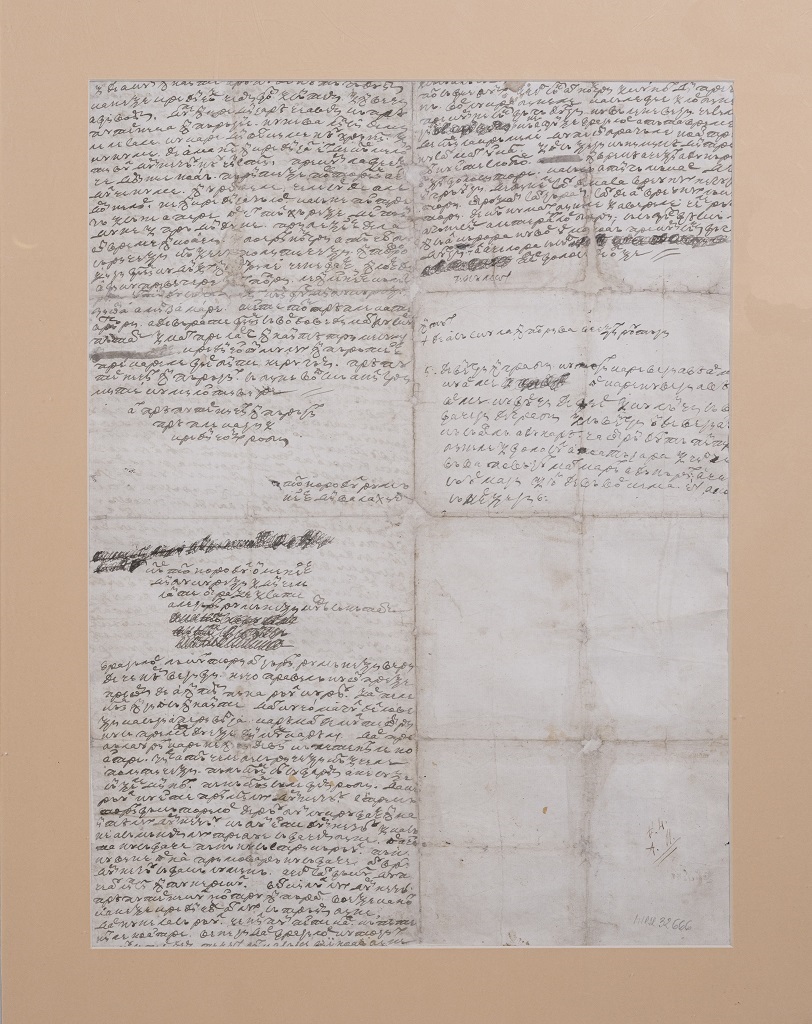
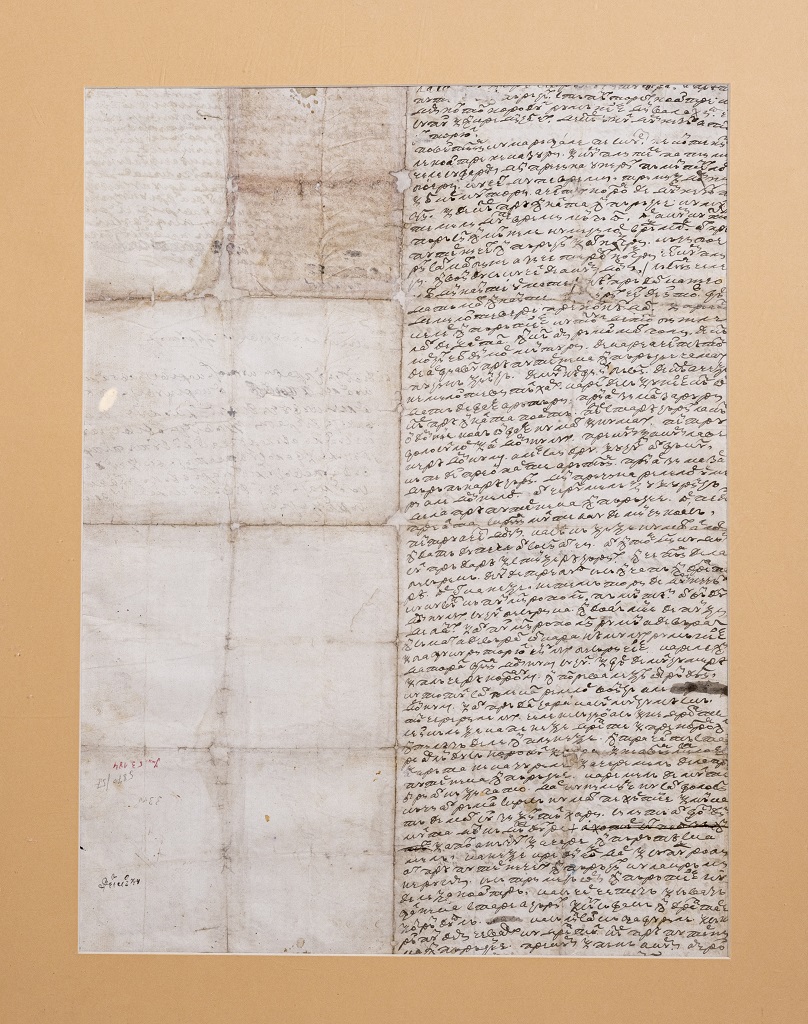
Under classification order no. 2604 of 7 April 2003, Proclamația de la Padeș, held by the National Museum of Romanian History, was added to the Treasure category of the national movable cultural heritage. The text is written on paper in black ink, in Romanian using the Cyrillic alphabet. In the presence of several hundred pandurs from Oltenia, Tudor Vladimirescu issued a proclamation to the inhabitants of Wallachia, promising the pandurs the restoration of their privileges, the peasants bound to labour service a share of “the ill-gotten wealth of the tyrannical boyars”, and everyone an end to abuses, freedom and a reduction in their burdens. The proclamation marks the beginning of the 1821 Movement in Wallachia, setting out economic, social and political demands intended to change the structures of Romanian society. The document displayed in the exhibition “Periplu istoric. De la Tudor Vladimirescu la renașterea națională” also contains, on its first page, part of the petition addressed to the “Most Powerful Empire” by Tudor, the supply officer, to recount “with great sorrow, briefly, our unceasing troubles and the terrible suffering we endure because of the alliance between the native boyars and those sent over time as princes and rulers of this people, protected by God and comforted over time by the many favours of the Most Sublime Empire”. Tudor Vladimirescu sent the memorandum to the Porte through Derviș Pașa, governor of Vidin, to prevent Ottoman intervention. At Padeș, on the plain to the left of the Motru, stands the monument to the Revolution of 1821, erected 100 years after Tudor Vladimirescu's death. The pyramid-shaped monument depicts, through metopes cast in bronze, the coats of arms of Wallachia and Oltenia, the Proclamation of 23 January, Tudor's likeness and “Adunarea Norodului”.
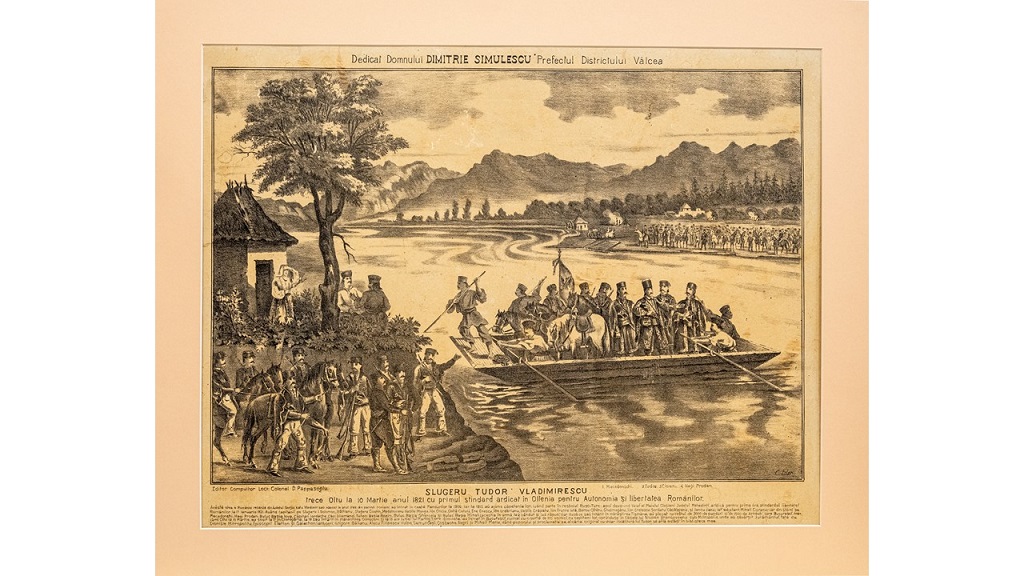
The third public document discussed is represented indirectly in the exhibition through another museum object: a lithograph from the collection of the prestigious National Museum of Romanian History. Created and published by Lieutenant Colonel Dimitrie Papazoglu, the lithograph depicts Tudor, the supply officer, crossing the Olt and refers to Proclamația de la Cotroceni, which is said to have been in Lieutenant Colonel Dumitru Papazoglu's collections during 1871-1888. We have chosen to provide details about this museum object partly because of our previously stated wish to trace the history of the cultural objects brought together for our historical journey. Our stories will also introduce us to passionate collectors committed to preserving cultural heritage. Lieutenant Colonel Dimitrie Papazoglu stands out among the collectors active in București during the early decades of the second half of the 19th century. In 1855, after resigning from the army, he opened a museum bearing his name in his own house at Calea Văcărești no. 151. A creator and publisher of lithographs, cartographic works and maps, Lieutenant Colonel Dimitrie Papazoglu showed “undeniable aptitude for collecting objects of real value”. Major Papazoglu's museum of antiquities and rarities held “one of the richest collections, far more impressive than that of the National Museum at the time”, with the aim of offering his compatriots “solid evidence to add to the many proofs Romanians possess of their noble origins”.
Returning to our exhibit, a lithographed inscription at the top reads: “Dedicated to Mr Dimitrie Simulescu, Prefect of Vâlcea County”. Below the composition are the following lithographed inscriptions: “Publisher and Composer Lt. Col. Pappasoglu/1. Macedonschi 2. Tudor 3. 4 Hagi Prodan/Tudor Vladimirescu, supply officer, crosses the Olt on 10 March in the year 1821 with the first standard raised in Oltenia for the Autonomy and Freedom of Romanians”. Beneath these, a caption recounts the historical episode that inspired the lithographer, along with details of Tudor's life and the course of the movement. Given the significance of the information it contains, we reproduce it in full: “This star of Romania, which rose from the village of Vladimir in Gorjiu County, was born in the year 1788 to Romanian parents and joined the pandurs in 1806; in 1812 he became their leader, taking part in the Russo-Turkish War; then, becoming head of the Plaiul Cloșani district in Mehedinți County, he raised the standard of Romanian freedom for the first time on 17 January 1821. His captains were supply officer I. Solomon, Bălțianu, supply officer Costin, basin-bearer Vasile, Ion Oncia, Ghiță Cuțui, Ene Enescu, Ion Urdărianu, Vasile Crăpatu, Ion Frunte lată, Barbu Olteanu, Ghelmegeanu, Ion Crețescu, commander Cacalețeanu and Iancu Jianu, with Mihail Cioran as his adjutant. Among the foreigners were Macedonschi, Hagi Prodan, company commander Iova, Captain Iordache, Captain Diamandi, musketeer commander Bozin and company commander Mihali (these later betrayed and killed him); after meeting at Tismana Monastery, they set off with the remaining 3,000 pandurs and 1,500 Arnauts towards București, crossing the Olt on 10 March. They arrived at Ciorogârla on the 17th, fortified themselves in Cotroceni Monastery on the 18th and entered București on the 19th of March, at 7 in the morning, with just 100 brave men and their captains, stopping at Nicolae Brâncoveanu's houses below the Metropolitan Church, where they took their oath before Metropolitan Dionisie and Bishops Elarion and Galaction, and the boyars Grigore Bălianu, Alecu Filipescu Vulpe, Costache Negri and Mihail Manu; he also gave the people his proclamation, the original of which, bearing Tudor's own signature, is today in my library”.
In “Anul Tudor Vladimirescu”, we offer readers two of the documents setting out the programme that helped usher in a new era.
Proclamația de la Padeș
“To all the Romanian people in București and all the other towns and villages of Țara Românească, brotherly love and good health. Brothers who dwell in this country, no law forbids anyone from crushing evil. When a snake appears before us, you must rush at it with clubs and kill it. How much more so when there are wounds and tears in our bodies through which these monsters ceaselessly suck all our blood, day and night, while we are still alive, as you can plainly see. These, as you know only too well, are the Greeks and our boyars, both ecclesiastical and secular.
Destroying evil is the best deed in God's eyes (for God is good). To be like Him, we too must do good, which cannot be done unless we first drive out evil, just as spring cannot come until winter has passed. God said, let there be light, and there was light. But first the darkness vanished. Likewise, God's representative, our all-powerful Emperor, wishes us to live well as his faithful subjects and does not condone the evils, plunder and dispossession inflicted upon us by these tyrants and vile Greek leeches, together with our boyars.
Rise up, then, brothers, so that with evil we may destroy evil and goodness may come from us, and, distinguishing our good boyars from the bad, let us recognise them as our own and as workers for good, so that goodness may come from us as we promise. Therefore, make haste to rise up, all of you, as quickly as possible: those who have weapons, with weapons, and those who do not, with spears, axes, pitchforks, clubs and whatever you can find. And without the slightest delay, hurry to wherever you hear that people are gathering for the good of the community and the benefit of the country. Follow the guidance of the leaders appointed over you; wherever they send you, there you must go.
For we have endured enough, brothers, with the tears on our faces never drying. I assure you that throughout these gatherings of the country, none of you will be permitted, without orders, to reach for and take even a single grain from the house of any merchant, any resident or even any boyar, however ill-gotten their wealth may be; only the property of those who do not rise up alongside us will be taken for public use. Signed: Tudor Vladimirescu”.
Proclamația de la Cotroceni
“To the noble-born boyars, honourable merchants and all inhabitants of the city of București.
My fellow men and brothers, I believe it is unnecessary to repeat to you now that my uprising has had and has no other purpose than to restore the rights of this God-protected country, which it has held since ancient times and which no one has ever taken from it by the sword, but which have instead been humbly defended by the sword and the blood of our forefathers and those worthy of all glory.
For some time, however, because of the vile alliance between the native boyars and the Greek princes sent from time to time by the Ottoman Porte, our rights have been utterly trampled upon and buried, until, as you can plainly see, we have come to fare worse than the enslaved. For those who are called boyars by virtue of their appointments, the dignity of the offices they have held and hold, and the ranks they bore and bear, have entirely abandoned their honourable and sacred duty to protect the rights of their people and country. Giving themselves over entirely to the vile interests, worthy of utter contempt, that they pursued through the plundering of the Romanian people by the Greek princes and the other Greeks who came with them, they have brought the country to complete misery and ruin, as you can plainly see, and even now they will not leave the darkness in which they dwell or bring their people and country into the light of its rightful freedoms. That is why the people of those five counties in Mica Românie have risen up, with twelve thousand now under arms at a single call from the country, besides the preparations made in Argeș County and extended through Roșii-de-Vede and other counties to the outskirts of București, and besides the other troops I have brought, now stationed at Bolintin and Ciorogârla. All these forces are arriving in București, where the people of all the country's counties are to gather and await the arrival of the faithful envoy of the Ottoman Porte to investigate the country's lamentable condition, an investigation from which we expect the restoration of our rights. That is why I informed them of all this on the 8th of last month, so that they might make it known to you, asking you, on the one hand, to prepare yourselves in every respect and, on the other, to send me representatives from all your guilds, with signed proof to give us assurance. Yet, having reached the outskirts of your city through the mercy of the Most High, I once again fulfil my duties as a Christian and advise you as a brother to reply to me in writing without the slightest delay, with the signatures of all of you: the clergy, the guilds and all the people.
We therefore welcome with open arms, and await, those men who live and earn their livelihood in this city, who truly feel and hear the sweet voice of their homeland and of justice, and who wish to join our troops, devoted solely to the homeland. Those whose intentions oppose us will be considered enemies of the homeland, with no grounds left to contest this judgement.
1821, March 17 Signed: Tudor Vladimirescu”.
Selected bibliography:
- Iorga, Izvoarele contemporane asupra mișcării lui Tudor Vladimirescu, Librăriile “Cartea Românească” și Pavel Suru Publishing House, București, 1921.
Ioan C. Filitti, Tudor Valdimirescu (rostul răscoalei lui), București, 1937.
- Bodin, Tudor Vladimirescu, București, 1937.
Ionel Ioniță, Bucureșteni din veacul al XIX-lea, in București. Materiale de istorie și muzeografie.
Aurica Ichim, Dimitrie Papazoglu și cultura muzeală a secolului al XIX-lea, in Ioan Neculce. Buletinul Muzeului de Istorie a Moldovei.
Dr. Mihaela-Cristina Verzea,
Exhibition curator
More on the same topic
Neamț County, an Ambassador for Local Traditions and Values in Brussels
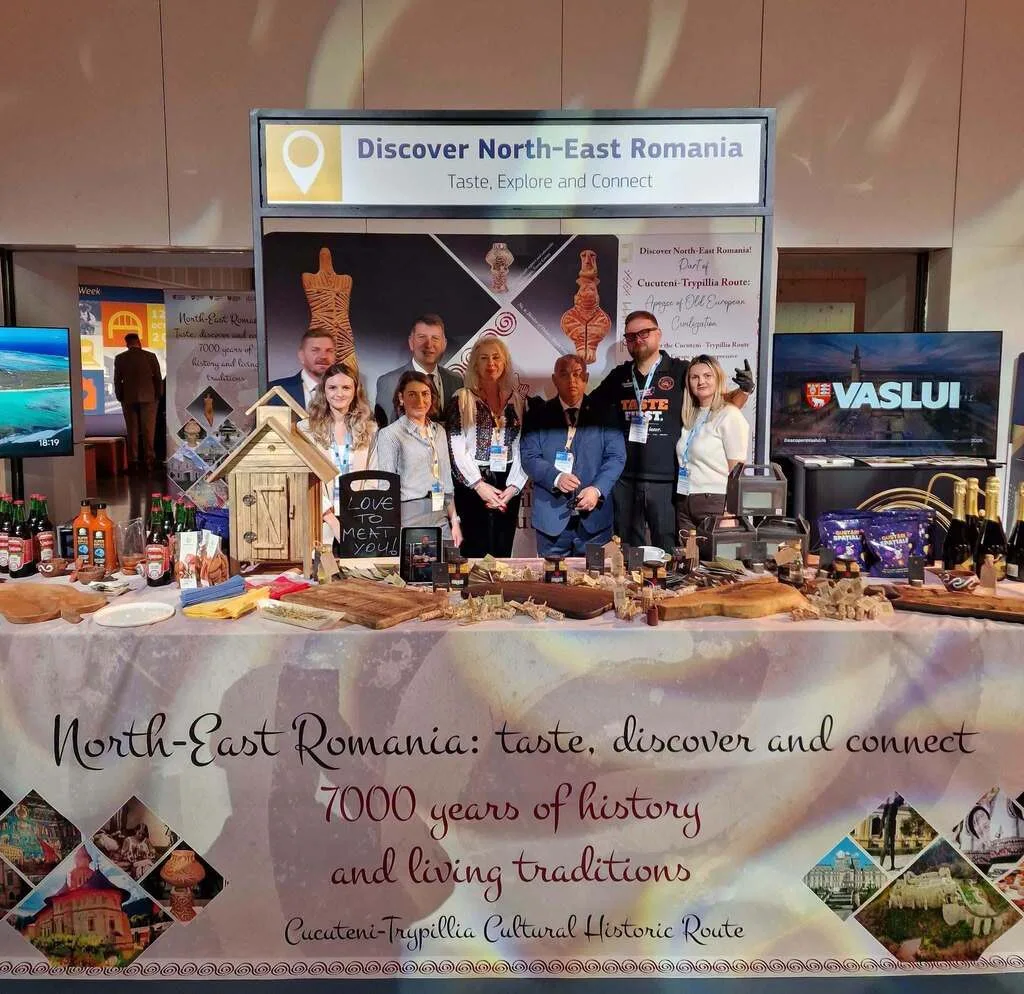
Neamț County showcased its values, traditions and development potential on the European stage during European Week of Regions and Cities, held in Brussels from 12 to 14 October.
Solo painting exhibition – Florin Mareș
Starting Saturday, 10 October 2026, the Art Museum in Roman opens a new solo exhibition by the visual artist Florin Mareș of Roman.
Book launch: “Regina Maria a României. Din viață în eternitate” by historian Narcis Dorin Ion
Neamț National Museum Complex invites audiences in Neamț to the launch of “Regina Maria a României.