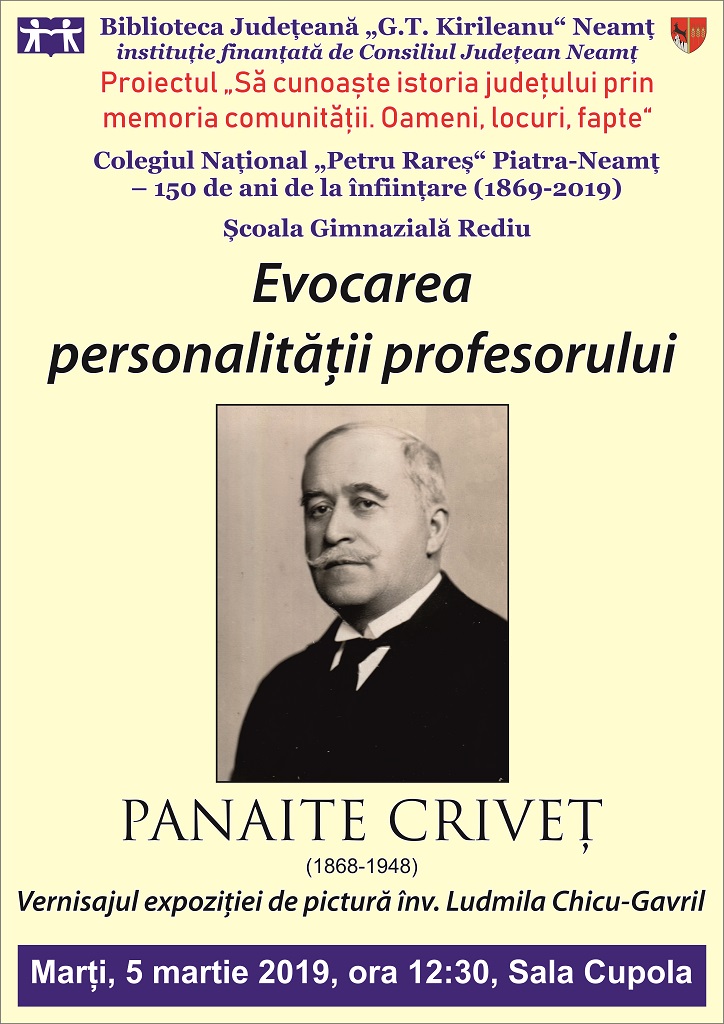
Teacher Panaite Criveț remembered at G.T. Kirileanu County Library
Teacher Panaite Criveț remembered at the County Library
G.T. Kirileanu County Library Neamț will look back on the life and work of the distinguished Romanian language and literature teacher Panaite Criveț as part of the project “Să cunoaștem istoria județului prin memoria comunității. Oameni, locuri, fapte”, on Tuesday, 5 March 2019, starting at 12:30, in the Cupola Room. The event is organised in partnership with Rediu Secondary School and “Petru Rareș” National College Piatra Neamț, which will celebrate its 150th anniversary in November.
A journalist, prefect of Neamț, senator and member of parliament, Panaite Criveț was born on 21 February 1869 in Rediu commune and died in 1948 at the age of 80. He taught at several educational institutions across the country and at “Petru Rareș” High School, from which he retired at the end of the 1932/1933 school year.
“You must master both the knowledge and the art of your profession, and you must also have dedication and love for it to the point of sacrifice – what we call a teacher's apostolic vocation. Pupils study each day to get through the year, and year after year to finish high school, so they can be done with books. An illusion! You are never done with books! I am a pupil myself. I often leaf through books and find new ways to adapt to our times” (Panaite Criveț).
Teachers Neculai Vasiliu, Constantin Tomșa, Dan-Mircea Borș and Ionuț Ciangu – headteacher of Rediu Secondary School – and librarian Elena Popa from “Petru Rareș” National College will share their reflections on the learned teacher. Kirileanu County Library Neamț.
“Criveț's classes captivated and fascinated his pupils; his beautiful lessons stirred all that was most sacred in their hearts, inspiring their love for everything Romanian” (teacher Eugenia Popovici, Girls' High School in Piatra Neamț).
“Criveț's course notebooks circulated through all the universities. He played an outstanding part in the life of the high school and in the cultural and political life of our town and county” (primary school teacher Leon Mrejeriu, Primary Teaching Staff Neamț).
“For Panaite Criveț's generation, the classroom was a sanctuary and the teacher a priest conducting a service” (teacher Panaite Popovici, Secondary Teachers' Association, Piatra Neamț branch).
“During his time as a member of parliament, prefect and senator, Panaite Criveț contributed to developments in Neamț County: the construction of buildings such as the Administrative Palace (History and Archaeology Museum) and the establishment of schools, for which the immortal Spiru Haret awarded him the Răsplata Muncii, Class I” (teacher Vasile Ghițescu, headteacher of “Petru Rareș” High School).
The tribute to teacher Panaite Criveț will be followed by the opening of an exhibition of paintings by primary school teacher Ludmila Chicu-Gavril. She was born on 22 June 1920 in the village of Nișcani in Basarabia, now a district of the town of Călărași across the Prut, halfway between Iași and Chișinău. She attended primary school in her home village, then the Diocesan Teacher Training School for Girls in Chișinău (a kind of boarding school), supported by the Orthodox Church. It trained future primary school teachers, who were required to have exceptional drawing and musical skills. These talents were nurtured by extremely strict teachers, in keeping with the school's entire regime. Here, the pupils learnt to cook a variety of sophisticated dishes, sew, weave small rugs and set tables according to very strict rules.
In 1940, two days after the USSR annexed Basarabia, she crossed the border into Romania with her younger sister, with great difficulty. She married there and, after the Romanian army crossed the Prut, settled with her husband in Basarabia, where their first child, a girl named Gabriela, was born. They then fled the front to Romania once more, travelling by train for two weeks from Chișinău to Craiova, where the authorities had assigned them to go. They were hungry and covered in lice.
After the war, she returned with her family to the Neamț area, living in Bozieni, Mărgineni and Hoisești, where her second child, Ștefan, was born, and then in Piatra Neamț, where she built a house on the site of the present House of Culture; it was demolished less than 5 years after she moved in.
She spent the last 21 years of her teaching career in Vaduri, captivated by the area's exceptionally beautiful natural surroundings. This is why nature features in most of her paintings. She produced numerous paintings, took part in several exhibitions and made teaching materials for the school. She painted sequences of scenes from stories, and her alphabet charts were small paintings, making the classroom feel like an exhibition room.
In later life, she mainly painted icons. A painting depicting Greater Romania being blessed by Jesus Christ remained unfinished.
More on the same topic

Neamț County, an Ambassador for Local Traditions and Values in Brussels
Neamț County showcased its values, traditions and development potential on the European stage during European Week of Regions and Cities, held in Brussels from 12 to 14 October.

Solo painting exhibition – Florin Mareș
Starting Saturday, 10 October 2026, the Art Museum in Roman opens a new solo exhibition by the visual artist Florin Mareș of Roman.

Book launch: “Regina Maria a României. Din viață în eternitate” by historian Narcis Dorin Ion
Neamț National Museum Complex invites audiences in Neamț to the launch of “Regina Maria a României.