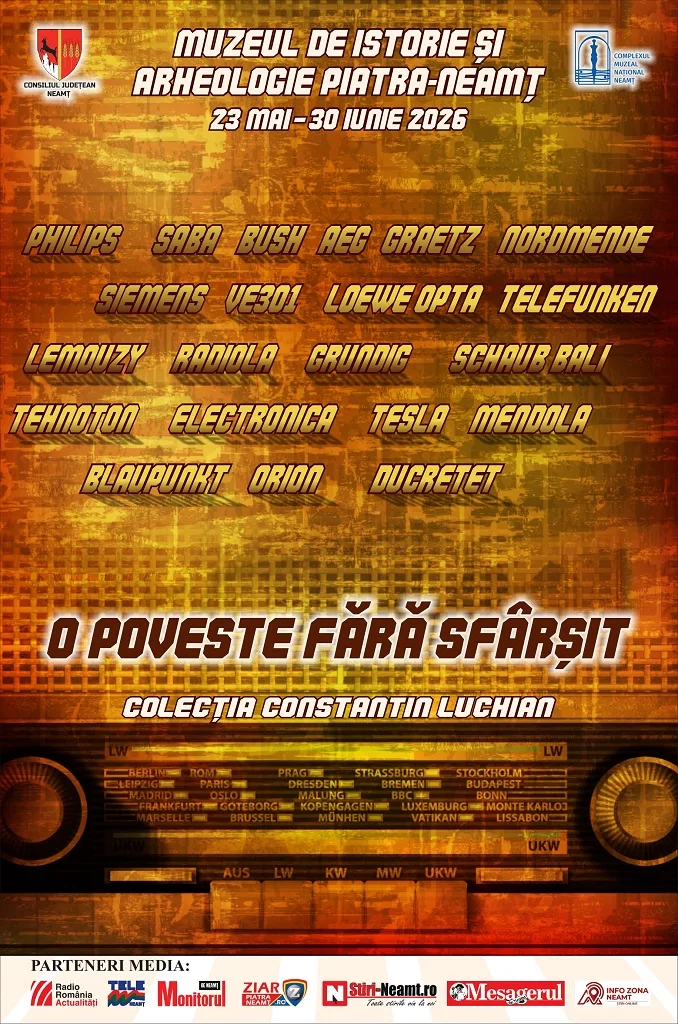
Exhibition project (the radio receiver) – Piatra Neamț History and Archaeology Museum
TV gives everyone an image, but radio gives birth to a million images in a million brains.”
Peggy Noonan
The exhibition project, which opens on 23 May at 19.00 at the Piatra Neamț History and Archaeology Museum, centres on a simple device – the radio receiver.
Continuing our tradition of presenting remarkable collections to the public, this year we have had the benefit of working with Mr Constantin Luchian.
He stands out, however, by adding a new dimension to his passion for collecting radio receivers: the ability to bring back to life equipment and devices that, at first glance, seem to belong to a long-forgotten world.
We will thus enter a world where concepts such as electronic tube, transistor, valve, frequency, tuning and modulation become magic wands which, once activated, open the gateway to the universe of radio.
Here we are greeted by industry giants – Philips, Telefunken, Radiola, AEG, Siemens, by famous unknowns – Emud, Orion, Tefag, Lemouzy, Ducretet-Thompson, by ghosts of the past – VE 301…and, last but not least, by familiar names – Simfonia, Carmen, Darclée…
A familiar voice recounts, in a monotone, a story that seems to have no end: in 1887, the German physicist Heinrich Hertz (1857 – 1894) discovered magnetic or Hertzian waves; in May 1895, the Russian physicist Alexandr Popov invented the antenna; the Italian engineer and physicist Guglielmo Marconi (1874 – 1937), inventor of wireless telegraphy and the earthed transmitting antenna, achieved true fame on 18 January 1903, when he placed his apparatus at the disposal of the President of the United States, Theodore Roosvelt, so that he could send a congratulatory message to King Edward VII of England; in 1909, Marconi received the Nobel Prize in Physics for this invention; Tesla lost the first lawsuit he brought against Marconi in 1915 to establish his “paternity” of radio; on 20 November 1920, a permanent radio broadcasting station began operating in Pittsburg; in 1908, Romanian radio took its first steps with the installation of a radiotelegraph station in Constanța; the first radiotelegraph station capable of establishing links abroad (Atena, Roma, Paris) was put into operation by the engineer Emil Giurgea (1885-1960) in the Țepeș Tower at Filaret in 1914; in 1920, a group of radio amateurs led by Professor Dragomir Hurmuzescu took the initiative to establish a radio communications course at București University; on 1 November 1928, Radio București made its first radio broadcast at 17:00, on a wavelength of 401.6 metres, with a power of 0.4 kW. The words “Hello, hello, this is Radio București” were heard[1].
Do you dare to follow it and begin exploring the universe of radio?
The exhibition is open until 30 June this year, Tuesday to Sunday, during the hours 10.00 – 18.00.
[1]The web source for the information presented is the radioromaniacultural.ro website –https://www.radioromaniacultural.ro/sectiuni-articole/produs-de-radio-romania/documentar-ziua-mondiala-a-radioului-13-februarie-locul-si-rolul-radiodifuziunii-publice-in-istoria-romaniei-id10698.html
More on the same topic

Neamț County, an Ambassador for Local Traditions and Values in Brussels
Neamț County showcased its values, traditions and development potential on the European stage during European Week of Regions and Cities, held in Brussels from 12 to 14 October.
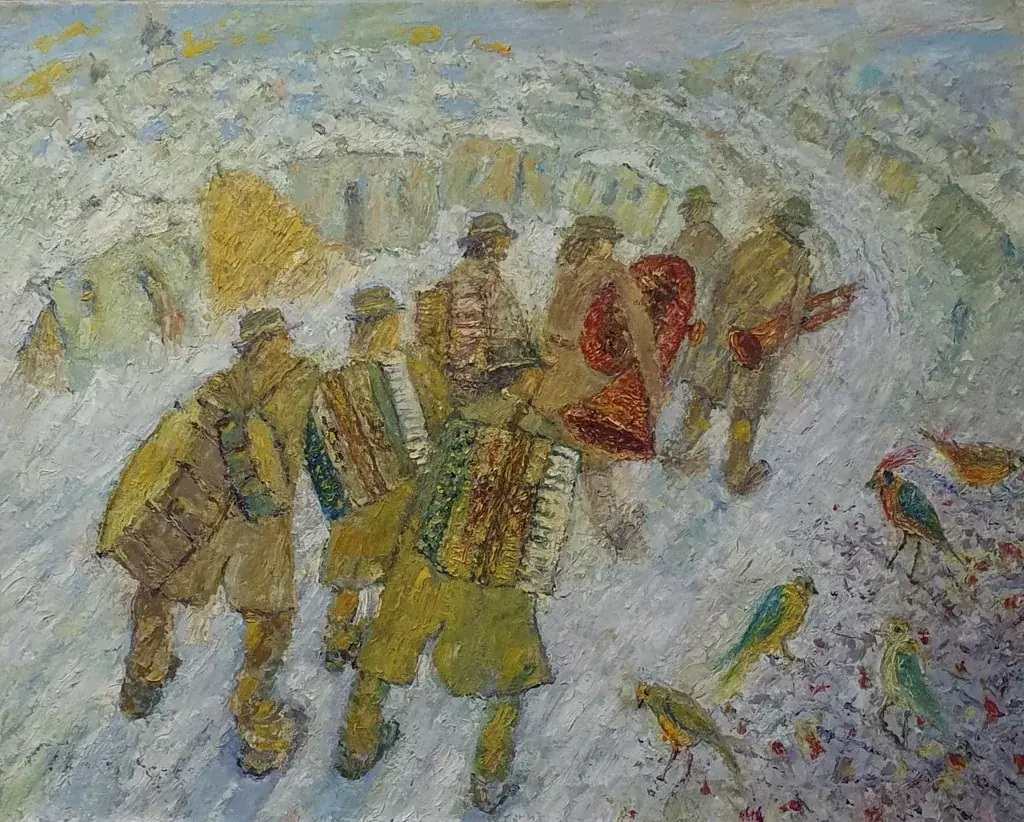
Solo painting exhibition – Florin Mareș
Starting Saturday, 10 October 2026, the Art Museum in Roman opens a new solo exhibition by the visual artist Florin Mareș of Roman.
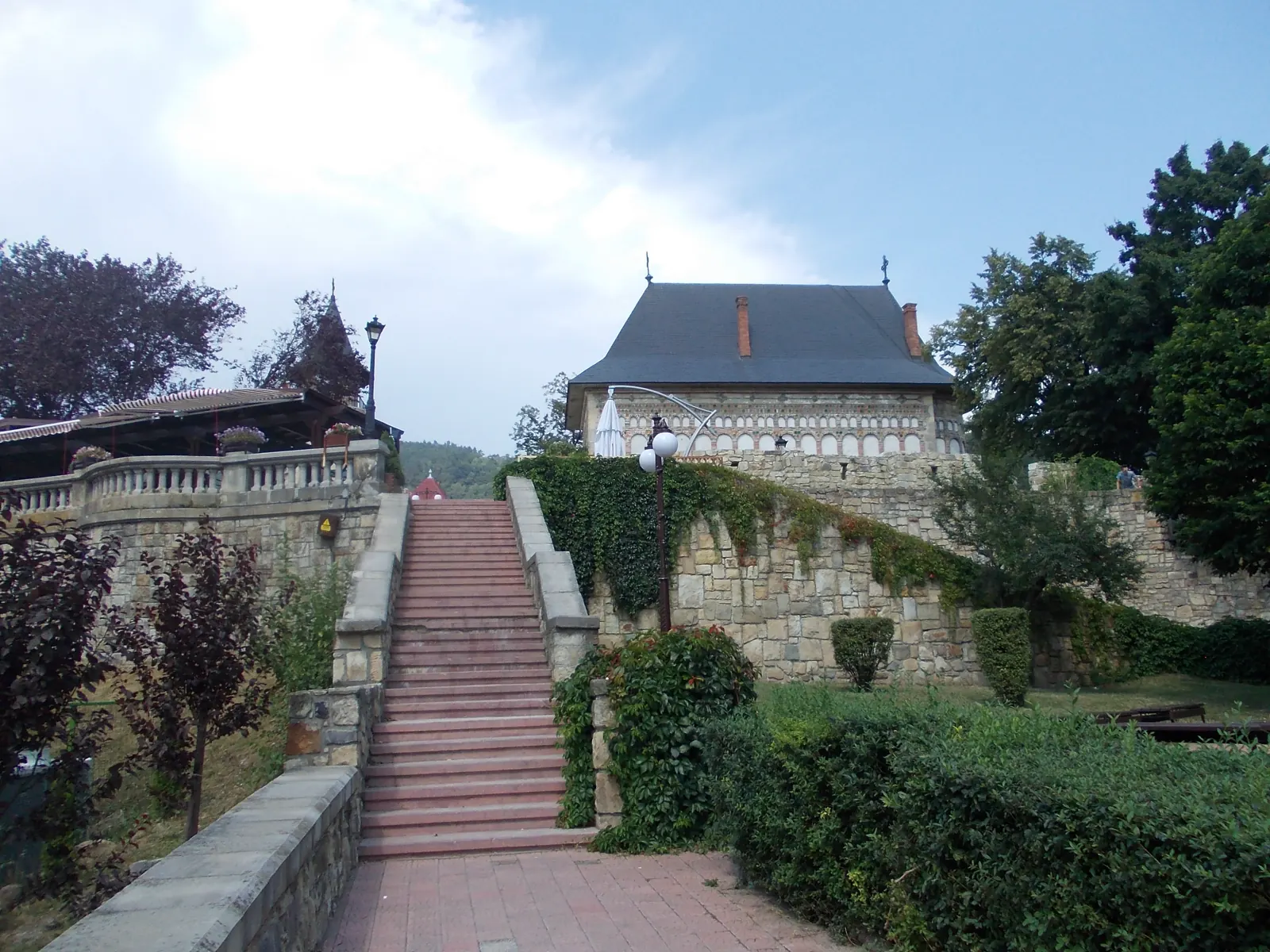
Book launch: “Regina Maria a României. Din viață în eternitate” by historian Narcis Dorin Ion
Neamț National Museum Complex invites audiences in Neamț to the launch of “Regina Maria a României.