Places of worship on Mount Ceahlău
Ceahlău is a legendary mountain, the only one in Romania and the second in the Christian world, after Mount Athos, to have a patronal feast day, “Transfiguration”, on 6 August.
The beauty of this holy mountain and its rich flora and fauna make Ceahlău Massif one of the country’s best-known and most visited mountains. Visitors can also explore the three places of worship on Mount Ceahlău.
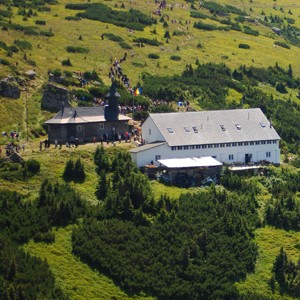
“Schimbarea la față” Monastery on Mount Ceahlău was founded in 1993 by His Eminence Daniel, Patriarch of the Romanian Orthodox Church, in memory of the hermits who pursued an ascetic life in this area for hundreds of years. Set among rocks on the mountain plateau near Dochia Mountain Lodge, the monastery church is built of wood in the shape of a cross. This place of worship was built with contributions from the faithful of Ceahlău commune and neighbouring villages, and with the blessing of Patriarch Daniel and the monastery’s residents. Every year, believers from across the country come to Mount Ceahlău for the feast of the Transfiguration to take part in the pilgrimage dedicated to the saints.
Durău Monastery stands at the foot of Mount Ceahlău, 5 km from Duruitoarea Waterfall, from which, according to tradition, it takes its name. The monastery was built on the site of a hermitage for nuns founded in the 17th century by one of Prince Vasile Lupu’s daughters. Construction of the present church began in 1830, undertaken by a few monks from Neamț Monastery and Secu, with help from schema-nun Safta Brancoveanu. The church porch, which can still be admired today, was painted in oils in 1835 by the monks Pimen, Macarie and Ghervasie. The narthex, nave and sanctuary remained unpainted from 1835 until 1935, when Nicolae Tonitza and his apprentices, students and graduates of the Academia de Arte Frumoase in Iași – including Corneliu Baba – decorated them with wax paintings using the encaustic technique.
Cerebuc Hermitage is a hermitage for monks belonging to the monastery on Mount Ceahlău, set in Cerebuc Glade in a place of unique beauty, and comprises a church and several monastic cells. The church is built of wood and roofed with shingles. Inside, the walls are adorned with exceptionally beautiful realist paintings, while the iconostasis is made of carved oak. The nave has broad, deep apses and is lit by one window on the south side and one on the north.
More on the same topic

Ethnographic museums, treasures of local history and traditions
Ethnographic museums are true treasures and expressions of love for traditions, folklore, and spirituality of the places, and so is the Ethnographic Museum Casa Bunicilor in the village of Mitocul Bălan, Crăcăoani commune.

Neamț receives five nominations across four categories in Destinația Anului
We have good news for everyone who loves Neamț County and all its beauty: it is among the finalists in the Destinația Anului 2024 competition, with five nominations across four categories: Piatra Neamț in the Inspiring Cities category.

The Story of the Seven Miraculous Icons of the Holy Virgin and Saint Anne from Neamț Land
Renowned not only for its beauty and historical significance but also called the “Jerusalem of Romanian Orthodoxy,” Neamț Monastery houses the miraculous icon of Virgin Mary with three hands…