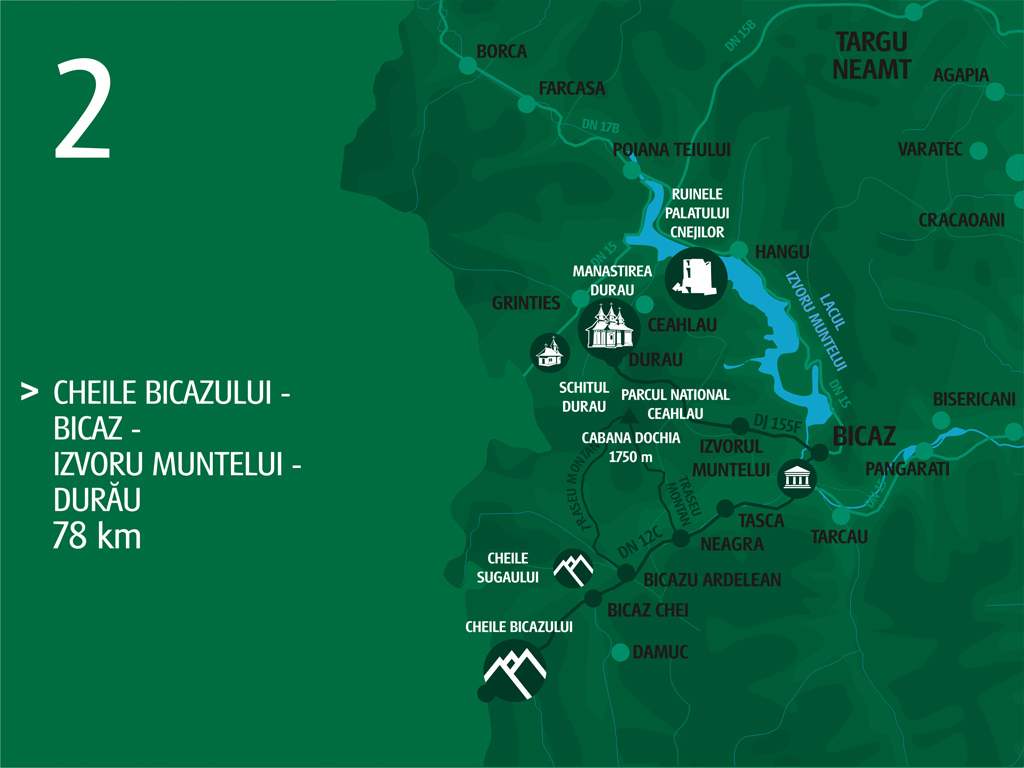
The Bicaz Gorge – Bicaz – Izvorul Muntelui – Durău Route
Tourist Circuit Maps Neamț County
Among the many attractions in the Neamț region, we recommend the following route for those who love mountain scenery, passing through one of the country’s most appealing tourist areas.
The route starts in Bicaz Gorge, passes through the town of Bicaz, follows the road towards Izvorul Muntelui Mountain Lodge, then takes the road through Ceahlău National Park to the resort of Durău. The attractions you will encounter along the route are:
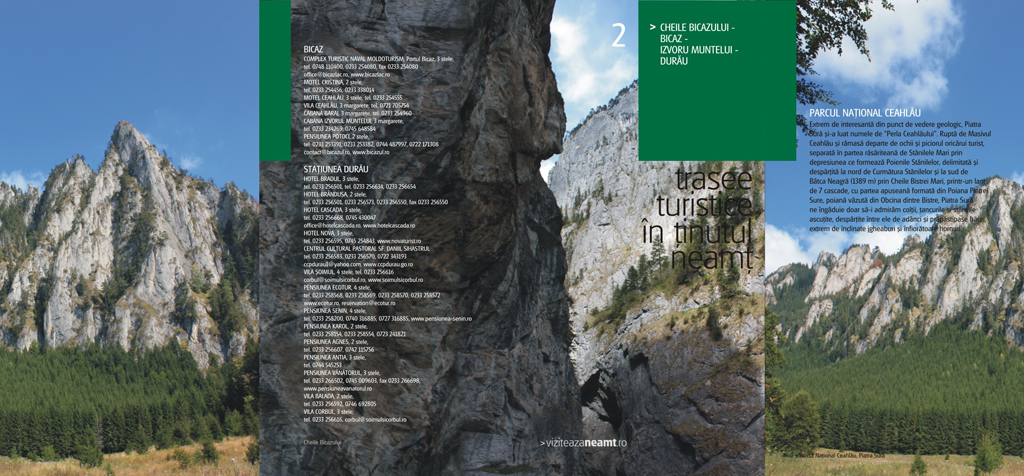
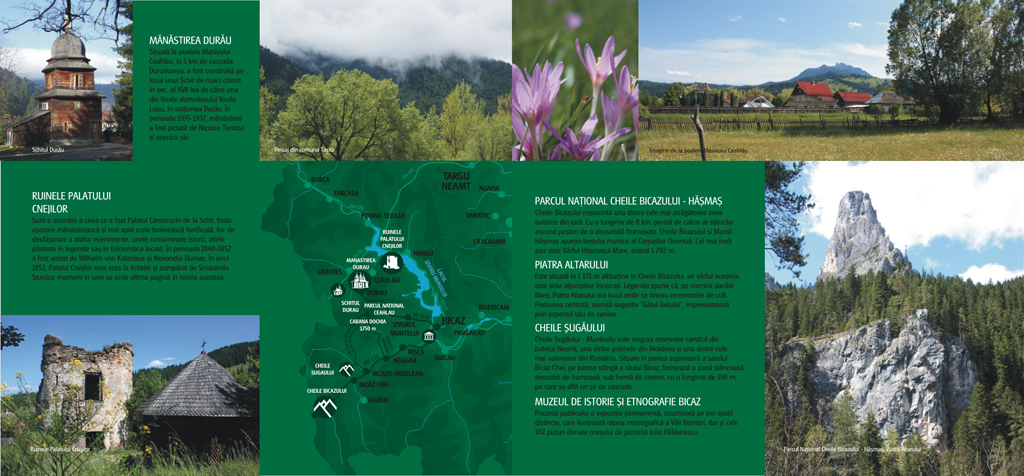
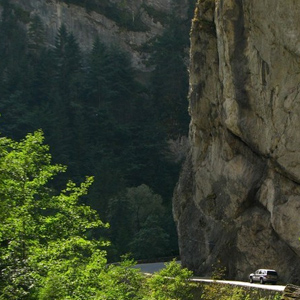


Cheile Bicazului-Hășmaș National Park – The impressive scale of Bicaz Gorge makes this one of the country’s most appealing tourist areas. Part of the Eastern Carpathians, the gorge is bounded to the north and north-west by Suhardul Mare (1,506 m) and to the south-east by Suhardul Mic (1,352 m), and extends for 8 km. Formed over time as the river Bicaz and its tributaries eroded the softer Mesozoic limestone, Bicaz Gorge lies within Cheile Bicazului – Hășmaș National Park, alongside the other protected areas of Red Lake, Bicaz Gorge, Sugaului Gorge, Hasmasul Mare and Hasmasul Negru.
“Piatra Altarului” – Along the road through Bicaz Gorge, you can admire “Piatra Altarului”, a rocky massif at an altitude of 1,120 m. Its summit attracts experienced climbers and, according to legend, was a site of religious ceremonies in the days of the free Dacians; “Piatra Arsitei” and “Piatra Singuratica” can also be seen. The central section, evocatively named “Gatul Iadului”, impresses with its canyon-like appearance.
Sugaului Gorge – Munticelu Reserve – The Sugaului Gorge protected area is a particularly beautiful rocky canyon, 350 m long, with a series of waterfalls. Here we find endemic plant species, petrifying springs that form calcareous tufa, rare animal species, surface and underground karst formations, fossil-bearing limestone and enchanting scenery.
Ceahlău National Park – Ceahlău Massif is the highest massif in the Bistritei Mountains, the greatest tourist attraction in the Eastern Carpathians and the most important massif in Moldavia. Regarded by the Dacians as the dwelling place of the god Zamolxis, Ceahlău Massif was known in ancient times as Pion (Peon), meaning “house of the pillar”. Ceahlău Massif is also considered Christianity’s second holy mountain, after Athos Mountain. This is probably why it appears so frequently in the works of the great Romanian writers Alexandru Vlahuță, Calistrat Hogaș and Mihail Sadoveanu.
Bicaz Museum of History and Ethnography – The museum was founded in 1958 following extensive research by the Romanian Academy in the area of the reservoir serving the “Dimitrie Leonida” hydroelectric power station at Bicaz. Since 1966, the museum has occupied the former “Ion Kalinderu” village theatre. Built in the early 20th century, the museum building is listed as a historic monument. The museum’s permanent exhibition is arranged across three distinct spaces, presenting the history of the Bistrița Valley as well as the 102 paintings donated to the town by the painter Iulia Halaucesu.
Durău Monastery – It was built on the site of a hermitage for nuns founded in the 17th century by one of the daughters of Prince Vasile Lupu. The first documentary reference to Durău Monastery dates from 1779, when the schema-nun Nazaria was abbess. Completed in 1835, the church was dedicated to the Annunciation and consecrated by Metropolitan Veniamin Costachi. The narthex, nave and sanctuary of Durău Monastery remained unpainted from 1835 until 1935, when Nicolae Tonitza and his apprentices, students and graduates of the Academy of Fine Arts in Iasi – including Corneliu Baba – decorated them with wax paintings using the encaustic technique. Under the master’s guidance, the students gave the figures a strongly human character, also imparting something of the distinctive Romanian folk tradition.
Palatul Cnejilor Ruins – Palatul Cnejilor, an architectural complex that witnessed many historical events, greets us today as ruins surrounded by an air of mystery and legend that still endures. Its origins date back to the 13th century, when the founder Silvestru built a hermitage on this site, under the authority of Neamț Monastery.
More on the same topic

Neamț receives five nominations across four categories in Destinația Anului
We have good news for everyone who loves Neamț County and all its beauty: it is among the finalists in the Destinația Anului 2024 competition, with five nominations across four categories: Piatra Neamț in the Inspiring Cities category.

Military firefighters bring competition and lots of adrenaline to Târgu Neamț
Târgu Neamț is hosting the 3rd zonal stage of the professional emergency situation competitions, in which representative teams from several counties of the country will participate: Bacău, Botoșani, Iași, Neamț, and Suceava.
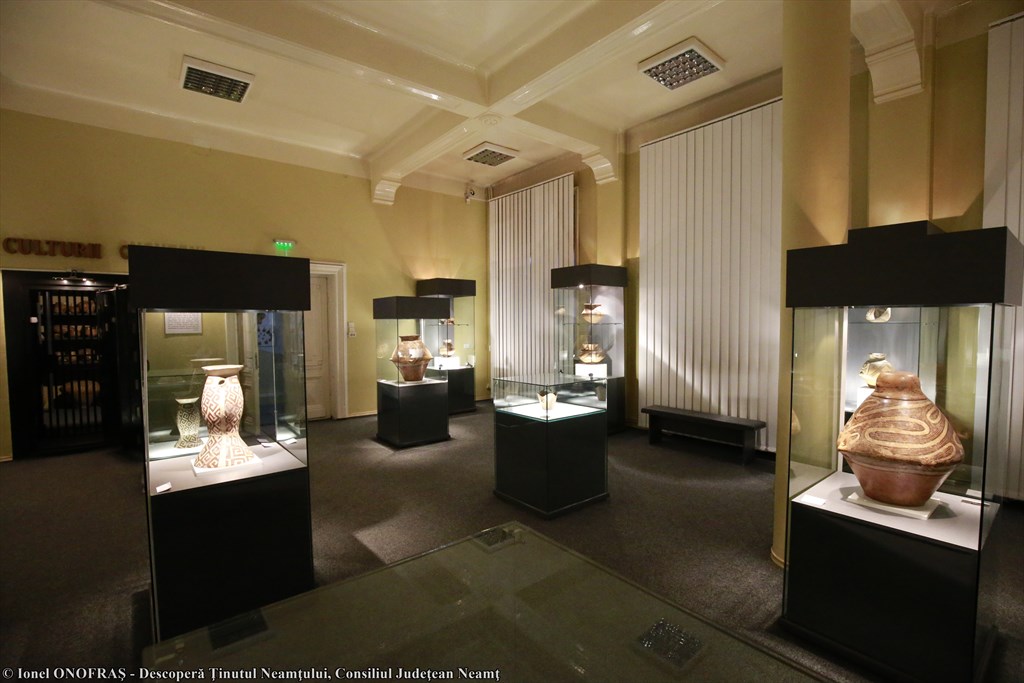
Discover, in Piatra Neamț, the most important Eneolitic art collection from the South-East of Europe
Photo Gallery: Nationally one of the kind, both history and art museum, it currently hosts the most spectacular artefacts, famous objects that belong to the Cucuteni–Trypillia Culture, which is in…