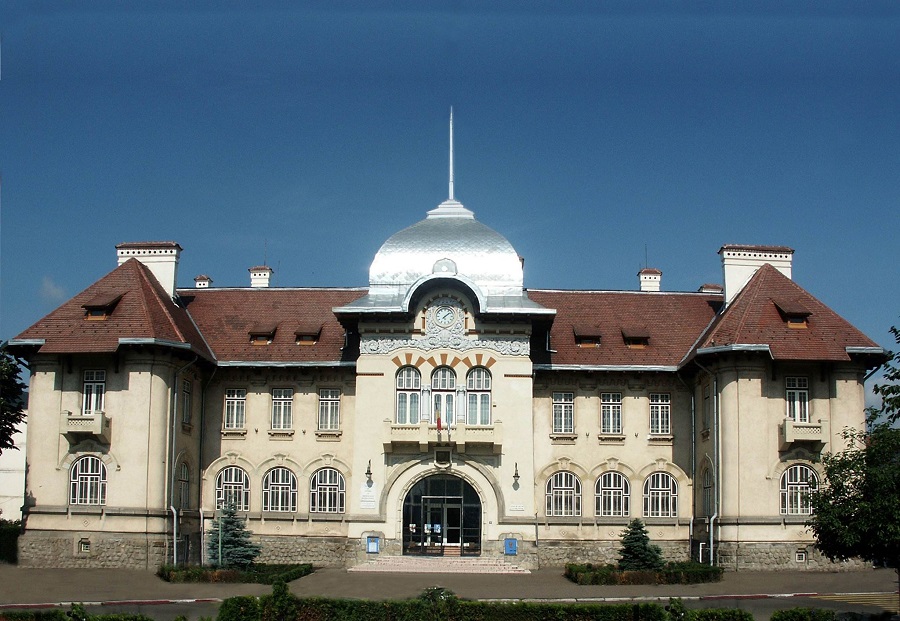
NEAMȚ COUNTY MUSEUM COMPLEX – “Jucării de altădată” exhibition
PRESS RELEASE
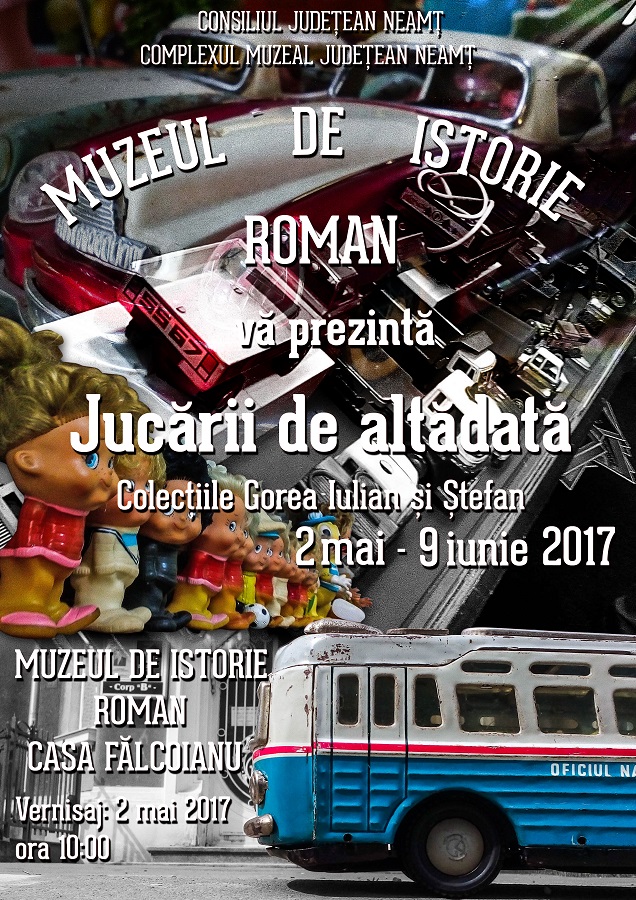
The History Museum Roman is hosting the Jucării de altădată exhibition from 02 May – 09 June 2017, featuring toys belonging to collectors Gorea Iulian and Ștefan from Piatra Neamț. The exhibition is aimed particularly at children, with display cases presenting a wide range of toys grouped into categories – industrial vehicles, transport vehicles (buses, trams, trains), racing cars and military vehicles, as well as dolls, games and musical instruments. Below, we present a few particularly unusual toys (the descriptions are taken from the website http://muzeuljucariilor.ro/):
– the ONT bus, a miniature replica of the real bus used by Oficiul Național pentru Turism – the toy that sold out first in bookshops in the 70s. The ONT bus was made by the Metaloglobus factory, founded in 1923 by Austrian industrialist Weiss Manfred (Metaloglobus produced metal containers, boilers, street numbers and lanterns for Arab countries; after nationalisation, its workers also specialised in stainless steel products, zips and hunting cartridges, and in 1965 opened the toy department. 4-5 million plush puppies, kittens and squirrels, or iron rifles, machine guns, trumpets and tambourines, were produced here each year)
The toy was assembled from numerous parts, including chrome-plated and painted sheet metal components, rubber wheels and painted metal hubcaps. The bumper and headlights were separate parts, while the small windows were made of Perspex.
– the tram, made from sheet metal by the well-known AGATEX company in Timișoara, was one of Romania’s popular toys from the 1960s to the 1980s. The first version appeared in 1966 and was a replica of a real tram running through the streets of Timișoara. A simple flywheel mechanism powered the small vehicle. Accidents involving children and the toy’s sharp edges and metal pantograph prompted an attempt to produce a more compact, safer version in 1979. Smiling faces of child passengers, lithographed onto the pressed sheet metal, replaced the cut-out windows, and the fragile metal pantograph was replaced by an even more fragile plastic one. The metal front and rear bumpers were replaced with plastic ones, while the lead wheel rims of the first version were replaced with PVC ones. In keeping with the drive to save materials dictated by the party line, the version from the 1980s had a simplified construction using thinner sheet metal with a light coat of paint. Some parts, the roof and chassis, were made of galvanised sheet metal coated only with varnish, creating the illusion of metallic paint. The toy cost 23 lei in 1966, rising to 37 lei in 1979. The last trams remained in bookshops until 1991–1992.
– Donald the duck was a very popular toy in Romania in the 1970s and 1980s. Made from rubber by the Arădeanca factory in the 1970s, it was a fixture in Romania’s kindergartens, nurseries and homes at the time. There are two models – Donald the sailor and Donald the guitarist, the latter being rarer. The figurines were probably copied from Western toys.
As they were painted by hand, there are many differences between individual toys, making each almost unique. One curious detail is the tattoo of a pierced heart on one of the toy’s arms; it was probably the only tattooed toy of the communist era.
As the toy was very durable, many examples have survived to this day.
– “Cine știe răspunde”, an educational electric game for children aged 7-12, made by Cooperativa Unirea in Petroșani in 1971.
One or more children could play this game, trying to answer 250 questions on its 5 boards. A correct answer, given by touching 2 electrical contacts, lit up a bulb. The game is powered by a 4.5 V battery installed in its box. Its questions and answers cover several subjects: geography, zoology, botany and riddles. As the electrical connections inside the box remained unchanged, children could learn where the answers were on the boards after playing for a while.
– Arădeanca dolls, (the factory being the oldest Romanian doll manufacturer)
Arădeanca dolls were so highly regarded that in the ‘80s they were exported to Soviet countries and to Great Britain.
Poster:
More on the same topic

Neamț County, an Ambassador for Local Traditions and Values in Brussels
Neamț County showcased its values, traditions and development potential on the European stage during European Week of Regions and Cities, held in Brussels from 12 to 14 October.

Solo painting exhibition – Florin Mareș
Starting Saturday, 10 October 2026, the Art Museum in Roman opens a new solo exhibition by the visual artist Florin Mareș of Roman.

Book launch: “Regina Maria a României. Din viață în eternitate” by historian Narcis Dorin Ion
Neamț National Museum Complex invites audiences in Neamț to the launch of “Regina Maria a României.