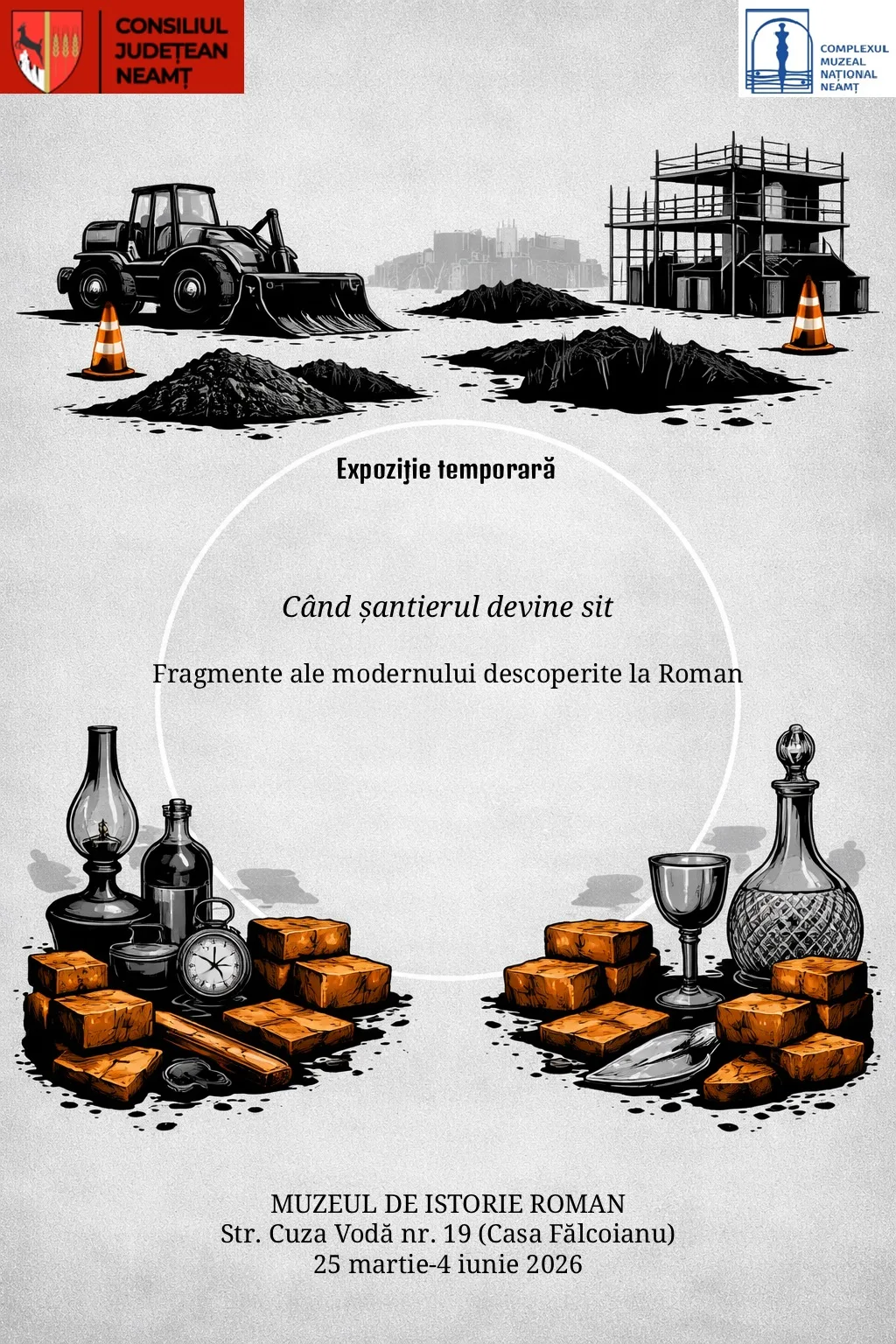
Exhibition – “Când șantierul devine sit” (Roman History Museum)
The Roman History Museum, part of Neamț National Museum Complex, announces the opening of the exhibition “When a Construction Site Becomes an Archaeological Site. Fragments of Modernity Discovered at Roman”, which can be visited from 25 March to 4 June 2026 at the Roman History Museum, Cuza Vodă Street, no. 19 (Fălcoianu House).
The exhibition presents the findings of preventive archaeological investigations carried out in 2025 in the city of Roman, during construction work on building “B” and the sports hall at “Costache Negri” School. The development’s proximity to “Precista Mică” Church made an archaeological intervention necessary to document and protect the area’s historical heritage.
The investigation uncovered both medieval remains and a collection of objects dating from the 19th–20th centuries, reflecting the town’s social and economic dynamics in the modern era. The variety of finds reveals an active urban community connected to regional and European trade networks, where everyday objects coexisted with imported products and goods reflecting increasingly varied consumption and adaptation to modern comforts.
The objects discovered illustrate the diversity of urban activities and everyday practices: pharmaceutical containers, packaging for food and drinks, objects associated with small local industries or trade, and materials reflecting the historical context of the first half of the 20th century. Beyond their original practical purpose, they provide important evidence for tracing the development of the urban environment and the community’s interaction with the economic and technological changes of the modern era.
The exhibition highlights the role of urban preventive archaeology, an essential part of protecting cultural heritage amid contemporary development. By intervening before or during construction work, archaeologists can identify, document and recover remains that would otherwise be destroyed, helping to incorporate them into cultural heritage and share their significance through research and public display.
Through its theme, the exhibition emphasises that the past consists not only of spectacular monuments or very old artefacts, but also of ordinary objects used in everyday life, which become part of the archaeological heritage over time.
Exhibition curator: museum curator, Dănuț Prisecaru
More on the same topic

Neamț County, an Ambassador for Local Traditions and Values in Brussels
Neamț County showcased its values, traditions and development potential on the European stage during European Week of Regions and Cities, held in Brussels from 12 to 14 October.

Solo painting exhibition – Florin Mareș
Starting Saturday, 10 October 2026, the Art Museum in Roman opens a new solo exhibition by the visual artist Florin Mareș of Roman.

Book launch: “Regina Maria a României. Din viață în eternitate” by historian Narcis Dorin Ion
Neamț National Museum Complex invites audiences in Neamț to the launch of “Regina Maria a României.