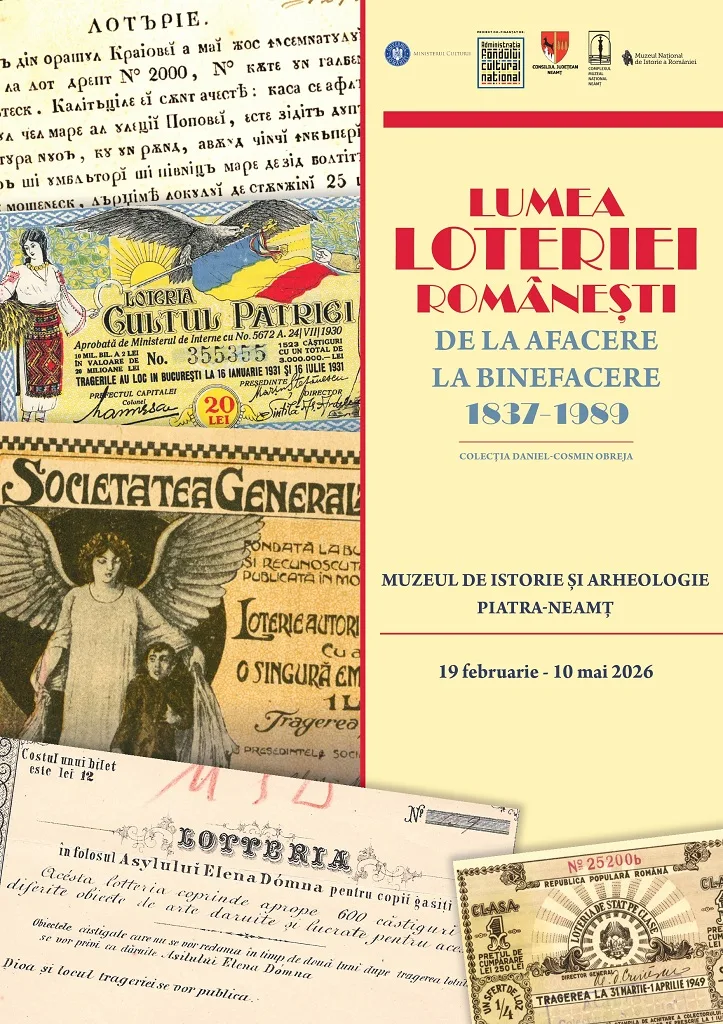
Exhibition “The World of the Romanian Lottery: from Business to Charity (1837-1989)” – History and Archaeology Museum Piatra-Neamț
Neamț National Museum Complex and the National Museum of Romanian History announce the organisation of the exhibition “The World of the Romanian Lottery: from Business to Charity (1837-1989)” at the History and Archaeology Museum Piatra-Neamț. The opening will take place on Thursday, 19 February 2026, at 13:00.
The history of the lottery was closely linked to charitable activities for a century, from the mid-19th century to the mid-20th century. One of the first charitable lotteries was held under the patronage of Mrs Elena Cuza for the construction of the Elena Doamna Asylum for foundlings in 1863. Two years later another lottery was held to support the Asylum; two tickets from that lottery have been preserved and are part of our exhibition.
Queen Elisabeta and later Queen Maria patronised charitable associations that built hospitals, schools, orphanages, asylums and sanatoria, and the funds were raised through lotteries; a few of the tickets from these lotteries have been discovered and are kept in the Daniel-Cosmin Obreja Collection.
For the first time, at Piatra Neamț, the earliest envelope tickets with immediate prizes will be displayed – tickets from the 1921 Merchants’ Council Lottery, one of which is a winner.
In addition to assisting the sick, widows, war veterans and disaster victims, charitable associations and foundations organised hundreds of lotteries to hold cottage-industry exhibitions, construct public buildings and support artists. Lotteries for occupational groups (military personnel, lawyers, actors, officials, journalists and students) helped the sick, the unemployed and their descendants. A separate section of the exhibition will be devoted to buildings across the country that were erected with lottery funds.
The establishment of the State Lottery (1906) at the suggestion of Dr Thoma Ionescu, founder of the Romanian School of Surgery, aimed to assist hospitals and improve the country’s health situation, with 80 % of the lottery’s profit allocated to the construction and funding of hospitals.
The second State Lottery (1932–1947), established at the initiative of Dr Ioan Cantacuzino, financed the fight against tuberculosis, the scourge of the interwar period.
In the early decades of the 20th century, the lottery was used to try to provide economic education to the population, just as we do today through our exhibition, in order to prevent gambling addiction among the younger generation and to foster an appreciation for history and an understanding of past eras.
The lottery under communism is represented not only by lottery tickets but also by pocket mirrors bearing Loto-Prono advertising and the Loto-Prono mascot Iliuță.
The exhibition that will open at Neamț National Museum Complex includes lottery tickets from the period 1837 – 1989, from the Daniel-Cosmin Obreja Collection, and was realised as part of the project “The World of the Romanian Lottery: from Business to Charity (1837-1989)”, co-financed by the National Cultural Fund Administration.
We invite you to visit it and discover what lottery tickets looked like at the end of the 19th century and the beginning of the 20th century, which churches were renovated with the help of charitable lotteries and how personalities such as Nicolae Iorga were involved in patronising associations that organised charitable lotteries.
The curators of the exhibition are Dr Cristina Păiușan and Daniel-Cosmin Obreja.
The exhibition can be visited during the period 19 February-10 May 2026.
More on the same topic

Neamț County, an Ambassador for Local Traditions and Values in Brussels
Neamț County showcased its values, traditions and development potential on the European stage during European Week of Regions and Cities, held in Brussels from 12 to 14 October.

Solo painting exhibition – Florin Mareș
Starting Saturday, 10 October 2026, the Art Museum in Roman opens a new solo exhibition by the visual artist Florin Mareș of Roman.

Book launch: “Regina Maria a României. Din viață în eternitate” by historian Narcis Dorin Ion
Neamț National Museum Complex invites audiences in Neamț to the launch of “Regina Maria a României.