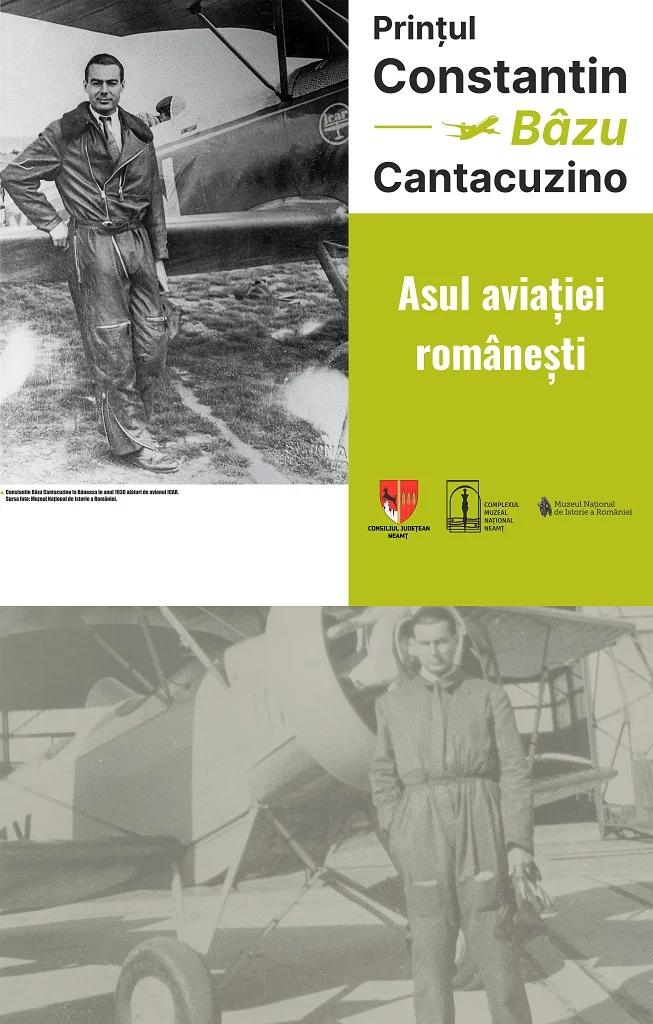
Outdoor exhibition project – Prince Constantin Bâzu Cantacuzino
With the aim of honouring the remarkable personality of pilot Constantin Bâzu Cantacuzino, Neamț National Museum Complex proposes an outdoor exhibition project titled Prince Constantin Bâzu Cantacuzino. The Ace of Romanian Aviation. Known in aviation history by the nickname Bâzu, pilot Constantin Cantacuzino (1905-1958) was a descendant of the Cantacuzino family, nobles of Byzantine origin, who gave the Romanian lands the rulers Șerban Cantacuzino and Ștefan Cantacuzino, the high steward Constantin Cantacuzino, and also the grand sword-bearer Mihai Cantacuzino.
He took part in both campaigns of the Second World War, being assigned from 6 July 1941 to the 53rd Fighter Squadron, with which he fought on the Eastern Front.
He distinguished himself as a pilot with exceptional qualities, and was therefore proposed on 30 August 1943 for promotion to the rank of Captain-aviator and awarded the Military Order “Mihai Viteazul”, third class, the highest Romanian war distinction.
The end of the Second World War found him on the Western Front, in Czechoslovakia, having carried out 608 missions in enemy airspace and fought 210 aerial battles, with 63 victories, of which 39 were confirmed, 14 pending confirmation and 10 unconfirmed. Thus, he ranked first among the aces of Romanian aviation and sixth in a ranking by nations, out of a total of 22 belligerent countries, with 69 aerial victories.
With the establishment of the communist regime in Romania, a difficult period began for members of the Romanian aristocracy, which is why, on 21 January 1948, Constantin Bâzu Cantacuzino decided to emigrate abroad. Following a flight with its final stop in Milan, pilot Constantin Bâzu Cantacuzino handed the aircraft over to co-pilot Tudose Stelian and left his comrades a farewell note stating: “Milan. 22 January 1948. Dear Mr Tudose and dear comrades, last night I sent the T.A.R.S. company the following telegram: ‘In response to the treatment you have subjected me to, please consider me to have resigned.’ C.M. Cantacuzino.”
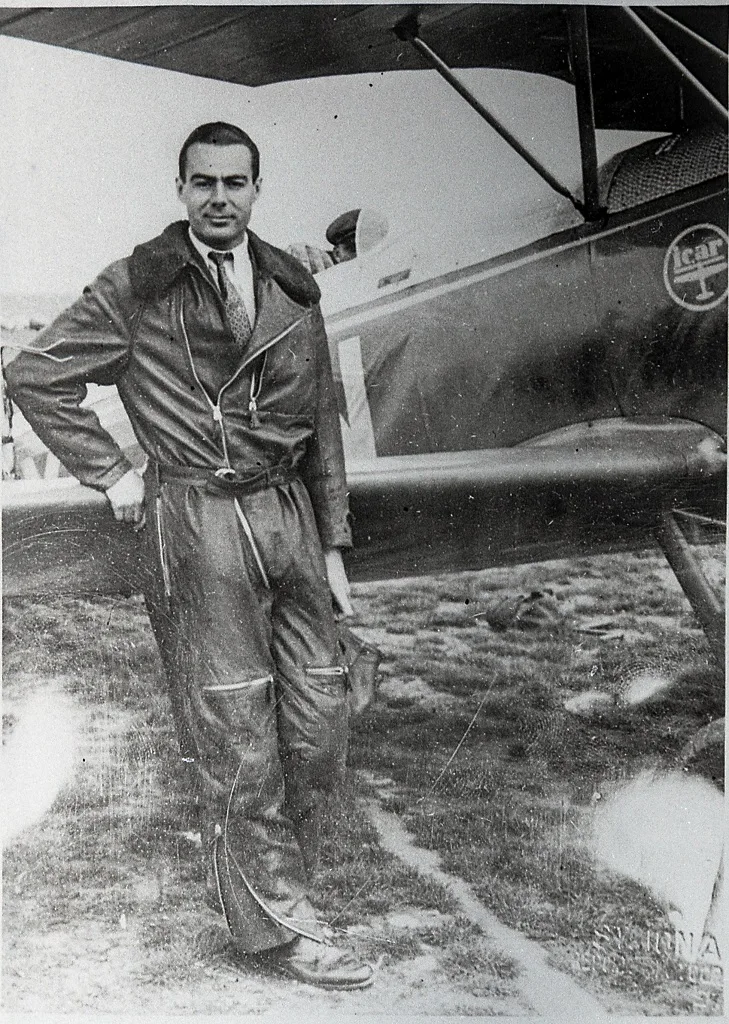
As a result of this decision, his Romanian citizenship was revoked on 23 February 1948 by ministerial decision No. 165. Constantin Bâzu Cantacuzino obtained political refugee status from the Italian Ministry of Foreign Affairs on 11 May 1948, allowing him to travel to Paris, where he reunited with his family. Later, in 1950, he settled in Spain, where he worked as a pilot for an aerial work company. During surgery for an ulcer, a condition he had developed during the Second World War, he died on the operating table in Madrid on 26 May 1958, joining his comrades to re-form the “Escadrila din Ceruri”.
We would like to thank our collaborators, the National Museum of Romanian History and film director and historian Lucian Dobrovicescu, for their contribution to the realisation of this exhibition project.
The street exhibition will be displayed near the Cucuteni Eneolithic Art Museum, “Gheorghe Dumitroaia”, from 17 February of the current year.
More on the same topic

Neamț County, an Ambassador for Local Traditions and Values in Brussels
Neamț County showcased its values, traditions and development potential on the European stage during European Week of Regions and Cities, held in Brussels from 12 to 14 October.

Solo painting exhibition – Florin Mareș
Starting Saturday, 10 October 2026, the Art Museum in Roman opens a new solo exhibition by the visual artist Florin Mareș of Roman.

Book launch: “Regina Maria a României. Din viață în eternitate” by historian Narcis Dorin Ion
Neamț National Museum Complex invites audiences in Neamț to the launch of “Regina Maria a României.