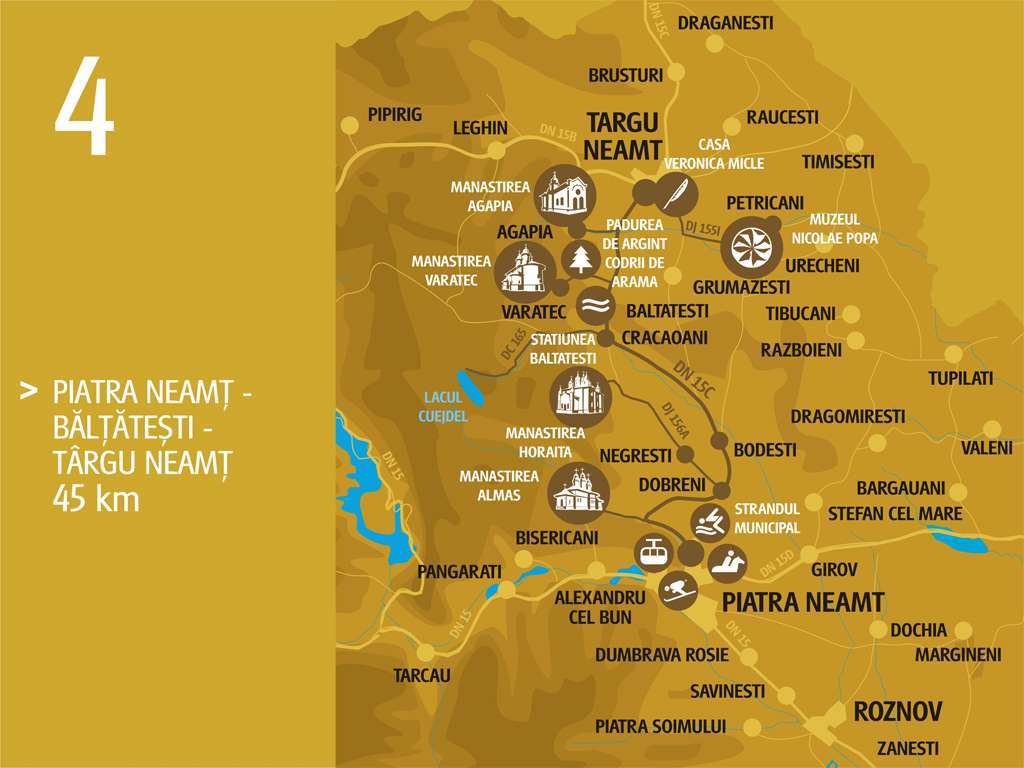
The Piatra Neamț – Bălțătești – Tg Neamț route
Tourist Circuit Maps of Neamț County
In Neamț County, we find priceless material and spiritual treasures that form part of the national heritage, have shaped our country's history and remain in people's collective memory.
Travelling from Piatra Neamț, a beautiful, lively mountain town, to the town of Targul Neamț, you have the opportunity to discover numerous museums, memorial houses, monasteries and churches rich in history and tradition, waiting for you to visit.
Alongside them, you will find particularly beautiful guesthouses and villas built in a traditional style, inviting you to pause before setting off to explore these wonderful places.
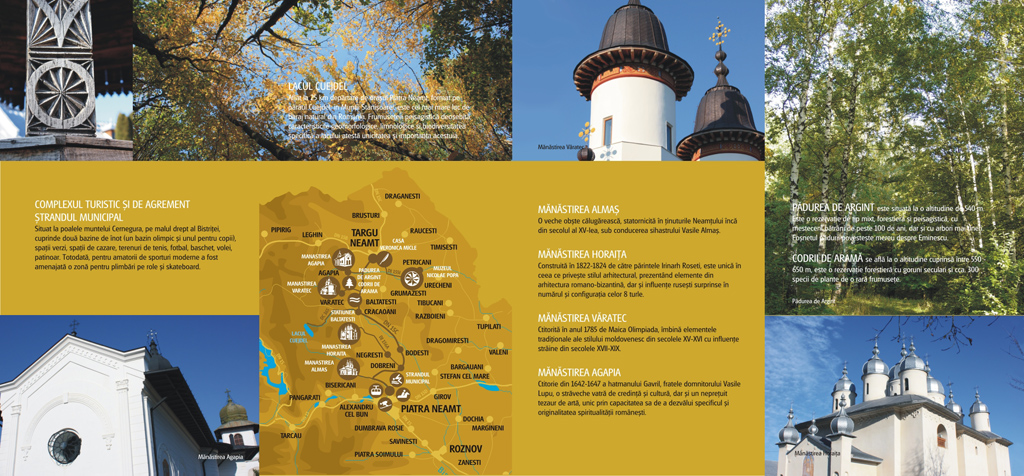


Piatra Neamț Tourism and Leisure Complex – The “Peste Vale” Tourism and Leisure Complex, situated at the foot of Cernegura Mountain on the right bank of the Bistrita, offers visitors all the facilities they need for recreation and relaxation: sports grounds, children's playgrounds, swimming pools, a designated beach and campsite, sun loungers, barbecues, etc.
Almaș Monastery is situated in the valley of the Almaș stream in Gârcina commune, in a glade at the foot of a wooded hill, approximately 12 km north-west of the town of Piatra Neamț, at an altitude of 510 m. The monastery at Almaș has its origins in a monastic community from the 15th century led by the hermit Vasile Almaș, who came from Tara Hategului. The church has distinctive architecture: built in the shape of a cross, it has three towers aligned from east to west, with the central tower rising above the others.
Horaița Monastery – The church at Horaita is architecturally unique. It features elements of Roman-Byzantine architecture as well as Russian influences, reflected in the number and arrangement of its 8 towers. The iconostasis at Horaița Monastery, made in Vienna, is unique in the country, and probably in the world, because of the position of the pulpit above the royal doors and the arrangement of two tiers that departs from Orthodox tradition: the tier of the Holy Apostles and the tier of the Old Testament prophets. The carving represents the last survival of the Baroque style in the country and incorporates three types of wood: lime, pear and thuja.
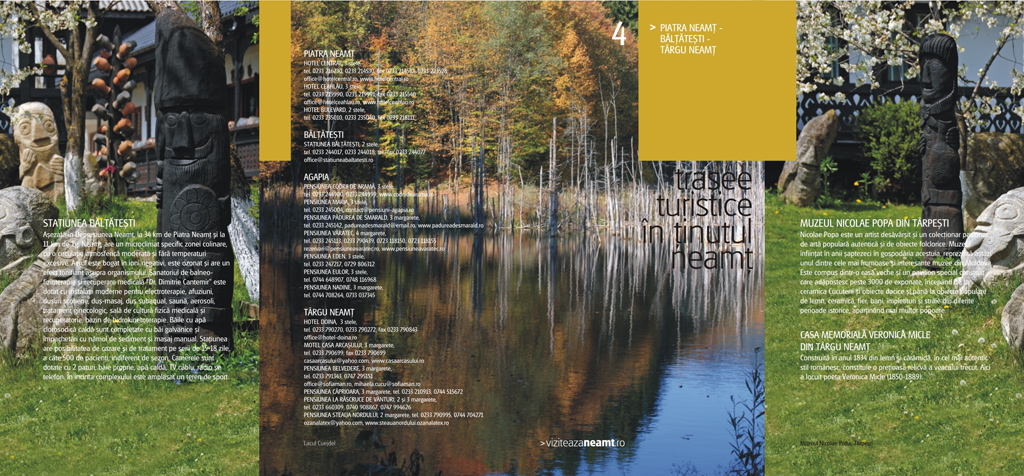
Cuejdel Lake – Set amid tranquil fir forests in a wild landscape, with the appearance of a submerged forest, Cuejdel Lake covers 2.2 ha, is 1 km long and has a maximum depth of 16 m. Its exceptional scenic beauty, geomorphological and limnological characteristics, and distinctive biodiversity testify to its uniqueness and importance. These qualities formed the basis for declaring Cuejdel Lake a nature reserve in 2004, allowing the area to receive special protection.
Bălțătești Spa Resort is situated 34 km from the city of Piatra Neamț and 11 km from the town of Târgu Neamț, on DN 15 C in the centre of Bălțătești commune. Set in beautiful natural surroundings with a moderate climate, the resort has mineral springs with a high salt content and significant therapeutic properties. Currently, Bălțătești Spa Resort has 4 hotels with a capacity of 500 beds.
Văratec Monastery – is situated in Agapia commune, 12 km north-west of the town of Târgu Neamț and 40 km from the town of Piatra Neamț, in a small depression at the foot of the Stanisoara Mountains, sheltered by the Dealul Mare ridge, at an altitude no higher than 460 m. The architecture of the church at Văratec Monastery combines traditional elements of the Moldavian style from the 15th–16th centuries with foreign influences from the 17th–19th centuries. The monastery complex at Văratec also includes the Church of Saint John the Baptist, dating from the 19th century, beside which lies the tomb of Veronica Micle, and the Church of the Transfiguration, also dating from the 19th century.
Agapia Monastery – Situated in the valley of the Agapia – Topolita stream, at the foot of the Magura ridge near Văratec Monastery, Agapia Monastery is the only monastic settlement in the country whose name means “Christian love”, derived from the Greek “agapis”. Painted by Nicolae Grigorescu in 1858, Agapia Monastery is an architectural jewel combining features of the Byzantine and neoclassical styles with Romanian art. At Agapia Monastery, there is an impressive museum collection of medieval and religious art, as well as a library containing old books and manuscripts. The monastic village at Agapia also houses the Alexandru Vlahuță Memorial House, which is open to visitors.
Padurea de argint – “Padurea de argint” is a mixed forest and landscape reserve. It covers approximately 2.4 ha and consists of a stand of birch trees. Most of the forest's trees are over 100 years old, but there are also younger trees aged between 20 and 50 years.
Codrii de arama – The “Codrii de arama” Forest Reserve covers 10.2 ha and consists mainly of centuries-old sessile oaks. Alongside them grow approximately 300 species of plants of rare beauty. Around sunset, in the light of the sun's rays, you can admire the “incense-scented air” described by the great Romanian poet Mihai Eminescu in Calin – file din poveste.
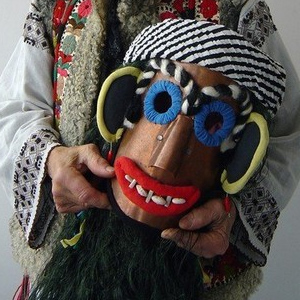
Neculai Popa Museum Târpești – Born on 13 August 1913, Neculai Popa is an accomplished artist and a passionate collector of authentic folk art and traditional objects. Founded in the seventies on his homestead, the museum is now one of the most beautiful and interesting museums in Moldavia. It consists of an old house and a purpose-built pavilion housing over 3,000 exhibits, ranging from Cucuteni pottery and Dacian objects to traditional wooden and iron objects, coins, woven items and clothing from different historical periods and peoples.
Veronica Micle Memorial House – The Veronica Micle Memorial House was built in 1834 by the monks of Neamț Monastery and bought by the writer's mother in 1850. Throughout her life, Veronica Micle often came to stay in this house, which she loved dearly. The museum's permanent exhibition is devoted to the life and literary work of the muse of our national poet, Mihai Eminescu, displaying objects and documents that belonged to her. One of the rooms recreates the setting in which Veronica Micle wrote some of her poems, maxims and letters. As we leave the museum, across the road we can admire “Aleea plopilor fara sot”, which features in Mihai Eminescu's love poetry.
More on the same topic
A Thousand and one stories in Neamt
Dear Traveller, wherever you come from, we invite you to discover the blessed lands of Neamț, a sacred realm once inhabited by the ancient Dacians, rich in legends and myths, with a history and roots…
A quarter of a century of medieval events in Neamț
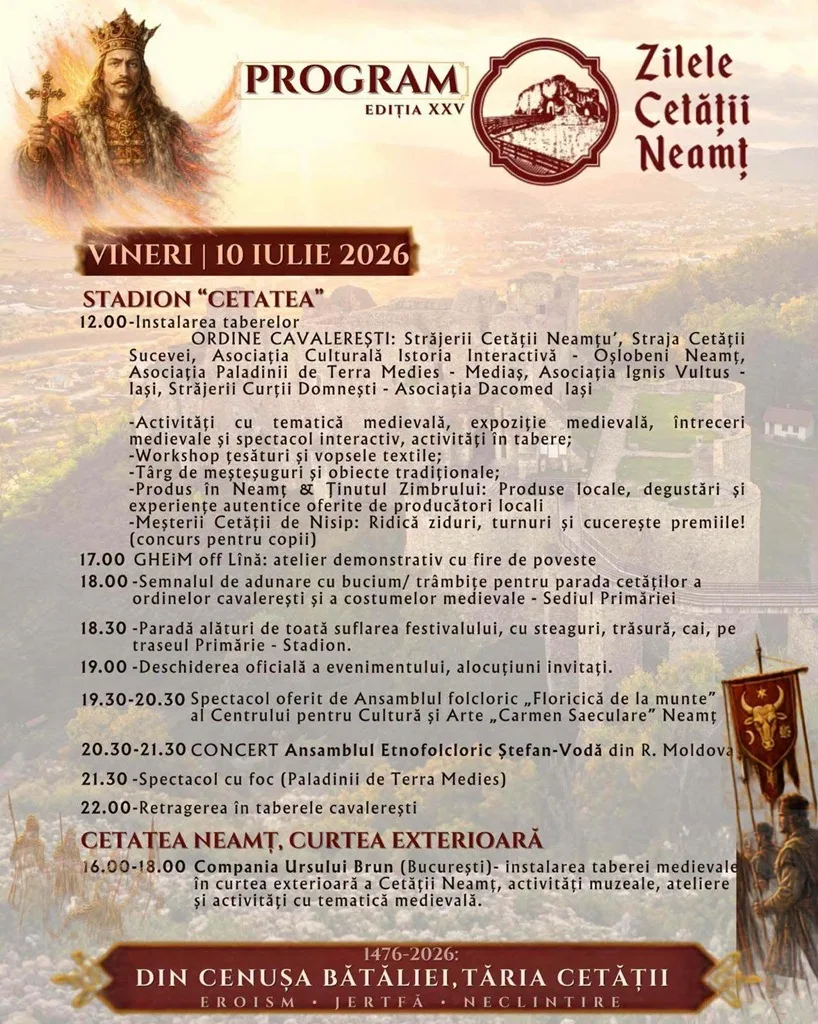
The Zilele Cetății Neamț Medieval Festival marks a quarter of a century. Now in its 25th edition, this year's event will open its doors from 10–12 July to a world of stories and pages of history from the time of Stephen the Great, Prince of Moldavia.
South-eastern Europe’s most important collection of Eneolithic art – a finalist in Destinația Anului 2026
The development of human communities in Neamț County, dating back to the Upper Palaeolithic, contributed to the emergence of Europe’s most remarkable and most extensively studied prehistoric…