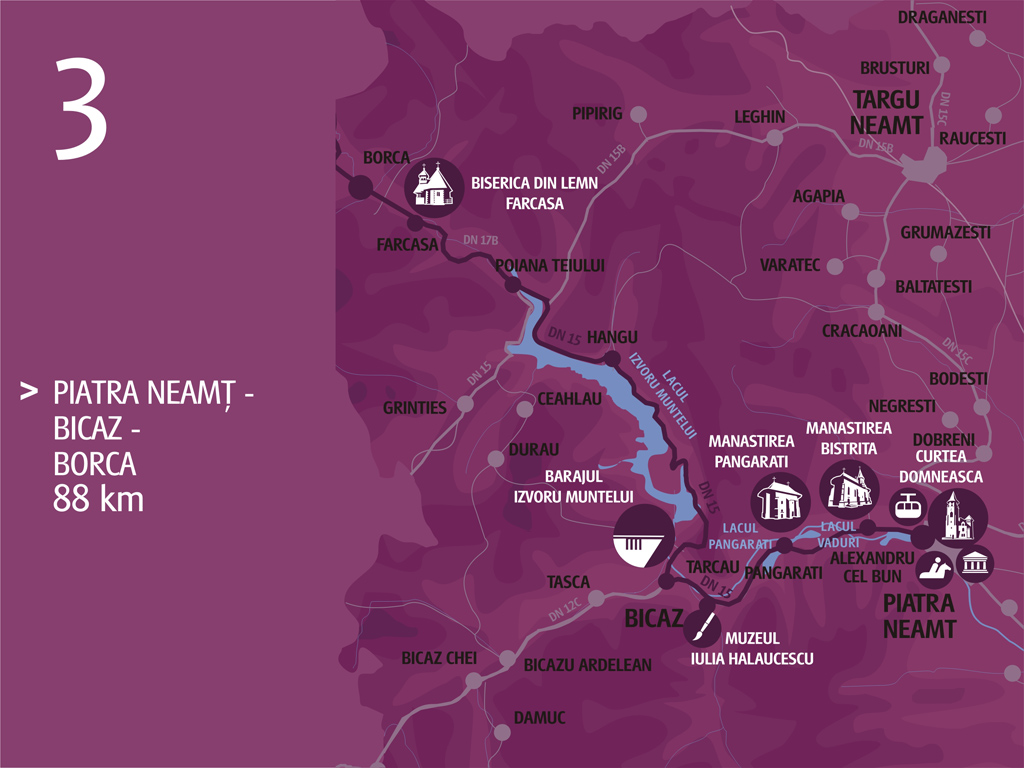
Tourist route: Piatra Neamț – Bicaz – Borca
Tourist Circuit Maps Neamț County
Once in Neamț, you can discover some of this county's history and culture by visiting attractions that bear witness to the region's richness and beauty. Here are some of the attractions along the route from Piatra Neamț through Bicaz towards Borca.
Tourist attractions along the Piatra Neamț – Bicaz – Borca route on Google Maps
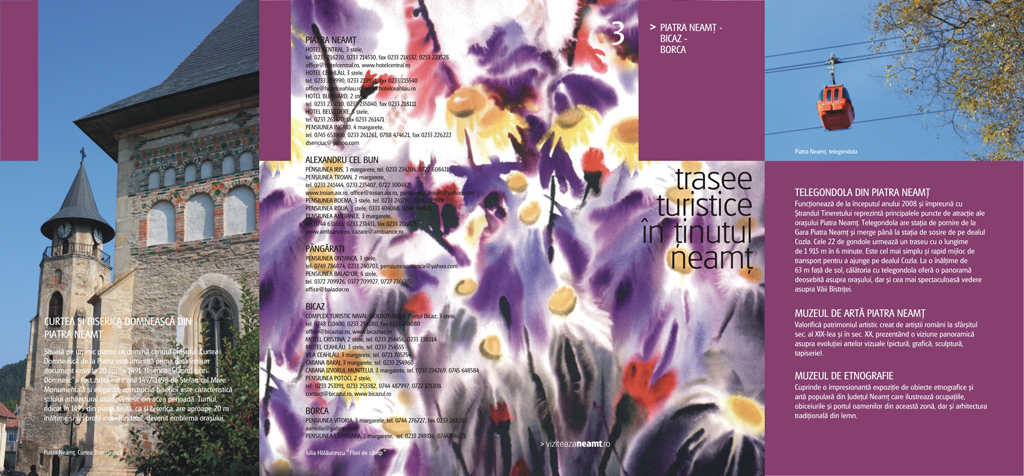
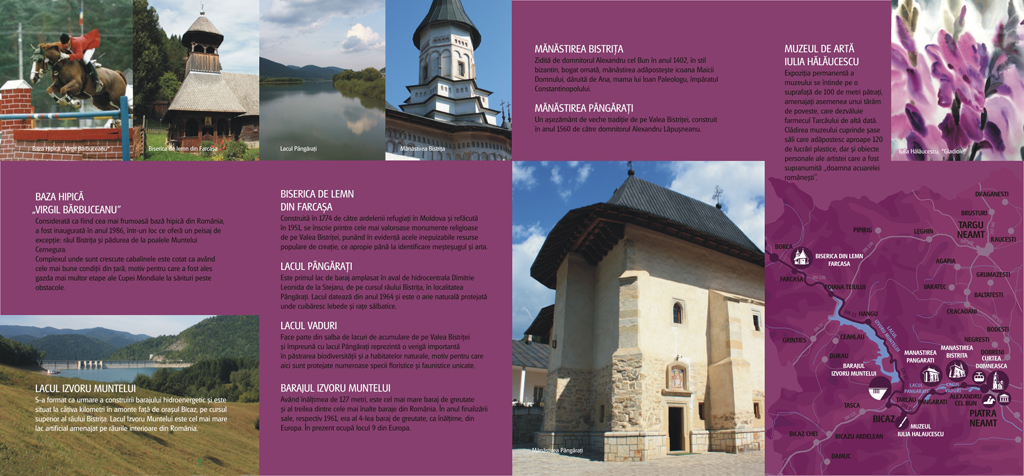


Princely Court and Church in Piatra Neamț – Founded by Voivode Stephen the Great between 1468 – 1475, the Princely Court, “Saint Ioan” Church and Bell Tower now form an architectural ensemble in the centre of Piatra Neamț, in Piata Libertatii. On the same plateau, close to the Princely Court, the “Saint Ioan” Princely Church, built between 1497-1498, survives in almost its original form. Beside “Saint Ioan” Church, the Bell Tower was built in 1499 to a height of 19 m.
Art Museum in Piatra Neamț – The building housing the museum was constructed in 1930 by the Italians Carol Zani and Vincenzo Puschiasis. The museum offers a broad view of the development of the visual arts (painting, graphic art, sculpture and tapestry) produced by Romanian artists in the late 19th and 20th centuries. The works of sculptors Ion Irimescu and Ion Jalea and painters Gh. Petrascu, Fr. Sirato, St. Popescu, N. Tonitza, I. Tuculescu and Corneliu Baba trace the interwar period in Romanian art, shaped by the influence of European movements that developed in the 20th century.
Ethnography Museum in Piatra Neamț – Founded in 1980, the Ethnography Museum houses an impressive exhibition of ethnographic objects and folk art from Neamț, illustrating the occupations, customs and dress of the area's people, as well as its traditional wooden architecture.
“Virgil Barbuceanu” Equestrian Centre – The equestrian centre in Piatra Neamț is considered the most beautiful in the country. Opened in 1986 in a setting with exceptional scenery, the centre is surrounded by the Bistrița river and the forest at the foot of Mount Cernegura. In summer, visitors can go horse riding in the Bâtca Doamnei and Bahrin areas on horses specially trained and accustomed to mountain trails. Carriages are available for leisure rides, as well as weddings and other important events. The equestrian centre in Piatra Neamț provides a pony for children.
Gondola lift in Piatra Neamț – When you visit Piatra Neamț, you can see the town from above on a gondola ride, one of the town administration's greatest achievements in tourism. The gondola lift runs from its departure station at Piatra Neamț railway station to its arrival station on Cozla Hill. It is the easiest and quickest way to reach Cozla Hill.
Bistrița Monastery lies 8 kilometres west of Piatra Neamț, on the DN 15 Piatra Neamț-Bicaz road, in the village of Bistrița, in Alexandru cel Bun commune. Sheltered by the surrounding forests, the monastery has endured for more than six centuries, weathering the hardships and trials of history. It is among the oldest monasteries founded by voivodes in Moldavia, preserving princely remains and memories of unforgettable events in the history and spiritual life of the Romanian people.
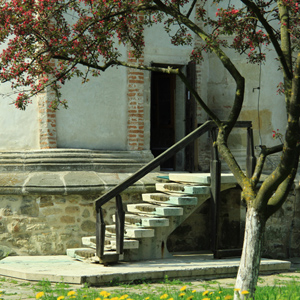
Pângărați Monastery – a settlement with a long tradition in the Bistrița Valley, stands on DN15 Piatra Neamț – Bicaz, near the Dimitrie Leonida hydroelectric power station at Stejaru and near Bisericani. Pângărați Monastery dates back to the 15th century, specifically to 1460, when the venerable Simeon Sihastru, one of Stephen the Great's advisers, built the first wooden church here, dedicated to the Holy Great Martyr Dimitrie. The church's architecture is unique among the monasteries of Moldavia and Romania; its windows are small, double and wooden, with metal grilles on the outside. The porch is lit by a rectangular window to the west and another to the north. The church's exterior walls are plastered and whitewashed in a muted shade of white.
Vaduri Lake – Vaduri Lake lies at an altitude of 350 m in the transverse section of the Bistrița Valley, with the Stanisoarei Mountains to the north and the Gosmanu Mountains to the south. It is a reservoir created in 1966 to generate electricity. The lake provides favourable feeding and shelter conditions for numerous species of migratory birds to spend the winter.
Pângărați Lake – Pângărați Lake lies in the transverse section of the Bistrița Valley at an altitude of 370.6 m, with the Stanisoarei Mountains to the north and the Gosmanu Mountains to the south. With its favourable feeding and shelter conditions, Pângărați Lake is an important area for birds travelling along the eastern Carpathian migration corridor.
“Iulia Halaucescu” Art Museum Tarcău – opened in November 2003 in the commune of Tarcău, in the building that housed the “former teacher’s school”. The museum has six rooms displaying almost 120 works of art, alongside personal belongings of the artist known as the “lady of Romanian watercolour”. Through these works and objects, the museum offers a glimpse into the artist’s life.
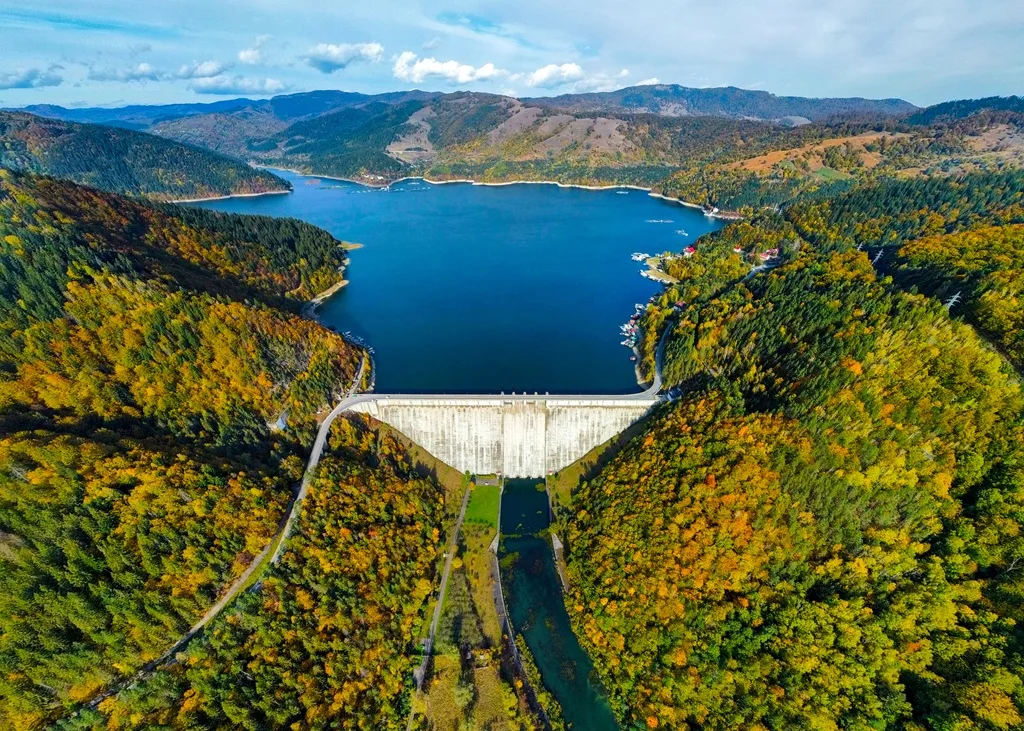
Izvorul Muntelui Dam – was built between 1950-1960 and links Gicovanu Mountain with the Horstei Ridge. It consists of 30 concrete blocks separated by joints sealed on the upstream side with reinforced concrete wedges and copper sheets, and contains kilometres of galleries, ventilation shafts and inspection recesses. The dam is a vast artificial mountain, measuring 435 m in length, 127 m in height and 119 m in width at its base.
Izvorul Muntelui Lake is also known as Bicaz Lake and was formed by the construction of the hydroelectric dam. Situated a few kilometres upstream from the town of Bicaz, on the upper reaches of the Bistrița River, Izvorul Muntelui Lake is the largest artificial lake created on Romania’s inland rivers. The lake also reflects Ceahlău on sunny days.
The wooden church in Farcașa – built in 1774 by Transylvanians who had taken refuge in Moldavia and restored in 1951, ranks among the most valuable religious monuments in the Bistrița Valley, revealing the boundless creativity of folk traditions in which craftsmanship and art become almost indistinguishable.
More on the same topic
A Thousand and one stories in Neamt
Dear Traveller, wherever you come from, we invite you to discover the blessed lands of Neamț, a sacred realm once inhabited by the ancient Dacians, rich in legends and myths, with a history and roots…
A quarter of a century of medieval events in Neamț
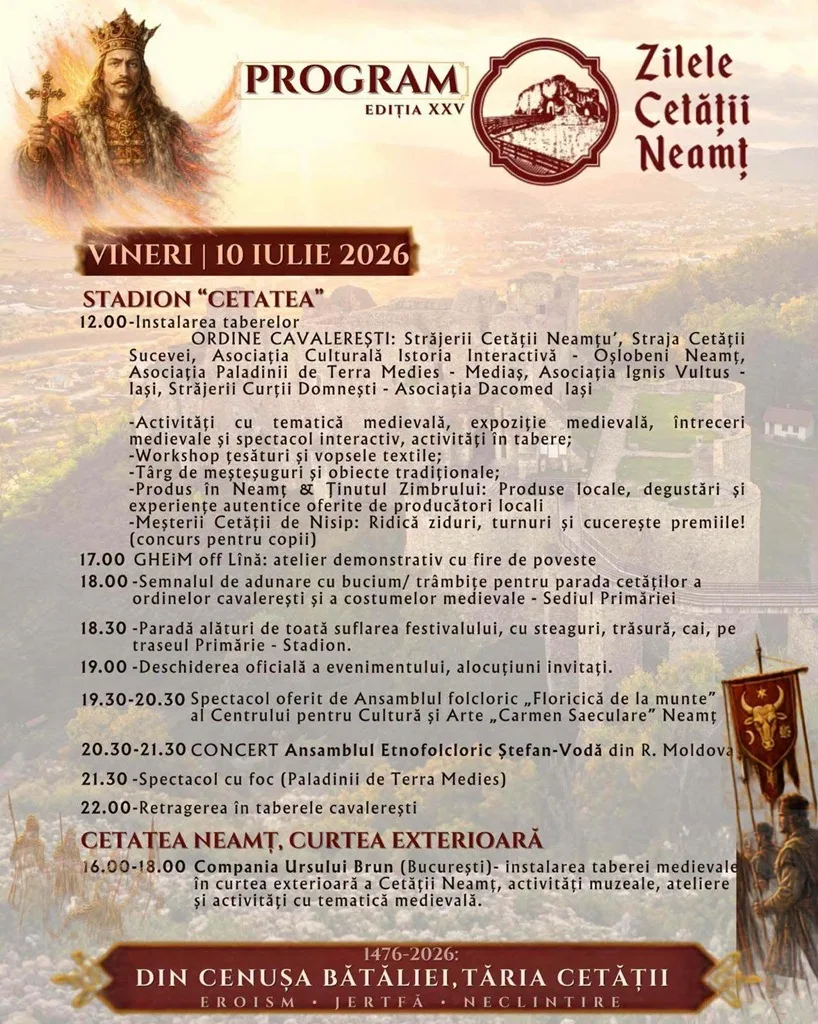
The Zilele Cetății Neamț Medieval Festival marks a quarter of a century. Now in its 25th edition, this year's event will open its doors from 10–12 July to a world of stories and pages of history from the time of Stephen the Great, Prince of Moldavia.
South-eastern Europe’s most important collection of Eneolithic art – a finalist in Destinația Anului 2026
The development of human communities in Neamț County, dating back to the Upper Palaeolithic, contributed to the emergence of Europe’s most remarkable and most extensively studied prehistoric…